
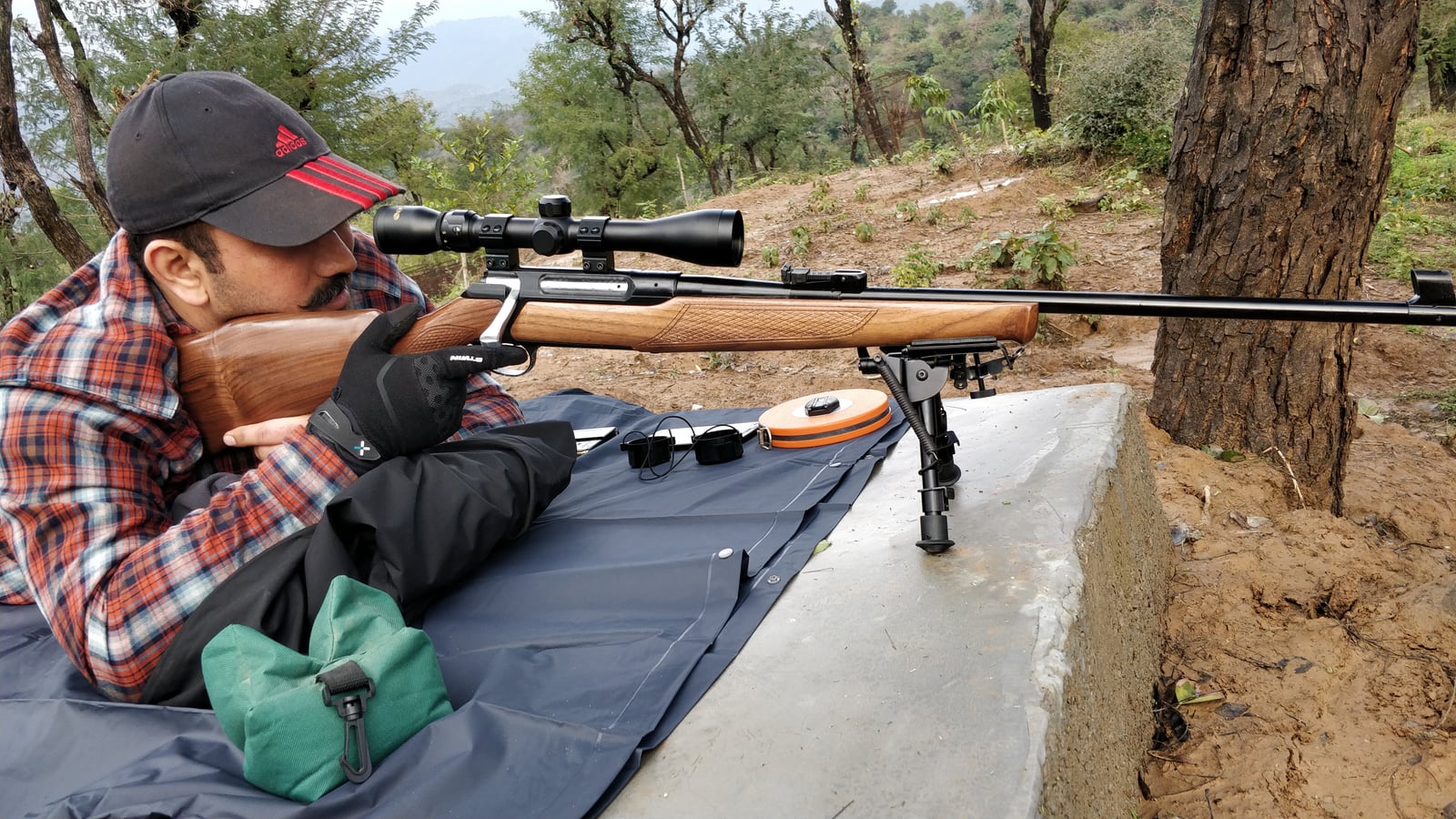
What calling your shot means
Calling your shot means announcing where the impact will land before you even check the target or the spotting scope. It’s not a guess — it’s a prediction built on what your body felt at the exact moment the shot broke. A shooter who calls shots correctly knows, as they come out of position, whether the shot was good, slightly off, or a complete miss.
This skill has nothing to do with your eyesight. It depends on proprioception: the ability to feel the position of your body, your hands, your finger on the trigger, without looking at them. Everyone has this sense, but very few shooters train it consciously.
The difference between a shooter who improves fast and one who plateaus often comes down to this. The first knows, right from the break of the shot, what they just did. The second waits for the impact to confirm it, and only then links the sensation to a result — but without building that connection in real time. An experienced coach will tell you this ability trains just like any other.
Calling your shot isn’t reserved for paper precision disciplines. A dynamic shooter (IPSC, Steel Challenge, USPSA) who feels the gun “travel” during the trigger break knows immediately they need to slow down on the next shot, without waiting for the timer’s readout.
Why this skill changes your progression
Without calling, your only feedback is the impact. You shoot, you check the target or the scope, you notice a deviation, and you try to guess retroactively what caused it. That’s delayed feedback, polluted by the time between the movement and the observation, and by the imperfect memory of what you actually felt during the shot.
With calling, feedback becomes immediate and internal. You know before you look. That information lets you correct in real time, shot after shot, without waiting for a full string to understand a problem. It’s the difference between adjusting your position after ten missed shots, and adjusting after the second shot because you felt the flaw the moment it happened.
Calling also teaches you to tell causes apart from symptoms. A low-left impact can come from recoil anticipation, a trigger pressed too abruptly, or a grip that gave way during the shot. Without an associated body sensation, all you can do is observe the symptom on the target. With calling, you identify the cause at the moment it occurs.
This skill becomes essential once you progress to a level where your groups are already small. At that point, pure visual analysis isn’t enough anymore — the deviations are too fine to diagnose from impact position alone. Your body has to tell you directly.
What your hand position reveals
Your hands are in constant contact with the gun, and every micro-movement they make during the shot changes the trajectory. Learning to feel what your hands are doing at the moment the shot breaks means learning to read the richest information available about your shot.
The pressure of your weak hand (the one that doesn’t work the trigger) should stay constant from start to finish. If you feel it loosen or tighten at the moment the shot breaks, that’s a directly identifiable source of deviation. A shooter who feels their weak hand move knows the impact will go in the direction of that movement, often before they even see the target.
Your strong hand, the one working the trigger, carries different information. If you feel your finger “yank” the trigger rather than press it progressively, you know the gun probably deviated laterally at the critical moment. That jerky sensation is identifiable and memorable, as long as you deliberately pay attention to it on every shot.
The wrist matters too, especially with a handgun. A rotation, even a tiny one, at the moment the shot breaks produces a predictable deviation. Experienced club shooters often develop this perception without even realizing it, simply through repetition — but it can be built consciously, and much faster.
What your body position reveals
Beyond your hands, your entire body plays a part in the shot’s trajectory. Your overall posture, the balance between your points of support, the tension in your shoulders — each of these leaves a mark on the shot that you can learn to feel.
A backward or forward imbalance at the moment the shot breaks almost always translates into a predictable vertical deviation. If you feel your weight shift backward while you’re pressing the trigger, expect a high impact. It’s a sensation you can learn to recognize as it starts, even before the shot actually breaks.
Breathing plays a similar role. A shot triggered mid-inhale or mid-exhale, rather than in the natural pause between the two, produces a movement of the torso that carries through to the gun. Feeling that you “forced” the shot while you were still breathing already tells you the impact will be off vertically.
Your shoulders and neck often betray a tension that has nothing to do with the trigger itself. A shooter tense through the traps transmits that tension all the way to the gun, and that tension typically builds over the course of a string — which is why the last shots of a string often differ from the first. Learning to feel that tension rise lets you anticipate the drift before it actually affects the group.
Finally, the position of your points of support on the ground or on a rest matters. Standing or prone, a support that slips slightly during the shot generates a movement your body can feel, as long as you’re paying attention.
Building the sensation before you look at the impact
The simplest method for developing calling is to set yourself a strict rule: after every shot, announce out loud (or mentally, if you’re at the range and prefer to stay discreet) where you think the impact landed, before you check. Do it every single time, even when you’re rushed, even at the end of a session when fatigue sets in.
At first, this call will often be wrong, and that’s normal. What matters isn’t the immediate accuracy of your prediction, but building the reflex: directing your attention to the body sensation at the exact moment the shot breaks, rather than to the impact that follows. It’s a shift in attention, not a change in shooting technique.
With repetition, you’ll start noticing correspondences. A particular sensation in your weak hand consistently precedes a deviation in a given direction. A weight shift consistently precedes a specific vertical deviation. These correspondences build up over several sessions, not a few shots, and they’re specific to each shooter: your body’s signature isn’t the same as the shooter’s next to you.
A complementary drill is to close your eyes right after the shot breaks, before opening them to check the impact. This forces you to stay focused on the sensation rather than on visually anticipating the result, and it reinforces the habit of judging the shot before you see it.
You can also ask a training partner to temporarily block your view of the target (a cover, or simply standing in front of the scope) while you shoot a string, and have them ask you to call each impact before revealing it. This external constraint stops you from cheating by sneaking a look before you call it.
A question that comes up often among shooters starting with calling: should you look at the target, the sights, or mentally close your eyes to focus on the body sensation? The answer lies in how you distribute your attention, not in where your eyes point. Your eyes can stay fixed on your front sight, your reticle, or your red dot, while your conscious attention shifts to the sensations in your hands and body.
This split takes training because it goes against the natural reflex, which pushes you to visually track the result the instant the shot breaks. A shooter who’s already anticipating lifting their head to see the impact, before the shot has even broken, loses a big part of the body information available at that exact instant.
Peripheral vision plays a secondary but real role: it lets you stay aware of overall body movement (a slight backward lean of the torso, a shift in your points of support) without having to stare directly at the area involved. This peripheral sense can also be trained, particularly among clay shooters, where perceiving the overall movement of the shoulder and arm matters just as much as the aim itself.
A simple drill for developing this split attention is to shoot several strings with an explicit rule: keep your eyes on the sights one extra second after the shot breaks, before checking the impact. That extra second, which feels artificial at first, gives the body sensation time to “register” before it gets overwritten by the visual information of the result.
Using a shooting logbook to make calling objective
Calling stays a largely subjective skill if you don’t regularly confront it with measured reality. Systematically writing down your prediction before checking the impact, then comparing the two, gives you a concrete record of your progress on this specific skill.
A digital shooting logbook like PewPewLife’s lets you structure this practice with no extra effort: you log your prediction for each shot or each string, then record the actual impact, and you can compare the two over time. Across several sessions, this tracking reveals trends that memory alone doesn’t retain — for example, a calling success rate that climbs noticeably early in a session and drops after a certain point of fatigue, or a hand that stays your main source of error despite months of training.
This record becomes especially useful when you switch guns or disciplines. Calling developed on a rifle doesn’t fully transfer to a handgun, because the sensations of recoil, grip, and trigger differ. Keeping a record of your progress by discipline stops you from thinking you’re regressing, when really you’re rebuilding a skill on a new platform.
The simple act of writing down a prediction before checking an impact, even without a dedicated app, already changes how you shoot: you go from a passive shot, where you just take in the result, to an active shot, where you commit to a hypothesis before every trigger pull.
The mistakes that keep you from developing this skill
The first mistake is looking at the impact before you’ve formulated your prediction, even mentally. This very natural reflex completely short-circuits the learning process: your brain then associates the body sensation with a result it already knows, which corrupts the link you’re trying to build between sensation and impact.
The second mistake is wanting to call only the good shots. Many shooters spontaneously announce it when they feel a shot is good, but stay silent or vague when they feel it’s a bad one, out of self-consciousness or a lack of habit analyzing failure in real time. Yet it’s precisely the precise identification of bad shots that has the most value for improving.
The third mistake is confusing calling with recoil anticipation. A shooter who anticipates their gun’s recoil (by pushing slightly forward before the shot breaks, as a reflex) will often “feel” a movement — but that movement is exactly what caused the bad shot, not neutral information about its trajectory. Learning to tell apart the sensation of anticipation (a problem to fix) from the sensation of pure calling (information to use) takes time and an outside eye, often that of an experienced coach.
Finally, many shooters give up the drill too quickly because their first predictions are bad. The opposite should happen: the worse your predictions are at the start, the more room you have to improve, and the more the drill deserves to be pursued rigorously.
Calling across positions and disciplines
Position directly influences how rich the available body information is. Prone, your points of support are numerous and stable, which reduces sources of error but also makes the sensations more subtle: a beginner shooting prone often struggles to feel anything abnormal, precisely because the position is already very stable.
Standing, sources of instability are far more numerous: overall balance, natural tremor, tension in the legs. Calling is both harder to learn there (more variables) and richer once mastered, because each variable leaves a distinct sensory mark that you can progressively isolate.
Sitting or kneeling, used in precision shooting on certain courses, sits between the two. Support is partial, which leaves enough room for movement to keep calling relevant, without the full complexity of standing.
Practical tip: start working on calling in the most stable position you practice, before transferring it to less stable ones. Sensations are clearer and easier to isolate when sources of body “noise” are kept to a minimum.
In dynamic disciplines, you generally don’t have the luxury of checking every impact before moving on to the next target. Calling takes a different shape there: rather than predicting a precise impact, you learn to feel whether the shot was “clean” or “dirty,” and to immediately adjust your speed or visual pickup based on that feeling.
On steel plates or cardboard targets set up on a course, an experienced shooter knows, from the feel of the gun at the moment the shot breaks, whether they need to come back to that target or move to the next one — often before even hearing the characteristic sound of a hit plate. This sensation blends calling with pace management, which makes it more complex to isolate than in static precision shooting.
Dry firing, without ammunition, remains one of the best ways to build this skill in dynamic shooting, because it removes the variable of actual recoil and lets you focus purely on sight stability and clean trigger movement at the moment of the simulated “break.”
A useful drill is to film your dynamic sessions and ask yourself, before reviewing the footage, whether you think you hit each target cleanly. Comparing your perception to the filmed reality afterward works on the same principle as paper calling, with a longer time lag but just as valid a learning process.
Combining calling with group analysis
Calling doesn’t replace analyzing the final group — it complements it. A string of ten shots where you correctly called every impact, even the bad ones, gives you far richer information than a simple scattered group with no history of associated sensations.
When your calling and your group agree, you can trust your diagnosis: the cause identified by the body sensation is probably the right one. When they diverge, it’s often a sign of an external factor you haven’t yet learned to feel, like an optic adjustment issue, inconsistent ammunition, or wind conditions you didn’t account for enough.
This regular confrontation between prediction and reality progressively sharpens your overall analytical ability. A shooter who’s practiced calling for several months develops a form of intuition that goes beyond simple “good or bad shot”: they perceive fine nuances, like the difference between a deviation caused by the trigger and one caused by breathing, even though both can produce a visually identical impact on the target.
Progressive drills and integrating it into your routine
Start with a simple dry drill, no ammunition: go through your complete shooting motion, up to the simulated break, then announce where the shot would have gone before you even set the gun down. Repeat the drill about thirty times per session, deliberately varying your position and tension to build up a range of distinct sensations to memorize.
Then move to a live-fire drill, but on a target you only look at after stating your prediction out loud or in writing. Stick to short strings (five shots) to keep your focus intact on the sensation rather than on the overall score.
A more advanced drill is to shoot a string while deliberately varying a single parameter on each shot (weak-hand position, breathing rhythm, shoulder tension) and try to feel which of these parameters has the biggest impact on your prediction. This helps you isolate variables rather than lump them into an undifferentiated block of “good or bad sensations.”
Finally, a summary drill is to keep a logbook over several weeks where you record, for each session, your calling success rate as a percentage. This simple measure, tracked over time, becomes an indicator of progress just as relevant as your raw score — sometimes even more revealing of your real technical mastery.
The role of the trigger and nuances by precision discipline
The trigger is the finest point of contact between your intention and the actual break of the shot, and it’s often where the quality of your calling is decided. A shooter who presses the trigger in a linear way, with no jerk, gets a clean sensation that’s easy to remember. A shooter who drags their finger or suddenly speeds up at the end of the travel gets a confused sensation, hard to later link to a precise impact.
Working the trigger motion in isolation, without aiming at a specific target, helps isolate this sensation. Press the trigger slowly, focusing only on the smoothness of the movement, without worrying about the aim point. This drill, repeated dry, builds a memory of the “correct movement” that then becomes the reference you compare every live shot against.
The travel length and trigger weight specific to your gun directly influence how rich this sensation is. A very short trigger, like those found on some finely tuned precision rifles, leaves less room to feel a gradual flaw: the shot breaks fast, and the sensation has to be caught in a narrow time window. A longer trigger, like those on many production guns, gives you more time to perceive the start of a jerk before the shot breaks, which can paradoxically make learning to call easier at first.
An often overlooked point: where your finger sits on the trigger changes the nature of the sensation it transmits. A finger positioned too deep (using the first joint) tends to pull the shot to one side under pressure, while a fingertip placement produces a different movement. Feeling this difference, and knowing which one you’re using at any given moment, is part and parcel of fine, reliable calling.
At 10-meter rifle, movements are minuscule in amplitude, and calling there rests almost entirely on the feel of the trigger and the stability of the shoulder support. Experienced club shooters in this discipline often develop remarkable sensitivity to deviations that would be completely invisible to the naked eye on a longer-range target.
At 50-meter rifle and beyond, breathing and pulse management take on a bigger role in calling, because the hold time is longer and the body has more chances to move before the shot breaks. Feeling the optimal moment in your breathing cycle, the one where the torso is most still, becomes a skill in its own right, tied to calling.
With a handgun, whether at 10 meters or in the 25- and 50-meter disciplines, one-handed grip completely changes the nature of the sensations available compared to a rifle held with both hands and shouldered. The wrist, already mentioned, becomes the most informative joint there, closely followed by the pressure from the non-firing fingers on the grip, which needs to stay constant so it doesn’t introduce unwanted rotation.
In practical/service pistol shooting, where the motion has to stay fast and repeatable across timed scenarios, calling gets closer to that of dynamic disciplines: an overall “clean or not clean” feeling takes priority over shot-by-shot fine analysis, because there isn’t time for detailed introspection between each shot.
Calling, mental game, and working in pairs
Learning to correctly call your bad shots has an important side effect on the mental side: it reduces the anxiety of waiting for the result. A shooter who already knows, before checking, that a shot missed isn’t surprised or thrown off by the impact they discover afterward. They’d already anticipated it, and can approach it with more emotional distance.
Conversely, a shooter who discovers every result without having anticipated it experiences every bad shot as an unpleasant surprise, which feeds frustration and, often, a chain reaction where that frustration itself degrades the next shot. Calling breaks this cycle by turning the surprise into confirmation of a hypothesis already made.
This mental dimension explains why some experienced coaches emphasize calling not just as a technical tool, but as a tool for emotional management in competition. A shooter who stays focused on their prediction, shot after shot, keeps their attention on the process rather than on the cumulative score, which limits the pressure felt as a string or a match nears its end.
Calling also helps you tell apart a bad result caused by an external factor (a gust of wind, an off ammo lot) from a bad result caused by your own movement. This distinction stops you from needlessly second-guessing yourself over a shot your body already knew it executed well, where the cause of the deviation lay elsewhere.
Developing calling on your own works, but a training partner clearly speeds up the process, especially at the start. The principle is simple: one shooter fires and announces their prediction, the other watches the actual impact (through the scope, on the target, or via an electronic readout) and confirms or contradicts it without giving any hints before the call.
This paired setup brings a benefit solo training can’t offer: an outside view of your posture and hands at the moment the shot breaks. Your partner might notice a movement you don’t yet consciously perceive — for example, a shoulder that sags slightly on the last shots of a string — and point it out so you learn to feel it yourself next time.
Swapping roles matters too: watching a partner shoot, trying to guess yourself where their shot will land based on their posture, develops a form of “remote” calling that sharpens your general understanding of shooting biomechanics. This observation skill then transfers back to your own body awareness, because it trains you to spot the same cues in yourself.
At the club, this drill works well as a dedicated session, announced as such rather than improvised between two regular strings. A simple format is to alternate blocks of ten shots, taking turns, with a short verbal debrief between each block to compare predictions to actual impacts and discuss the sensations felt.
When your predictions stay poor over time, despite regular training, that’s information in itself, not a failure to ignore. Calling that isn’t improving can point to an equipment problem rather than a perception problem: an inconsistent trigger, abnormal mechanical play, or a poorly mounted optic can introduce deviations that have nothing to do with what your body feels, making any prediction structurally impossible to refine.
Before concluding that your body awareness is at fault, rule out these external sources. Have your gun, your optic, and its mounts checked by a gunsmith or an experienced coach if doubt persists over several consecutive sessions. Calling that stays poor after that check then points to real underlying work on the body sensation itself, probably by going back to the simplest dry drills.
Poor calling can also reveal poorly managed fatigue. Your ability to finely feel your own movement degrades with muscle fatigue and dropping concentration, often well before that decline becomes visible in the group. Tracking your calling success rate over the course of a session, not just from one session to the next, lets you spot that tipping point and adjust your session length accordingly.
Calling shouldn’t become a burden that weighs down every shot to the point of hurting your overall flow. The end goal is for it to blend naturally into your routine, as a silent reflex rather than a conscious, laborious step. This integration takes time, and it’s normal for the first few weeks to demand an almost uncomfortable level of focus.
A good way to measure this integration is to notice whether calling still slows down your pace in dynamic shooting, or whether your awareness of body sensation now happens “in the background,” without extra conscious effort. Once that shift happens, calling stops being a separate drill and becomes a permanent part of your perception of shooting, on the same footing as aiming itself.
It’s worth periodically going back to the basic drills, even once the skill is broadly mastered. A routine that includes, say once a month, a session entirely dedicated to pure calling (with no score objective) helps maintain this sensitivity at a high level and keeps it from dulling over time, especially if you’re going through a period where you’re shooting mostly for score and less for technique.
Finally, keep in mind that calling remains a means, not an end. It exists to speed up your understanding of what’s happening during the shot, so you can correct faster and more precisely. A shooter who calls every shot perfectly but never uses that information to adjust their technique gets no real benefit from it: the value of calling is realized in the corrective action that follows, not in the prediction itself.
One last point worth clarifying: calling isn’t a talent reserved for a few shooters with a special gift for body awareness. It’s a trainable skill, just like breath control or trigger consistency, and it progresses with the same logic of conscious repetition as any other technical aspect of competitive shooting. A beginner who starts working on it from their very first sessions will build this perception faster than an experienced shooter who’s never paid it any attention, simply because they have no opposing habits to unlearn.
This skill is also worth sharing at the club. An experienced coach who builds calling drills into group sessions gets new shooters used to paying attention to their sensations from the very start of their practice, rather than letting them default into an exclusive dependence on visually checking the impact. This early habit avoids having to “unlearn” a reflex of instant checking years later, right when fine calling becomes genuinely decisive for improving.
FAQ
Q: How long does it take to develop good calling ability? A: It varies a lot depending on how regularly you train and which discipline you practice. Some shooters start noticing reliable correspondences after a few weeks of conscious practice; others need several months, especially standing, where there are more sources of movement.
Q: Does calling work as well with an air gun as with a firearm? A: Yes, the principle stays identical since it rests on body sensation, not the type of ammunition. Category D air guns, often used for indoor training, are actually particularly well suited for developing this skill, since the absence of significant recoil makes it easier to isolate the sensations.
Q: Should you announce your shot out loud, or can it stay mental? A: Both work, but announcing out loud (alone or with a partner) commits you more and stops you from “cheating” by mentally adjusting your prediction after the fact. At the club, doing it mentally is plenty if speaking out loud makes you uncomfortable.
Q: Can calling help with flinching (recoil anticipation)? A: Indirectly, yes, because it forces you to pay attention to what your body is doing at the moment the shot breaks, which makes anticipation easier to consciously spot. But calling alone doesn’t fix an established flinch; targeted dry-fire work with an experienced coach remains the best approach.
Q: Do I need to master calling before working on other technical aspects? A: No, it’s not a strict prerequisite, but it’s a complement that speeds up every other technical correction because it gives you immediate feedback. Many experienced club shooters work on it alongside other areas, not in isolation.
Q: Is calling useful in competition, or only in training? A: It’s genuinely useful in competition, especially in disciplines where you can’t check every impact right away. Knowing a shot is bad before you see the result lets you adjust your strategy on the following shots, which can make the difference on a tight final score.