Why nobody gives you a real number
Ask ten shooters how much a first year of sport shooting costs and you’ll get ten different answers, most of them vague. “It depends,” “not much at the start,” “budget comfortably” — none of that helps you plan anything. The problem is that the real cost depends on variables that change everything: the discipline you pick, the club you join, your region, and above all whether you decide to buy a firearm during that first year or not.
This article won’t give you a single figure, because it doesn’t exist. Instead, it breaks costs down item by item, with realistic ranges, so you can build YOUR own budget for your situation. We clearly separate the “I’m trying it out with club equipment” scenario from the “I’m buying my own firearm as soon as I sign up” scenario, because the gap between the two is considerable.
The core principle to keep in mind before diving into the numbers: your first year of sport shooting is structurally more expensive than the following ones. You pay entry costs (paperwork, protective gear, sometimes training) that won’t repeat afterward. Don’t panic if the total looks high at first glance — a good chunk of it is a one-time investment, not a recurring expense.
One more thing to internalize before you start crunching numbers: your budget isn’t set in stone once the season starts. It evolves month to month depending on your motivation, your discipline, and material opportunities (a good deal at a gunsmith, an ammo sale, switching clubs). Treat this guide as a calculation base to adjust as you go, not a fixed quote you need to follow to the cent.
Item 1: the shooting federation license and club affiliation
The federation license is the mandatory step to practice in an affiliated club and access supervised facilities. Its exact price varies by category (junior, adult, board member) and changes every season, so pay attention to the amount your league or club actually posts rather than a fixed figure found online. It generally includes civil liability and personal accident insurance, which isn’t a minor detail: it’s coverage that genuinely protects you in case of an incident on the range.
On top of this license comes the club’s own membership dues, a completely separate and often even more variable item. An associative club with basic facilities and lots of volunteer work will charge noticeably less than a club with a climate-controlled indoor range, professional maintenance, and extended time slots. These dues fund facility upkeep, supervision, and sometimes access to shared equipment (club firearms, ammunition at negotiated prices).
A point beginners often overlook: some clubs charge a registration or admission fee only in the first year, on top of the usual annual dues. These are entry costs into the structure, not fees that recur the following year. Find out exactly what applies before signing, by explicitly asking “which fees only apply to my first registration?”
The mandatory medical certificate required to issue the license is a separate cost, generally modest with a regular doctor, but it can climb if you need to see a specialist for a specific reason. Some clubs also ask for an ID photo and fees for reproducing administrative documents — symbolic amounts, but they add up to the total.
One last detail that directly affects this item: the club’s legal status. A purely associative club run by volunteers doesn’t have the same cost structure as a larger association employing staff or a part-time professional instructor. Neither is inherently “better,” but the latter logically charges more to fund that permanent supervision. Explicitly ask about a club’s status and how it operates before comparing two membership prices that, on the surface, seem to cover the same thing.
Item 2: initial training and the shooting school
Many clubs require a training path before letting a new member shoot independently. This path may be included in the dues or billed separately depending on the club, in the form of mandatory supervised sessions with an instructor before you earn independent shooting status. Never treat this step as a waste of time or money: it’s what makes you progress quickly and without bad habits.
If you start with the shooting school (a typical learning path for younger shooters or for a very gradual discovery), the cost is generally pooled with club dues and stays reasonable, since the equipment (laser rifles, club air rifles) is provided by the structure. It’s objectively the cheapest way to test your motivation before investing in personal gear.
The length of this training phase varies enormously depending on the club, the discipline you’re aiming for, and your availability. Some clubs validate independence in a few sessions, others spread it over several months of weekly slots. The longer this phase lasts, the longer you can delay buying costly personal gear — which is actually good news for your starting budget.
Item 3: mandatory personal protective equipment
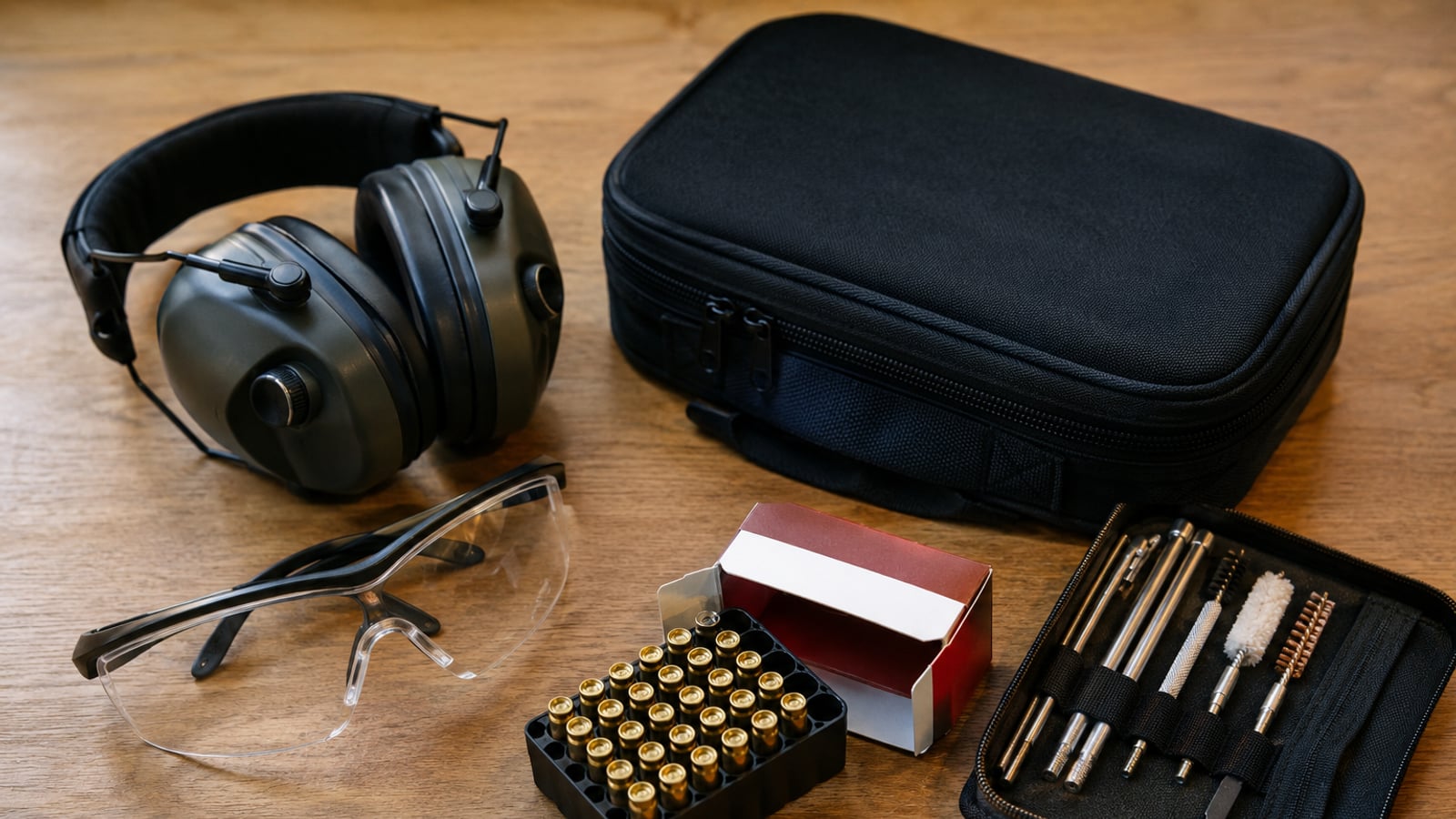
You can’t shoot without hearing and eye protection, that’s non-negotiable and most clubs check this before every session. On hearing protection, entry-level options (foam plugs or a basic passive headset) fit any tight budget, while electronic headsets with ambient sound amplification and automatic gunshot cutoff cost considerably more. For a first year, a decent passive headset does the job perfectly; electronics are a comfort upgrade to consider once you’re sure you’re sticking with it.
Eye protection glasses meeting the appropriate standard are also essential, especially in disciplines that generate debris (clays, steel targets, some rifles). A basic compliant pair is plenty to start with; models with interchangeable lenses for different light conditions are an upgrade to consider later.
Depending on the discipline, also plan for suitable clothing: clothes that don’t restrict movement, closed sturdy shoes, possibly a glove if you practice a discipline demanding on manipulation. Nothing extravagant is needed in the first year — regular sportswear covers the vast majority of cases.
Item 4: consumables, ammunition first
This is the item that varies the most depending on your discipline and how often you practice, and it’s often the one beginners underestimate the most. Ammunition cost depends directly on caliber and firearm type: air and small-bore rimfire are noticeably cheaper to shoot than the centerfire calibers used in larger-caliber pistols or rifles, and clay shooting has its own cost logic tied to shotgun shells.
Concretely, your ammunition bill depends on three things: the discipline (Olympic precision vs. dynamic vs. clays don’t consume anywhere near the same number of rounds per session), how often you train, and the caliber. Rather than throwing out a bare number that’s probably wrong for your situation, calculate your own budget by multiplying your planned monthly sessions by the average rounds fired per session and by the retail price of your ammunition — this method gives you a personalized figure far more reliable than any national average.
A strategic point: starting with an economical-ammunition discipline (air, rimfire) lets you shoot a lot more for a given budget, so you progress faster in your first year. That’s a serious factor to weigh when choosing your starting discipline, beyond simple aesthetic preference for one type of firearm or another.
Don’t forget targets and small consumables (pasters, correction stickers, basic cleaning supplies), which represent a minor but real cost over the year, especially if your club doesn’t provide them for free.
Item 5: buying your own gear or using the club’s equipment
This is the real budget fork of the first year. Many clubs make club firearms available to beginners, letting you practice for several months, or even a whole season, without spending a cent buying a firearm. That’s objectively the most reasonable strategy if you’re not 100% sure you want to stick with this exact discipline.
If you choose to buy your own firearm right in the first year, the budget shifts scale radically. An entry-level air rifle or an unrestricted-category firearm stays within an accessible range; a restricted-category firearm (most handguns and semi-automatics), subject to authorization from the licensing authority, represents a substantially larger investment, not counting the administrative wait before you can legally acquire it.
Buying a personal firearm comes with add-on costs that are easy to forget: a case or bag suitable for transport rules (firearm disassembled or unloaded, transported out of sight), a secure storage system meeting legal requirements for the category you own, and the first full cleaning with a basic maintenance kit. Always add these extra items to the listed price of the firearm — they represent a non-negligible share of your real equipment budget.
The good practice for a genuine beginner: wait until you’ve had a few months of practice on club equipment before investing in a personal firearm. This saves you from buying a model that doesn’t suit your build or your eventual discipline, a frequent and costly mistake among new members eager to gear up.
Scenario A vs. Scenario B: no personal firearm, or buying one
Scenario A is the shooter who’s discovering the discipline, uses club equipment, and focuses on learning rather than gear. Spending is limited to the federation license, club dues, medical certificate, basic personal protective gear (passive headset and glasses), and ammunition consumed during sessions if it isn’t included in the dues.
This is by far the most financially accessible path to test your real motivation for a discipline before committing further. Many clubs deliberately structure their beginner offering around this principle, knowing that a new member who first has to invest heavily in gear before even knowing whether they enjoy the discipline is statistically more likely to quit quickly. This scenario fits particularly well someone still hesitating between several disciplines, a parent introducing a child with no certainty about how long the commitment will last, or a shooter on a tight budget who mainly wants to confirm their interest in the sport. Nothing stops you from staying in this setup for several seasons if your club allows it and it suits you.
Scenario B is the shooter who already knows precisely which discipline they want to practice, often after a first experience at a club or a taster session, and decides to invest directly in their own gear. The total includes everything from Scenario A, plus the price of the firearm, the storage and transport add-ons mentioned above, and potentially an optic depending on the discipline (red dot, scope, or a regulation aperture sight system).
The gap between the two scenarios can be significant, especially if the firearm you’re after falls into a restricted category requiring authorization from the licensing authority: the administrative delay adds to the cost, and it varies by jurisdiction with no reliable single figure that applies everywhere. It’s better to check directly with your club or the licensing authority about locally observed timelines rather than trust a general average.
This scenario has a real advantage that shouldn’t be underestimated: owning your firearm lets you dry-fire safely at home, personalize your gear to your build, and stop depending on club equipment availability during busy slots. If your budget allows it and your motivation is confirmed, it’s not an unreasonable investment.
The hidden expenses nobody mentions
Beyond the obvious items, several expenses often fly under new members’ radar and inflate the real year-end bill. Fuel and travel time to the club, if it isn’t close by, represent a real cost people forget to count that still weighs on the overall budget — especially if the available slots force you to go several times a week.
Competitions, even local ones, involve entry fees for each event, on top of travel. If you plan to enter your first competition in your first year, budget these registration fees on top of the base license — they add up event after event over the season.
The premature renewal or replacement of small gear (electronic optic batteries, damaged hearing protection, targets) is a diffuse but real expense line. None of these items is dramatic on its own, but their sum over twelve months can represent a non-negligible amount that the initial calculation hadn’t anticipated.
Finally, if you choose to reload your own ammunition to cut cost-per-round over the long term, know that the initial investment in reloading equipment (press, dies, scale) is significant and only pays off over a substantial volume of shooting spread across several seasons. It’s generally not a relevant move in the first year, unless you already have a clearly identified discipline and practice volume.
On top of these hidden expenses come classic budgeting mistakes that widen the gap between forecast and reality even further. The first is budgeting only for the firearm purchase while forgetting the immediate add-on costs (secure storage, compliant transport, first maintenance): these items aren’t optional, and their combined amount can represent a significant share of the firearm’s own price. The second is underestimating the volume of ammunition consumed early on, when a progressing beginner mechanically needs more repetitions than an experienced shooter to lock in the right movements.
The third common mistake is buying top-of-the-line gear in the first year out of fear of “under-equipping” your practice, when the performance gap between decent entry-level gear and top-of-the-line gear is rarely the limiting factor for a beginner: technique improves first, not equipment. The fourth, more insidious mistake is ignoring the cost of time and travel in the overall calculation: a cheaper club that’s far away can, once fuel and travel time are factored in, end up costing more than a slightly pricier club close to home. Finally, not budgeting a margin for the unexpected (equipment failure, early replacement of damaged protective gear) exposes you to having to skip a session or a competition for lack of available cash mid-season.
How to cut your bill without sacrificing safety
The best saving remains delaying the purchase of personal gear as long as your final discipline isn’t settled. Using club equipment for as long as possible isn’t a sign of being cheap, it’s a rational budget strategy that avoids buying equipment you’ll end up not wanting after all.
On personal protective gear, favor quality over comfort in your first year: a decent passive headset and glasses meeting the right standard are plenty, electronics and premium options can wait until you’re sure you’re in it for the long haul. This isn’t an item where you should cut corners on safety, but a reliable entry-level model protects just as effectively as a top-of-the-line one for the occasional use of a first year.
On ammunition, steering your starting discipline choice toward an economical caliber (air, rimfire) mechanically lets you shoot more for the same budget, so you progress faster. It’s a discipline-selection criterion underestimated by beginners who focus on a firearm’s looks rather than its real cost per use.
Some clubs offer discounted rates or ammo-included packages for beginner slots: systematically ask about these before calculating your budget, they can significantly change your year-end total. Don’t hesitate to also ask whether free or discounted trial sessions exist before fully committing to a license.
Comparing real cost by chosen discipline
Historic disciplines like black powder shooting deserve their own paragraph in a budget calculation, because their cost structure differs noticeably from modern disciplines. Regulation equipment (powder flask, wads, caps) forms a recurring expense line specific to this practice, distinct from simply buying manufactured cartridges.
The immediate cleaning required after every session, mandatory because of how corrosive black powder residue is, also adds a time and specific cleaning-supply constraint you need to fold into your consumables budget. It’s not a dramatic item in absolute terms, but it comes up at a faster pace than with a modern firearm, where cleaning can sometimes wait several sessions without harm.
These niche disciplines often attract shooters already experienced in other practices, so rarely absolute beginners. If it’s nonetheless your entry point into sport shooting, know that the secondhand market is active there and the club often plays a stronger advisory role in choosing your first gear, since the community of practitioners is generally small and tight-knit.
Beyond this special case, discipline choice remains by far the most powerful budget lever of your entire first year, well ahead of the firearm brand or the club you attend. Each family of disciplines has its own cost structure, and the gaps between them are considerable over a full season of regular practice.
10m air pistol and air rifle are the most economical entry point into Olympic sport shooting. Pellets cost little per unit, equipment wear is limited, and facilities are often indoor, so usable year-round without weather constraints. It’s an excellent budget entry point for anyone who wants to shoot often without blowing up their ammunition bill.
Rimfire disciplines (notably .22 Long Rifle) also remain very affordable to shoot, with a per-round cost noticeably lower than centerfire calibers, while offering a live-round shooting experience closer to what some beginners are looking for. It’s a good compromise between a controlled budget and “real-deal” shooting sensations.
At the other end of the spectrum, dynamic shooting (IPSC, USPSA, Steel Challenge) burns through a noticeably higher volume of ammunition per training session, since progression relies on repeating fast movements and firing many rounds in strings. Add to that the cost of specific gear (holster, magazine pouches, rigid belt) and you get an overall pricier discipline across the year, even though it stays fully accessible if you start out gradually.
Clay shooting (trap, skeet, sporting) has its own cost logic tied to the price of shotgun shells and the number of clays thrown per session, generally billed by the club per clay or per round. This billing method has the advantage of being very transparent: you know immediately what a given session costs you, unlike other disciplines where the calculation is more diffuse.
Long-range precision shooting (PRS, TLD, F-Class) stands out for a potentially high entry equipment cost (quality optics, match-grade ammunition if you want consistency), but a relatively moderate volume of ammunition consumed per session compared to dynamic shooting, since the discipline relies more on the quality of each shot than on quantity.
None of these families is inherently “the best,” but if your main criterion for the first year is limiting the budget, ranking your discipline choice by this cost-per-use logic is a far more useful reflex than comparing firearm prices against each other.
Adapting your budget to your profile and practice frequency
Two shooters registered at the same club, in the same discipline, can end up with radically different year-end bills simply because their practice frequency differs. An occasional shooter who comes once a month doesn’t structurally have the same spending profile as an enthusiast who strings together two to three sessions a week from their very first season.
Stated like this it may seem obvious, but that’s exactly the trap many motivated beginners fall into: they base their forecast budget on a moderate practice rhythm, then discover a genuine passion and multiply their sessions without having anticipated the impact on ammunition and equipment wear. Better to honestly ask yourself, from the start, what your realistic frequency over twelve months will be, rather than systematically underestimating out of optimism.
The region where you practice also influences the budget, notably through two variables: the density of available clubs (which affects price competition and therefore dues) and the distance you need to travel to reach a facility suited to your discipline. A shooter in a rural area with a single club at a fair distance doesn’t have the same travel and time calculation as a shooter in a dense urban area with several facilities within short distance.
The “family” profile deserves a separate mention. If several household members practice, some clubs offer discounted membership tiers or family packages that noticeably change the calculation compared with individually stacked registrations. Systematically ask about this if you’re introducing a child or a partner alongside your own practice — the savings across all the licenses can be significant.
Spreading your spending across the season rather than paying it all at once
Nothing forces you to concentrate all equipment spending at the start of the season. A financially more comfortable approach is to spread non-urgent purchases over several months, prioritizing what’s genuinely essential to get started (license, dues, basic protective gear) and pushing back what can reasonably wait (premium optics, a personal firearm, comfort accessories).
This spreading logic also naturally fits a beginner’s learning path: you don’t need a personal firearm before finishing your initial training phase, so you might as well use those first weeks or months to observe, compare other members’ gear at the club, and refine your choice before pulling out your card.
Some clubs and gunsmiths offer payment facilities on large equipment purchases, notably restricted-category firearms that require an administrative wait anyway. This delay, often seen as a hassle, can also be viewed as a natural window to smooth out your cash flow rather than paying the full amount at once.
Finally, think about the seasonality of certain expenses: more thorough winter maintenance before an extended break, a license renewal at the start of next season, competition entries concentrated in certain months of the year. Anticipating this spending calendar lets you avoid months where several items fall due at once, which is often the real budget stress factor, more than the annual total itself.
Another way to smooth out the budget is to think secondhand rather than systematically buying new. Buying used equipment is a serious way to cut your first-year budget, especially for firearms and optics, which often retain good resale value if well maintained. A gunsmith remains the recommended intermediary for this kind of transaction, both for the technical check of the firearm and the compliant transfer paperwork.
Sport shooting, unlike other leisure equipment, has the particularity that quality gear depreciates relatively slowly when well maintained: a properly cleaned and stored firearm keeps real value on the secondhand market years after purchase. It’s an argument worth keeping in mind if you’re torn between buying new or used for your first personal firearm.
Conversely, some items have almost no resale value: consumed ammunition, worn hearing and eye protection, or maintenance consumables. Treat these items in your calculation as pure spending, with no hope of recovering part of the invested capital — unlike the firearm or optic, which can in theory be resold if you eventually switch disciplines.
If you’re not sure of your long-term commitment to a given discipline, favoring a used purchase for your first personal firearm mechanically limits the financial loss in case of a quick resale, compared with a new purchase that immediately loses part of its value the moment you first use it. It’s a purely pragmatic calculation, not a value judgment on new versus used.
One last point too often ignored in this calculation: the insurance tied to your practice isn’t limited to the civil liability included in the federation license. If you become the owner of a personal firearm, check exactly what your home insurance covers in case of theft, water damage affecting your gear, or a broader claim. Many standard policies exclude or heavily cap coverage for firearms and their accessories, which may require a specific rider for an extra premium.
This point is too often discovered after the fact, at the moment of a claim, when it should be part of the budget calculation from the moment you buy a personal firearm. The cost of this rider generally stays moderate compared to the value of the covered gear, but it’s a recurring yearly item to fold into your overall budget, not just a one-time expense tied to the purchase.
In the same spirit, if you travel with your gear for a competition, check that your insurance covers transport and not just storage at home. Terms vary from one insurer to another, so stay general on this point and check directly with your own policy rather than relying on what applies to another shooter in a different situation.
Building your own personalized budget grid
Rather than looking for a magic figure that applies to everyone, the most useful approach is to build your own grid by listing, item by item, what concretely applies to your situation. Start with fixed, certain items: federation license, club dues, medical certificate. These are amounts you can get precisely by contacting your club directly, far more reliable than any national average.
Then add the variable but predictable items: basic personal protective gear if you don’t have it yet, ammunition calculated based on your realistic practice frequency and your discipline’s caliber. These are the items where the personalized calculation method (number of sessions times average consumption times unit price) makes the most sense, far more than any figure published online.
Finally, add a “personal equipment” line only if you’re certain you want to invest in your first year, with the price of the firearm you’re aiming for plus a systematic 15 to 20% margin for storage, transport, and first-maintenance add-ons. This margin isn’t an arbitrary universal number, but a cautious calculation method that spares you bad surprises when finalizing the purchase.
Finish your grid with an “unexpected expenses and competitions” line if you’re considering entering events in your first season, factoring in entry fees and travel. This personalized grid, even if approximate, will give you a far more honest picture of your real budget than a generic range that accounts for neither your region, nor your discipline, nor your practice pace.
Tracking your real budget with a shooting logbook
One of the best habits to pick up from your first year is systematically noting your shooting-related expenses: rounds consumed per session, dues, gear bought. Not only does it help you build a realistic budget for the following year, it also lets you spot items that drift without you noticing, particularly ammunition burned in dry-fire or free practice sessions.
A well-kept digital shooting logbook doesn’t just track your scores and technical progress, it can also centralize this cost-per-session and cost-per-discipline information. Cross-referencing your real progress (groupings, scores) with your ammunition volume gives you a far more precise view of your progress-to-spending ratio than any abstract estimate found online.
This tracking habit becomes especially useful if you practice several disciplines or are considering investing in a new firearm: you know exactly what each session actually costs you across each discipline, which helps you prioritize future equipment investments based on your real practice rather than whatever you feel like at the moment.
FAQ
Q: Can you really start sport shooting without buying a firearm in the first year? A: Yes, that’s actually the recommended approach at most clubs, which make firearms available to new members. It lets you confirm your motivation and your preferred discipline before investing in personal gear.
Q: What’s the expense item beginners underestimate the most? A: Ammunition consumed over time, especially if you train frequently or choose a caliber that’s costly to shoot. It’s a recurring cost that often exceeds, over the year, the purchase price of the firearm itself.
Q: Should you favor an unrestricted-category firearm to limit cost and paperwork? A: That is indeed the administratively simplest option (free sale or simple registration depending on the model), and often the most economical both to buy and to use. But the choice should above all depend on the discipline you want to practice, not just the cost.
Q: Is electronic hearing protection essential from day one? A: No, a compliant passive headset protects just as effectively for occasional use in your first year. Electronics are a usage comfort to consider once your practice is settled over the long run.
Q: How do I estimate my personal ammunition budget instead of relying on a general average? A: Multiply the number of monthly sessions you plan by the average number of rounds fired per session, then by the retail price of your ammunition in your caliber. This personalized calculation is far more reliable than a national range that doesn’t account for your discipline or your real pace.
Q: Is the mandatory initial training at the club an extra cost, or is it included in the dues? A: It varies by club: some include it fully in the annual dues, others bill it separately for supervised sessions with an instructor. Ask precisely about this when you register to avoid a bad surprise partway through the season.