
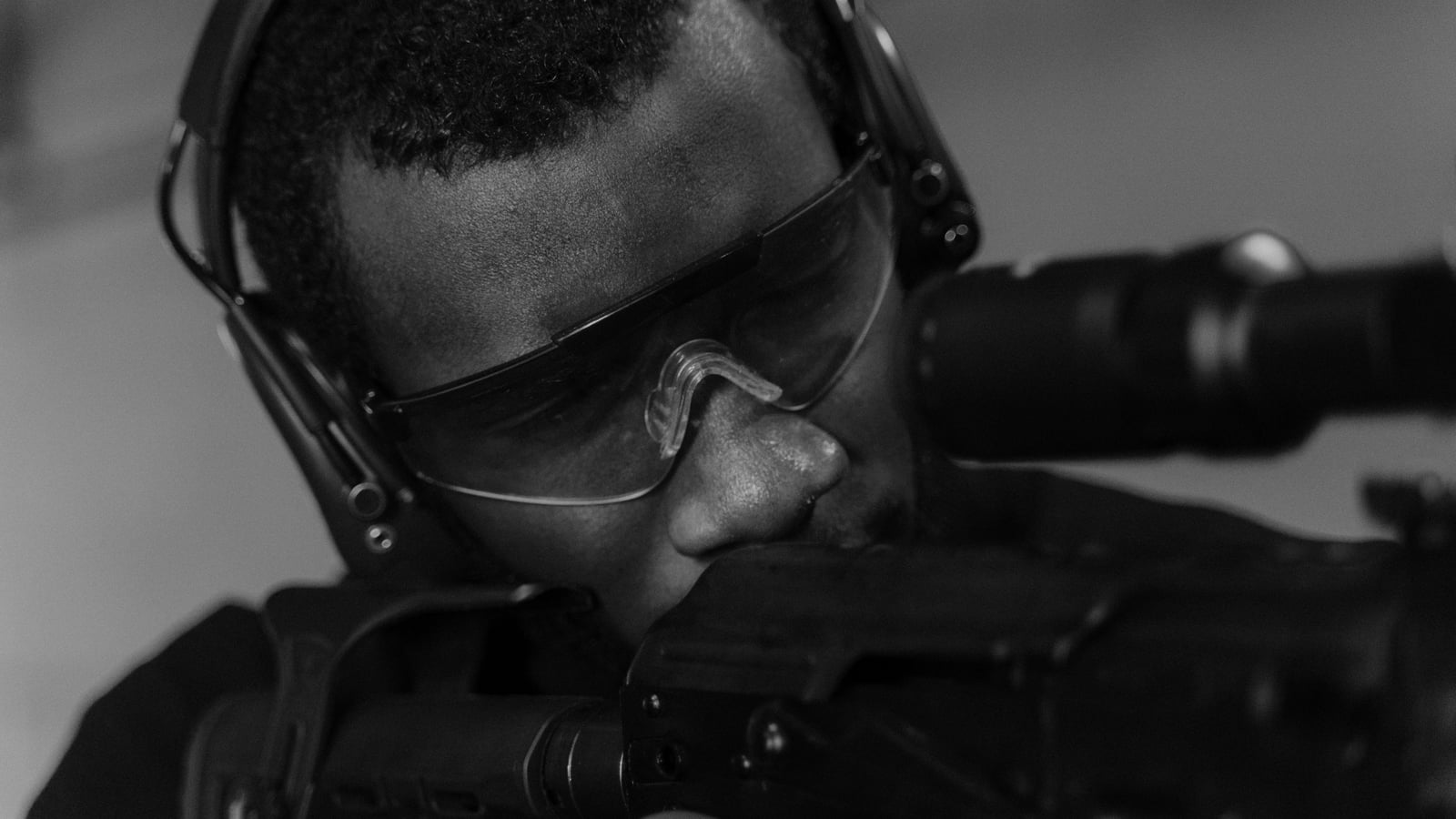
Your body keeps moving, even when you think you’re still
When you think you’re perfectly still in shooting position, you never really are. Your rib cage rises and falls with your breathing, and with every beat your heart sends a pressure wave through your arms and hands that ends up moving the barrel by a few tenths of a millimeter. At the muzzle or through the scope, that translates into a shift of the aiming point that can be several centimeters at 25 or 50 meters.
This isn’t a technique flaw, it’s pure physiology. A beginner often discovers this by accident, noticing their scope trembling slightly in rhythm with their pulse, with no obvious link to stance or grip. An experienced club shooter, on the other hand, has learned to stop simply enduring this movement: they anticipate it and choose the moment to fire based on it.
The core idea of this article is easy to state and hard to master: within every breathing cycle and every heartbeat cycle, there’s a window where your body is temporarily more stable than the rest of the time. Learning to spot that window, and to time your shot to coincide with it, directly changes the size of your groups. It’s not just one trick among others: it’s one of the pillars of fine precision, alongside grip and trigger control.
This article covers the mechanics of breathing while shooting, the real influence of pulse on barrel stability, and concrete exercises to train the synchronization of the two. Nothing here is abstract theory: every idea applies directly to your next session.
The optimal breathing window
The complete breathing cycle breaks down into four phases: inhalation, a short pause with full lungs, exhalation, and a longer pause with empty lungs before the next inhalation. It’s this last pause, right after a natural, incomplete exhalation, that forms the shooting window most used by precision shooters.
Why exactly this phase? When your lungs are full, your rib cage is under tension, your intercostal muscles are working to hold the air volume, and that muscular tension transmits to your shoulders and arms. When you exhale normally and mark a natural pause, your rib cage returns to a relatively relaxed position, with no active muscle tension holding it. It’s this absence of tension that makes the position more stable for a few seconds.
The classic protocol looks like this: you inhale normally, exhale about half to two-thirds of the air, then pause. It’s during this pause that you refine your aim and finish the follow-through on the trigger. The classic beginner mistake is emptying the lungs completely before firing, thinking less air equals more stability. In reality, a full exhalation creates the opposite tension — the body’s urge to breathe in again — and that tension is just as disruptive as a full inhalation.
The duration of this window is limited, and it’s a point many shooters underestimate. After a few seconds of breath-holding, your body starts demanding oxygen, your heart rate may accelerate slightly to compensate, and your stability degrades progressively. A rushed shot beats one held too long in apnea: if the window closes before you’re ready, the right call is to breathe again and restart the cycle, not force the shot.
This management differs slightly by discipline. In precision rifle or pistol on paper targets, you have time to build this cycle calmly, shot after shot. In dynamic shooting (IPSC, Steel Challenge, USPSA), the breathing window compresses enormously: you don’t have the luxury of a multi-second pause between each cardboard or steel target. Breathing work there shifts more toward overall management between movement phases and shooting phases, rather than a fine per-shot cycle.
Understanding the influence of pulse on barrel stability, and learning to feel it
Every heartbeat sends a pressure wave through your arteries, including the ones supplying your arms and hands. This wave, the pulse, creates a minimal but real mechanical oscillation in the tissues supporting your weapon. The more stable your grip and the longer the barrel, the more visible this oscillation becomes at the muzzle or in the scope’s field of view.
This phenomenon is particularly visible with a bipod or a stable rest in prone position, where the leverage of the barrel makes the pulse movement visible to the naked eye in certain setups. Standing, held at arm’s length, the pulse movement generally gets lost in the overall wobble of the position, but it remains present and continues influencing the trajectory at the moment the shot breaks.
Resting heart rate varies a lot between individuals, and above all, it varies enormously depending on context: a relaxed shooter in a training session doesn’t have the same pulse as one in a competition final. This is an essential point to internalize: competition stress mechanically raises your heart rate, which reduces the time between two beats and therefore reduces the stability window available between two pulse waves. A shooter who manages stress well indirectly gains stability, simply because their heart beats slower and more regularly.
Between two heartbeats there’s a brief instant where the pressure wave has already dissipated and the next hasn’t yet begun. This is the instant that very high-level precision shooters try to exploit, learning to feel their own pulse in their hands and timing the shot to coincide with this dip between two beats. It’s a fine skill that takes years of conscious practice, but it always starts with the same first step: learning to feel your own pulse while holding your position.
Before you can sync your shot with your pulse, you first need to be able to feel it while holding your position. Many shooters have never done this simple exercise: staying in aiming position, without firing, and focusing purely on the sensation of the pulse in the hands or arms.
The most direct exercise is done without a weapon, or with an unloaded weapon checked clear. Take your usual position, hold your aim on a fixed point for fifteen to twenty seconds, and try to spot whether a regular, rhythmic movement appears in your sight or scope, distinct from general muscular tremor. That regular movement is your pulse. It sometimes takes several sessions before you manage to consciously isolate it from the rest of the postural noise.
Once you can feel your pulse, the next step is observing how it varies with your breathing, fatigue, and stress level. A useful club exercise is comparing the feel of your pulse right after light physical effort (climbing stairs, a few push-ups) and after two minutes of calm. The difference in rate and amplitude is often striking, and it helps you understand concretely why physical and mental preparation before a session has a direct impact on your precision.
An experienced coach will often stress that this pulse perception is individual: some shooters feel it very easily in the fingers, others more in the wrist or forearm, depending on grip and body build. There’s no right or wrong way to feel it — only the need to find where, for you, this sensation is clearest.
Syncing breathing and pulse: building a single cycle
Once you separately master managing your breathing window and perceiving your pulse, the next step is making them coexist in a single, coherent shooting cycle. This isn’t a mechanical stacking of two techniques — it’s one single movement built with two physiological components accounted for simultaneously.
The typical sequence looks like this: you inhale, exhale to your natural pause, refine your aim during that pause, and during the last seconds before the shot breaks, you turn your attention to your pulse to look for the dip between two beats. The shot then breaks in a doubly stable window: breathing paused, pulse in its dip. This is the coincidence that top-level precision shooters actively seek.
This level of refinement isn’t necessary or realistic for every shooting context. For a casual shooter or one in dynamic disciplines, basic breathing management (avoiding firing on a full inhale, using the natural pause) already delivers most of the benefit. Fine synchronization with the pulse becomes relevant mainly when you’re trying to tighten an already-small group, typically in precision shooting at distances where every tenth of a millimeter of barrel movement translates into centimeters on target.
An important caution: this pursuit of synchronization should never become a source of extra tension. A shooter who focuses so hard on their pulse that they forget to breathe naturally, or who stiffens their grip to “feel better,” gets the opposite of the intended effect. Synchronization should remain a subtle guide for the shot’s timing, not a goal that takes over the entire mental space of the session.
The role of the autonomic nervous system
Your breathing and your heart rate aren’t two independent systems: they’re linked through your autonomic nervous system, and more precisely through a phenomenon called respiratory sinus arrhythmia. In plain terms, your heart rate tends to speed up slightly during inhalation and slow down slightly during exhalation — a natural coupling present in every healthy person.
This coupling partly explains why the pause at the end of exhalation is such a good moment to fire: it’s an instant when your heart rate is naturally at the lowest point of its cycle, on top of being a moment when your rib cage is relaxed. The two effects reinforce each other, which makes this window particularly interesting rather than a mere coincidence of two separate phenomena.
This mechanism is also why slow, controlled breathing techniques, practiced outside of shooting, have a measurable effect on heart rate variability and on the overall calm of the nervous system. Slow breathing, with a longer exhale than inhale, favors activation of the parasympathetic system, the one that slows the heart and relaxes muscles. That’s the physiological basis behind many stress-management techniques used in competition, well beyond the shooting motion itself.
Understanding this mechanics helps you move past a purely mechanical view of shooting breath. It’s not just “holding your breath at the right moment” — it’s using a lever that acts on your entire physiological state, heart included. A shooter who works on their general breathing, including outside of shooting sessions, indirectly improves their pulse management on the firing line.
Dry-fire synchronization exercises
Dry-fire work (no ammunition, weapon checked clear, in a secure setting approved for this kind of exercise) is the ideal ground for learning breath-pulse synchronization, because it removes the noise and recoil components that complicate learning with live ammunition.
First exercise, cycle counting: take your position, close your eyes or keep your sight on a neutral point, and simply count the number of complete breathing cycles over two minutes, marking each end-of-exhale pause quietly or mentally. The goal is purely to make this cycle conscious, without yet trying to shoot on it.
Second exercise, trigger follow-through during the pause: in position, run your breathing cycle, and during the end-of-exhale pause, progressively follow through the trigger to a simulated break point, with no ammunition. Repeat this ten to fifteen times in a row, slightly varying the pause length to observe at what point your stability starts to degrade.
Third exercise, more advanced, adding pulse perception: once the first two exercises are mastered, redo the trigger follow-through exercise, but add the instruction to look for a pulse dip before the simulated break point. Don’t chase perfection right away — the goal is simply to train your attention to perceive several physiological signals at once without losing control of the main motion.
Fourth exercise, controlled heart rate variation: after light physical effort (a few squats, a brisk walk), get back into position and observe how long it takes you to regain satisfactory stability. This exercise is particularly useful for shooters practicing disciplines involving movement, where the shot comes after real cardiovascular effort rather than at complete rest.
Application in static precision shooting, and adaptation to dynamic shooting
In rifle at 10, 50, or 300 meters, or pistol at 10 and 25 meters, breath-pulse synchronization finds its most favorable ground, because the preparation time between each shot allows you to build this cycle without rushing.
A precision shooter’s routine typically includes several preparatory breaths even before entering the final shooting cycle. These slow breaths help bring the heart rate back down after the effort of loading, aiming, and adjusting position, before starting the breathing cycle that leads to the shot. Skipping this preparation phase, and going straight into a shooting cycle while the pulse is still elevated, mechanically reduces the quality of the available stability window.
An often-overlooked point: position itself influences the perception and impact of pulse. Prone with support, the body is more stable overall, which makes pulse movement relatively more visible. Standing, general postural instability is greater, and pulse becomes one factor among others, harder to isolate but just as physically present.
Working on a fixed target also allows direct feedback: by watching the sight’s trace or the scope’s behavior while holding your aim, you can literally see whether your stability improves as you sync breathing and pulse better. It’s one of the rare areas of shooting technique where immediate visual feedback is this clear.
The context changes radically in dynamic shooting (IPSC, Steel Challenge, USPSA): the time available between spotting a cardboard or steel target and breaking the shot is measured in fractions of a second, which makes the idea of a complete, conscious breathing cycle before each shot illusory.
Breathing management takes a different shape there: it’s worked mainly ahead of the course, during movement and waiting phases, so you arrive on each shooting position with heart rate and breathing as controlled as possible given the physical effort of the course. A shooter who controls their breathing during transitions between shooting zones arrives more stable on each new position than one who holds their breath while running, for example.
Some experienced dynamic shooters use slightly deeper, more regular breathing during movement phases, precisely to avoid arriving breath-holding or hyperventilating at the next shooting position. This underlying breathing choice has more impact on the course’s overall accuracy than any attempt at fine pulse synchronization during the shot itself, which remains out of reach in this speed context anyway.
Pulse, in dynamic shooting, is almost always elevated because of physical effort and competition stress. Rather than chasing a dip between two beats, the main challenge becomes learning to shoot with an elevated pulse without it excessively degrading accuracy — a different skill, closer to stress management and motion automation than to fine synchronization.
Factors that disrupt synchronization
Several elements disrupt your ability to sync breathing and pulse, and knowing them helps you understand why the same method works well one day and less well the next.
Caffeine and stimulants raise heart rate and can create more pronounced rhythm variations, making the dip between two beats less distinct and harder to perceive. That’s not a reason to ban coffee entirely before a session, but it’s a factor worth knowing about if you notice unusual instability on a given day.
Lack of sleep and general fatigue also degrade the quality of this work, by reducing the fine concentration needed to perceive discreet physiological signals like the pulse. A tired shooter can have a technically correct grip but a dulled internal perception, which makes conscious synchronization much harder to achieve.
Competition stress, already mentioned, has a double negative effect: it raises heart rate, which reduces the duration of each cycle, and it can also make breathing shallower and more irregular, which complicates building a clean breathing pause. This is one of the reasons why mental preparation and stress management are considered, in many clubs, inseparable from pure technical work.
Cold, finally, deserves mention: a low ambient temperature can cause shivering or protective muscle tension against the cold, which masks or disrupts fine pulse perception. A shooter practicing outdoors in winter should warm up well before starting fine precision work on this topic.
Common mistakes to avoid
The first mistake, already mentioned, is fully emptying the lungs before firing. This practice creates an air-hunger tension that disrupts position, the opposite of the intended effect. The pause should come after a natural, partial exhalation, not after a fully forced one.
The second mistake is staying in apnea too long, chasing “the perfect moment.” Past a few seconds, position quality degrades, the need to breathe generates tension, and the shot ends up worse than if you’d simply restarted a clean cycle. A cycle interrupted and restarted beats one forced to the point of discomfort.
The third mistake is focusing so hard on finding the pulse that the aim itself suffers. Syncing with the pulse is a refinement that comes after mastering aim and trigger follow-through, not a goal to work on before those basics are solid. A beginner trying to feel their pulse before mastering their base position is adding complexity where they should be simplifying.
The fourth mistake is applying the same synchronization rigor to every discipline without distinction. What works with a supported rifle at 50 meters doesn’t apply the same way in timed dynamic shooting. Adapting the level of breathing demand to the context of the discipline being practiced avoids wasting time on unnecessarily complex refinement for the goal at hand.
Measuring your progress on this specific point
Working on breath-pulse synchronization without ever measuring its effects is like navigating blind. The simplest method remains the group on paper: at the same distance and with the same weapon, compare the spread of your hits on a string where you consciously apply the breathing protocol, and a string where you fire at your usual pace without thinking about it. The difference, if it exists, should show up in a tighter group, not just in a subjective feeling of calm.
Logging your sessions helps enormously on this topic, more than on many other technical aspects, because the effects are gradual and easy to forget from one session to the next. Recording, for each worked string, whether you managed to feel your pulse, whether the breathing pause was held cleanly, and the size of the resulting group, lets trends emerge over several weeks that an approximate memory won’t retain. A digital shooting log, where you attach these observations to each session and each distance, makes this comparison far more reliable than a vague memory of “I felt good that day.”
Another useful, less direct but revealing indicator is how long it takes you to regain stability after effort or a one-off stress spike, for instance between two strings or after a position change. If that time shortens over sessions, it’s a sign your cardiovascular system and breathing management are progressing together, independent of the raw result on target that day. This progress is sometimes slower to notice than a tightening group, but it’s just as real.
You also have to accept that day-to-day variability will always be present. Your resting pulse and your ability to mark the breathing pause depend on your sleep, hydration, general fatigue level, and many other factors that change daily. Comparing one isolated session to another rarely gives reliable information; it’s the trend over several weeks or months that actually matters.
Physical preparation outside the range
Working on breathing and pulse isn’t limited to the firing line. A good part of the ability to achieve a low, stable heart rate is built outside of sessions, through general physical fitness maintained regularly. A shooter who does moderate cardiovascular activity several times a week, like brisk walking, cycling, or swimming, generally sees a lower resting heart rate over time, which mechanically lengthens every available cycle between two beats.
Breathing exercises practiced off the range, away from any shooting context, are a simple and accessible complement. Slow breathing, with an exhale deliberately longer than the inhale, practiced a few minutes a day, progressively trains the autonomic nervous system to shift into a calm state more easily. This isn’t an exercise reserved for elite shooters: anyone can build it into their routine, for instance in the evening before sleep or before heading out to a session.
Sleep quality directly influences heart rate variability and the concentration needed to finely perceive your pulse. A shooter who arrives on the line after a short or restless night will statistically have more trouble consciously isolating these sensations, even with otherwise good technique. This link between general lifestyle habits and fine technical performance is often underestimated by shooters who focus solely on the motion and the gear.
Warming up before a session also deserves mention here. Arriving straight from work or a stressful commute, without transition, puts your body in a state of tension and a higher heart rate than necessary. A few minutes of calm, slow breathing, and settling into position before the first live shots let you come back down to a more favorable state, exactly like an athlete warms up before more classic physical effort.
The special case of archery, crossbow, and air guns
Low- or no-recoil disciplines, like match crossbow or low-power air shooting, are particularly sensitive to this synchronization work, because the absence of recoil disturbance leaves full room for pulse and breathing movement in the analysis of the group. In these disciplines, often shot at short distances like 10 meters, a movement of a few tenths of a millimeter at the barrel or weapon translates directly into a visible spread on target.
In match crossbow, whether at 10 or 30 meters, the hold time before release is generally longer than in firearm shooting, which makes managing the breathing window even more decisive. A shooter who holds position several seconds too long, exceeding their natural stability window, will see their group progressively degrade over the course of the string, even with unchanged aiming technique.
Conversely, certain clay-target disciplines, where the target (a clay disc) moves fast and the shot is nearly instantaneous, leave practically no room for this conscious synchronization work. The motion there is too fast for a complete breathing cycle to fit between spotting the target and breaking the shot. That doesn’t mean breathing has no importance in these disciplines, but that it’s worked ahead of time, between repetitions, rather than during the motion itself.
Moving-target shooting, present in some federation events, sits between these two extremes: preparation time is reduced compared to static precision shooting, but enough for basic breathing management to still matter, without however allowing the fine pursuit of the pulse dip described above for the more static disciplines.
Biofeedback tools, body build, and individual variability
Some shooters equip themselves with a heart rate monitor or a smartwatch to track their heart rate during training, including on the firing line. This kind of tool can provide complementary objective information: seeing in black and white that your pulse drops by ten or fifteen beats per minute between the start and end of a preparation cycle confirms, with numbers, what you’re supposed to feel subjectively.
This equipment remains a complement, though, not a prerequisite. Most shooters who progress on this topic do so purely through direct bodily perception, without ever using a sensor. The main value of a measuring tool is educational, particularly early in learning: it helps connect a still-vague sensation to a measurable physiological reality, which speeds up the phase where you learn to trust what you feel.
There are also more specialized devices, used in some clubs or by coaches, that directly measure weapon movement via a sensor mounted on the barrel or rail. These tools display, in real time or after the fact, the trace of the aiming movement, letting you concretely visualize the effect of pulse and breathing on stability, rather than having to infer it solely from the final group on target. This remains a club or coach tool, not equipment necessary to progress on this topic on your own.
Whatever tool is used, it never replaces training internal perception. A shooter who depends solely on a sensor to know whether their position is stable loses the autonomy needed in competition, where none of these tools can be used during the event itself. Material biofeedback should serve as a springboard toward self-perception, not become a permanent crutch.
This individual variability, precisely, is a reminder that every shooter has a different baseline heart rate and breathing capacity, influenced by age, general physical condition, and sometimes individual medical factors. A senior shooter, even a very experienced one, may have a different resting heart rate than a younger shooter, without that reflecting any problem: it’s normal variability that doesn’t call into question the ability to progress on this topic.
Certain medical conditions, ongoing treatment, or simply a state of chronic fatigue can alter the regularity of the pulse or how easily you can mark a clean breathing pause. In these cases, the best approach remains talking to a healthcare professional if there’s doubt about an unusual heart rate, rather than trying to force a technique that doesn’t match your current physiological state. Shooting sports remain first and foremost a leisure or competitive activity, never a reason to ignore a health signal.
Body build also plays a role in how the pulse transmits through to the weapon. A grip with longer arms, a thinner wrist, or a different muscle mass doesn’t transmit the pressure wave the same way. This is one of the reasons why two shooters with the same breathing technique can feel their pulse very differently, one very clearly in the fingers, the other barely perceptible anywhere but the forearm.
This individual variability is a good reason to never directly compare your perception to another shooter’s, even an experienced one. An experienced coach will tailor their advice on this topic to each student, rather than applying a strictly identical method to everyone. The goal stays the same for everyone: find your own stability window and learn to recognize it, no matter exactly where on your body this sensation shows up.
FAQ
Q: How long can you hold your breath before firing without losing stability? A: This varies with each shooter and their training level, but past a few seconds, most shooters feel a stability decline tied to the need to breathe. If the window closes, the best option is to breathe again and start a clean cycle rather than force the shot.
Q: Should you fully exhale before the shooting pause? A: No, a full exhalation creates an air-hunger tension that destabilizes the position. The optimal pause is taken after a natural, partial exhalation, in a state of rib-cage relaxation.
Q: Can you really feel your pulse while holding a weapon? A: Yes, with training, most shooters end up perceiving this rhythmic movement in their hands or arms, especially in a stable supported position. This perception often takes several dedicated sessions before becoming clear and usable.
Q: Does this technique apply to dynamic shooting like IPSC? A: Partially. The available time doesn’t allow for a complete breathing cycle before each cardboard or steel target, so the work focuses more on overall breathing management during movement, to arrive stable at each shooting position.
Q: Does competition stress really change the physiological picture? A: Yes, a higher heart rate under stress reduces the time between two beats and therefore the available stability window. This is one of the reasons stress management is treated as a technical topic in its own right, not just a secondary mental aspect.
Q: Does a shooter who practices an endurance sport have an advantage here? A: A lower resting heart rate, often seen in regular endurance practitioners, can offer longer cycles and therefore potentially more comfortable stability windows. It remains one factor among others — shooting technique and mental management stay decisive.