
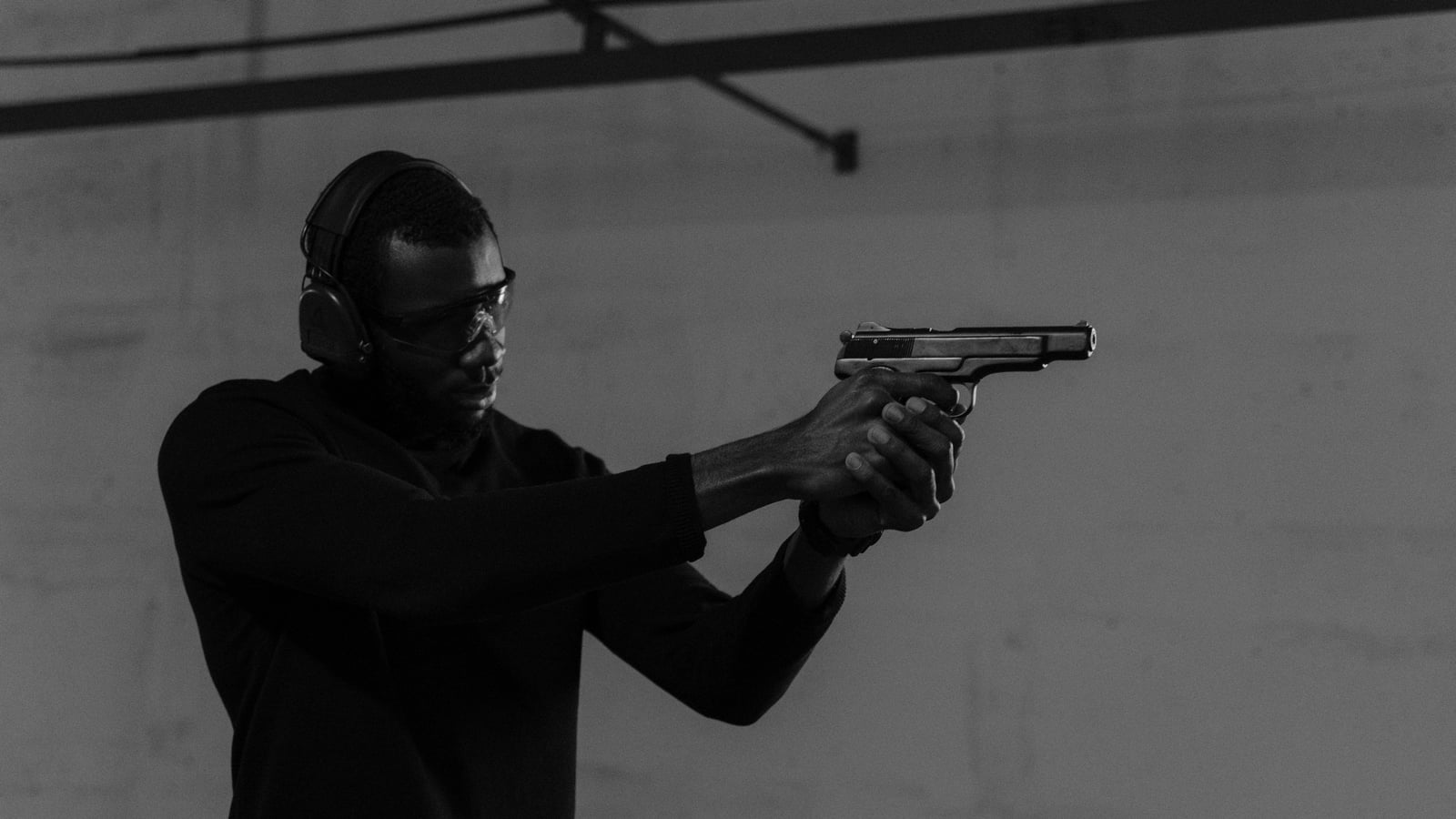
A bad string doesn’t make you a bad shooter
You just shot a disastrous string. The hits are scattered all over the place, one or two even missed the target entirely. Your first reflex is to tell yourself you’re regressing, that the session is ruined, that you might as well pack up the gun.
That reflex is almost always wrong. A bad string is a one-off event, not a final verdict on your level. Rifle, pistol, or clay shooting works in waves: solid strings, then sometimes a dip, with no obvious reason you can pin down in the moment.
The problem is almost never the bad string itself. The problem is what you do with it in the thirty seconds that follow. A seasoned club shooter and a beginner can shoot exactly the same average string on a given day. What separates them over time is what happens next: one chains together an even worse string because they stay stuck on the miss, the other corrects and moves on almost normally.
This isn’t a minor observation. Watch any firing line on a club Sunday morning and you’ll see that variability is part of the game for everyone, from the first-year member to the shooter who’s been competing for a decade. The real skill that develops with experience isn’t the absence of bad strings — it’s the speed at which you get out of them.
This article gives you a concrete method for telling the difference between an isolated technical error and a mental spiral taking hold, for regaining control between two strings before the session goes off the rails, and for building, over time, real resilience to one-off failure. The goal isn’t to sell you a magic confidence potion, but a set of practical tools you can test at your very next session.
One last point before diving in: nothing that follows replaces serious technical work on your stance, your grip, or your trigger control. Mental management of failure complements solid technical work — it never replaces it. A shooter with a real technical gap who only works on their mental game will stay stuck at the same level, just with more apparent calm.
Technical error or mental drift: the diagnosis that changes everything
Before trying to “calm down” or “think positive,” ask yourself a precise question: does this bad string have an identifiable technical cause, or did your head give out before your movements did? This distinction is the starting point for everything else, because the two situations call for radically different responses.
A technical error has a recognizable signature. The hits are scattered in a consistent direction (low-left for an anticipated recoil in a right-handed shooter, for example), or the grouping is tight but offset, proof that a setting or a hold has shifted. You can trace the thread of the motion back: foot placement, hand position, pressure on the trigger, breathing at the moment of release, cheek contact on the stock.
Mental drift, on the other hand, has no consistent technical signature. The hits scatter in every direction, with no directional logic from one shot to the next. You’ll also notice side signs that have nothing to do with ballistics: rising heart rate, an urge to shoot faster to “get it over with,” thoughts drifting toward the final result instead of the movement currently unfolding.
These two diagnoses don’t call for the same response, and that’s where many shooters get the treatment wrong. A technical error is corrected with a precise, targeted adjustment: you identify the parameter at fault, correct it consciously, and shoot a control string to validate the fix. Mental drift is corrected with a change of rhythm: you stop shooting, change your state before reloading, and don’t try to “force” a movement that was already correct to begin with.
The classic trap is treating mental drift as a technical problem. You start changing your stance, your grip, your sight setting, when objectively none of that has moved since the previous string, which was fine. Result: you add technical confusion to an already unstable head, and the next string gets worse, feeding the feeling that “nothing is working anymore.”
Conversely, treating a genuine technical error as a simple mental blip makes you ignore a real problem that will keep recurring string after string until it’s fixed. If your average point of impact has been drifting low-right for three strings in a row, that’s probably not your head — it’s your movement. Thirty seconds of breathing won’t fix anything until the physical movement is identified and adjusted.
A simple tool to decide quickly between the two: look at your grouping, not just your score. A tight but poorly centered grouping is almost always technical (the movement is reproducible, just miscalibrated). A wide, scattered grouping with no clear pattern is more often mental (the movement itself varies from shot to shot). Reading the target or the control screen this way, before even thinking about how you feel, keeps you from misdiagnosing in the heat of the moment.
Warning signs of a spiral taking hold
A negative mental spiral doesn’t appear all at once. It follows a fairly recognizable progression, if you learn to spot it early, before it takes over your whole session.
First signal: rumination. You replay the missed shot in your head while reloading, instead of thinking about the string ahead. Your attention stays stuck on the past instead of turning to the next movement to execute. This is often the very first signal in the chain, and the easiest to catch if you’re paying attention.
Second signal: speeding up. You shoot the next string faster than usual, as if going faster would erase the previous one or help you “move on” quicker. The opposite happens in nearly every case: rushing degrades precision further, feeding the spiral instead of stopping it.
Third signal: generalized negative self-talk. You go from “that string was bad” (a factual, limited observation) to “I’m bad today” (a broader judgment), then to “I never improve” (a generalization that goes well beyond the current session). The shift from a one-off judgment to a global one is the most reliable marker of a spiral forming.
Fourth signal: physical tension. Shoulders rising, jaw clenching, gripping the gun too hard, breathing locking up high in the chest instead of staying full. The body translates mental tension almost instantly, and that extra tension further degrades your hold and the quality of your release, creating a self-feeding loop.
Fifth signal: avoiding the precise movement in favor of the fast one. You stop aiming properly and “get through” the shots just to finish the string, with the vague idea that things will go better next time or the session will pass faster. This is a clear sign to stop, not to keep riding the momentum.
Sixth signal, less obvious but very telling: the need for immediate justification. You look for an external excuse as soon as the string ends (“there was wind,” “it was the wrong ammo,” “I wasn’t warmed up enough”) before you’ve even objectively analyzed what happened. Looking for an explanation is healthy; looking for an excuse before the analysis is a sign the ego is trying to protect against what just felt like a threat rather than a simple result.
Noticing one of these signals in isolation isn’t a big deal, and it happening to you now and then is perfectly normal. Noticing two or three signals chaining together in the same session, however, is the moment to apply a reset technique before firing another shot, without waiting for the spiral to end on its own.
The immediate reset technique between two strings
The immediate reset is a short, deliberately mechanical routine you apply between the end of a bad string and the start of the next. The goal isn’t to artificially “think positive” or convince yourself everything’s fine, but to cut the thread of rumination and give your attention a concrete, actionable anchor point.
Here’s a four-step sequence you can adapt to your discipline and your competition or training format:
- Put the gun down, safely. This physical gesture marks a clean break between what just happened and what comes next. Never reload in the immediate wake of a bad string, even if your discipline’s rules would technically allow it.
- Name the fact without judging it. Tell yourself mentally or under your breath “three hits scattered low,” not “I suck” or “this is a mess.” The factual, neutral description defuses the global judgment that feeds the spiral.
- Breathe at a deliberately slower rhythm. Three to five breathing cycles longer than your natural pace are usually enough to bring down the physical tension built up during the bad string.
- Set a simple intention for the next string. Not “I need to do better,” which is vague and anxiety-inducing because it’s about the outcome, but a single, concrete technical point: “follow through the recoil,” “press the trigger smoothly,” “keep both eyes open.”
This sequence rarely takes more than a minute in practice. That’s precisely its strength: it’s short enough to fit naturally between two club strings, without disrupting the session or annoying other shooters waiting their turn on the line.
An important point not to underestimate: the reset works better if it’s repeated identically every single time, including after a good string. If you only use it when things go badly, your brain ends up associating the routine itself with failure, which makes it feel almost punitive to apply and therefore less effective over time. If you use it systematically, regardless of the previous string’s result, it becomes a simple neutral airlock between two turns, with no negative connotation.
There’s a useful variant of this reset for moments of particularly strong emotion, for example after a disastrous string in competition. In that case, add one extra step before the four above: a brief, deliberate physical contact, like clenching then releasing your fists, or firmly pressing the palm of your free hand. This gesture serves as a physical “release valve” for accumulated tension, before you begin the slowed breathing. Many shooters report that this extra step helps them get out of an intense frustration spike faster than breathing alone.
Reframing a bad string without minimizing or dramatizing it
Mental reframing is not the same as lying to yourself. Telling yourself “this string doesn’t count” or “it was nothing” when it reveals a real technical problem is avoidance disguised as optimism, not useful reframing.
Useful reframing consists of putting the bad string back into its real context, without giving it more weight than it objectively has, and without ignoring it either. Here are concrete reformulations you can use throughout your sessions:
- Instead of “I completely blew that string,” say “this string is below my usual average, and I have a lead on why.”
- Instead of “I’m regressing,” say “I’m having an inconsistent session today, which happens to everyone regularly, including shooters more experienced than me.”
- Instead of “I’ll never get this,” say “I’ve already corrected this type of error before, I know what to concretely adjust.”
What makes these reformulations effective isn’t their positive tone in itself, but their factual precision. They stay anchored in observable elements (a personal average, a one-off and non-systematic irregularity, a real history of correction), not in a vague, reassuring claim that would ring hollow and that your own brain would instinctively reject as not credible.
A regional champion I’ve had the chance to watch at the club has a simple line she repeats to her young shooters during team training: “the string is over, it’s not coming back, only the next one still exists.” This isn’t magical thinking or a hollow mantra, it’s a factual, operational reminder: you can’t change anything about the shots already fired, you can only influence the ones to come. This line works precisely because it doesn’t deny the miss, it simply makes it irrelevant going forward.
Another reframing tool is to explicitly separate performance from personal worth. A bad string says something about a technical movement executed at a given moment, under given conditions. It says nothing about your worth as a shooter, or your medium-term potential for progress. This separation seems obvious stated this way, but it’s often blurred in the heat of the moment, where a bad one-off result quickly turns into an identity judgment (“I’m a bad shooter”) instead of staying a simple performance observation (“that string was bad”).
Finally, reframing benefits from a realistic sense of time. A shooting session rarely lasts less than an hour, often much more at the club or in competition. A bad string in the middle of that duration weighs proportionally quite little in the overall balance, even if it takes up a lot of space in how you feel in the moment. Consciously remembering this proportion, rather than letting the emotion of the moment dictate the perceived importance of the incident, helps put things in perspective without minimizing the underlying technical problem, if there is one.
The special case of competition
At the club, in training, a bad string has few real consequences: you adjust, you keep shooting, the session continues normally with no outside stakes. In competition, the stakes change everything, and managing failure becomes noticeably more demanding because the context adds a pressure that training alone doesn’t replicate.
The first pitfall in competition is wanting to “make up for” a bad string on the next one. This reflex pushes you to force the movement, rush the shot, or change a setting mid-match without enough perspective to judge whether the adjustment is even sound. A string can’t be technically made up for: each string is independent in terms of movement, and the best way to limit the damage is to shoot the next one well, not to try to mathematically compensate for the previous one.
The second pitfall is real-time comparison with other shooters on the line. Seeing the score or hearing the comments of a competitor pulling ahead while yours stalls directly feeds the rumination spiral described above. The best defense remains keeping your attention on your own target and your own rhythm, without trying to know your opponents’ scores before the match is fully over, even if curiosity pulls the other way.
The third pitfall concerns match time management, particularly critical in timed disciplines. A bad string puts you behind your personal clock, which mechanically pushes you to speed up the following strings to “make up” the lost time. An experienced coach often recommends building in deliberately generous time margins during training, precisely so you’re never under time pressure in competition, even after a mishap that eats up a few precious seconds.
A fourth pitfall, specific to team competitions, deserves separate mention: the fear of “tanking” the collective score. This social pressure adds a layer of stakes that goes beyond individual performance and can strongly intensify the negative spiral after a bad string. The most effective defense remains reminding yourself, even before the event starts, that every shooter on the team goes through this kind of moment at one point or another, and that a weak string offset by solid mental management often weighs less on the final result than an uncontrolled spiral that contaminates several turns in a row.
Finally, debriefing a competition that went badly must wait until the match is completely over, never during. Many shooters start analyzing their bad strings while they’re still shooting the following ones, which pulls attention that should stay entirely on the present movement. The full debrief, with the necessary distance and without the emotional load of the moment, happens afterward, with a cool head, ideally the same day or the next while the details are still fresh.
Building a pre-string routine that protects against slipping
The best failure management is the kind that limits, upstream, the risk of an isolated incident turning into a full spiral. A stable routine before each string plays this protective role, giving your attention a familiar frame to invest in rather than letting it drift into rumination.
An effective pre-string routine generally involves the same steps every time, in the same order: stance check, breathing setup, visual focus point, then trigger release. This stability creates a familiar frame that better absorbs the emotional jolts left by a previous bad string, a bit like a ritual that automatically re-centers attention.
The value of a fixed routine is that it works almost on autopilot, even when your mental state is disturbed by what just happened. If your routine depends on your mood in the moment or your momentary confidence, it collapses exactly when you need it most, which is immediately after a miss.
Here are the elements to build into a robust, repeatable pre-string routine:
- A physical transition gesture (setting down and picking the gun back up, adjusting foot position) that marks the official start of preparation, distinct from what just happened before.
- An identical breathing anchor for every string, for example two full breaths before shouldering or getting into position.
- A quick, non-anxious technical check (aim, alignment, cheek contact) that occupies attention on present, directly actionable elements, rather than on the hoped-for result.
- A trigger word or mental image that systematically brings you back to the movement, not to the final result of the string.
This routine is built in training, never in competition, where the stakes leave no room for experimentation. The club range is the right place to test different variants and keep the one that suits you best, before treating it as locked in and relying on it for official matches.
An often overlooked point: the pre-string routine needs to be tested specifically under simulated fatigue or stress conditions, not only in the comfort of a calm weekend session. A routine that works perfectly when you’re rested and relaxed can fall apart under pressure if it’s never been tested under conditions closer to a competition or the end of a tiring session. So build in, from time to time in training, shooting slots at the end of a session or after prior physical effort, precisely to check that your routine holds up when conditions worsen.
The role of the shooting log in managing failure
Writing down your strings, even the bad ones, concretely changes how you experience them in the moment and afterward. An incident that stays only in your head tends to grow over time or repeat itself without you really understanding why. An incident recorded with its precise circumstances instead becomes usable, almost neutral data.
Concretely, jot down three things right after a bad string: the score or grouping obtained, a hypothesis about the likely cause (technical or mental), and the adjustment you applied before the next string. This discipline, even applied roughly, turns a vague emotional experience into genuinely usable information for improvement.
Over several sessions, this tracking reveals patterns that memory alone never retains precisely. You might notice that your bad strings mostly happen at the end of a session, as fatigue gradually sets in, or on the contrary at the very start, before warm-up is complete. This kind of pattern only shows up by accumulating regular notes over time, never by relying on a general impression after the fact.
The log also plays a particularly valuable role in after-the-fact reframing. Reading back over a stretch of training sessions across several weeks almost always shows you a real progression trend, even punctuated by bad strings here and there. This overview naturally counterbalances the bias that makes an isolated bad moment feel, in the moment, far more significant than it actually is in the overall trajectory.
A finer use of the log is cross-referencing your string notes with context elements outside of shooting itself: sleep quality the night before, general stress level for the day, time of the session, whether an audience was present or not. This cross-referencing sometimes reveals surprising correlations, for example a tendency toward more inconsistent strings after a short night’s sleep, or on the contrary better concentration in the evening than in the morning. Once identified, this information becomes concrete levers for organizing future sessions.
Finally, recording systematically — including the good strings and not just the bad ones — avoids turning the log into a mere register of failures that would become discouraging to reread. The goal remains a complete and honest snapshot of your practice as a whole, not a list of reproaches you’d make to yourself afterward by only consulting the bad passages.
What repeating the same failure actually reveals
Sometimes the same error keeps coming back across several sessions despite repeated attempts to fix it. That’s frustrating in the moment, but it’s not necessarily a deep mental block: it’s often a sign that the initial technical diagnosis was incomplete or poorly targeted.
Before concluding there’s a deep psychological block, methodically go back through the possible technical causes one by one. Dispersion that always returns in the same direction points to a stable, uncorrected parameter: a grip that’s never truly been adjusted in depth, an optical setting that has subtly shifted without you noticing, a posture compensating for a physical discomfort not yet identified.
An outside perspective often changes everything at this stage of the diagnosis. A club coach or a more experienced shooter notices details you simply can’t see yourself while fully focused on your target: a gradual shoulder tightening, a head movement just before release, an anticipation of the recoil invisible from your own position but obvious from the outside.
If, after a complete and rigorous technical check, the error persists even though no material cause can be identified, then the mental hypothesis legitimately gains weight again in the diagnosis. Apprehension about recoil, anticipating the sound of the shot, or a stress load tied to a particular stake (a qualifying test, a selection, an unusual audience) can produce errors that look uncannily like technical errors without really being ones.
In this specific case, the solution is almost never to “force” more strings under the same conditions causing the problem. Temporarily reducing difficulty (shorter distance, slower pace, different ammunition depending on the discipline) often allows you to restore a clean movement and baseline confidence, before very gradually working back up to usual conditions once the movement has stabilized.
There’s also a third category of cause, halfway between technical and mental, worth mentioning separately: an equipment issue misidentified as something else. Ill-suited ammunition, a sight point poorly set since a previous outing, uncomfortable hearing or eye protection that distracts without you being fully aware of it — all of these can produce a recurring irregularity you’ll wrongly attribute either to a technical movement problem or a mental one, when the real cause is material and gets fixed off the range, by calmly checking your gear before the next session.
Adapting failure management to your discipline
The way you experience a bad string isn’t the same across disciplines, and the reset method benefits from being adjusted accordingly to stay genuinely applicable within the time format available.
In precision rifle or pistol shooting at a fixed target, failure is visible immediately on the grouping or score, shot by shot, leaving little room for doubt about when things are going wrong. The reset between two strings can be relatively long and unhurried, since this discipline’s format generally leaves time between turns, allowing you to apply the full four-step sequence described above without pace constraints.
In dynamic shooting on cardboard or steel targets, failure is also measured in time, not just pure accuracy. A bad string can be too slow a time, a penalty for a missed shot, or a poorly executed engagement order that costs points even if accuracy was good. The reset then needs to be very brief, often just a few seconds between two stages, which demands an even more condensed routine than in static precision disciplines, sometimes keeping only two or three essential steps of the full sequence.
In clay shooting, failure (a missed clay) happens in a split second and the next one comes almost immediately, with no real natural pause. The reset is often limited to a single breath and a posture reminder before the next clay is called, with no room for an extended pause given the collective pace imposed by a firing point shared with other shooters.
In animal-silhouette disciplines like FFTir (chicken, pig, turkey, ram), failure concerns accuracy at varying distances with speed requirements that also vary depending on the event. The reset needs to include a quick balance between analyzing the miss (position, distance, pace adopted) and resuming fire, without losing the collective rhythm of the firing line or holding up other competitors.
In indoor air-gun disciplines, often used for introduction or winter training, the target’s proximity and the generally slower pace leave more room for an unhurried reset. This is often the most favorable setting for testing and breaking in a new reset routine, before transposing it to faster or longer-distance disciplines.
In all cases, whatever the discipline, the underlying principle stays the same: recognize the type of failure encountered, apply a reset adapted to the time actually available in that specific format, and move forward with a clear, single technical intention rather than a vague general hope of doing better on the next attempt.
The role of the coach or club partner in bouncing back
Managing failure alone, in complete self-sufficiency, has its limits, especially for shooters who are just starting out or going through a recurring block. A caring outside perspective often provides help that introspection alone can’t, regardless of experience level.
A club coach plays a valuable role in quickly identifying the technical or mental diagnosis discussed above. Their position as an outside observer, not emotionally invested in the string’s outcome, lets them objectively spot posture or movement details that completely escape a shooter focused on their own target.
Beyond the technical diagnosis, an experienced club partner can also serve as a useful mental mirror. Saying out loud what just happened (“I blew that string, I think it’s because…”) to a supportive third party forces you to phrase things more calmly and factually than silent internal rumination, which tends to amplify things without the filter of putting them into words.
That said, it’s important to distinguish constructive support from a dynamic of constant comparison, which instead feeds performance anxiety. A good training partner questions and observes without judging, and doesn’t systematically compare your results to their own or to a third club shooter’s. If you feel that a particular training environment fuels more comparison than genuine support, it’s entirely legitimate to adjust who and in what context you choose to train with regularly.
Finally, the coach’s role takes on a particular dimension for shooters preparing for a competition deadline. Working in advance on likely failure scenarios (a bad string early in the match, pressure from an audience being present, an unexpected equipment issue) allows you to mentally prepare responses before the situation actually arises, rather than discovering your own reaction for the first time on the day of the event.
Building long-term tolerance to failure
Managing failure shot by shot has its limits if it isn’t paired with broader work on failure tolerance in general, built over time rather than in a single session. A shooter who experiences every bad string as a drama will keep rebuilding the same tension, no matter how good their one-off reset routine is.
This tolerance is first built through deliberate exposure to difficulty in training. Deliberately putting yourself in more demanding conditions than usual (increased distance, reduced time, physical fatigue deliberately induced beforehand) and accepting that you’ll miss strings in a setting with no real stakes gradually desensitizes the emotional reaction to failure, which becomes less intense with repeated controlled exposure of this kind.
It’s also built through attentively watching other shooters at the club. Spending time watching seasoned shooters miss strings, calmly adjust, and get back to it almost normally concretely demonstrates that one-off failure is a genuine, integral part of the practice at every level, not just at your current stage of progress.
It’s also built through work done over time between sessions themselves, not just during them. Deliberately going back, with a cool head, to a session marked by one or more bad strings, without the emotional load of the moment, lets you draw useful technical lessons without reliving the initial discomfort. This delayed rereading, supported by the shooting log mentioned earlier, gradually transforms your relationship with failure from something to avoid into a normal source of information.
Finally, it’s built through changing your personal definition of success within a session or competition. If your only measure of success is the final score, every bad string along the way weighs heavily and constantly threatens that single indicator. If your measure also includes the quality of your mental management during the session (did you reset effectively after a miss, did you keep your pre-string routine intact despite the pressure), a bad string becomes an opportunity to succeed at something else real, not just a flat, one-dimensional failure.
Over the very long term, this increased tolerance for one-off failure also has an unexpected positive effect on technical risk-taking in training. A shooter who overly dreads a bad string often avoids, without realizing it, testing new settings or new positions for fear of an immediate disappointing result. A shooter more at ease with occasional failure explores more freely, which paradoxically accelerates their overall technical progress over time.
FAQ
Q: How do I know if a bad string comes from a technical problem or a purely mental one? A: Look at the direction of the dispersion in your grouping. A consistent, repeated direction points to an identifiable technical cause, while dispersion with no directional logic, accompanied by speeding up and rumination, more often signals mental drift.
Q: Should you stop shooting after a truly bad string? A: Yes, a short pause is preferable to shooting immediately again. Put the gun down safely, apply your reset routine, and only resume once you’ve set a clear technical intention for the next string.
Q: Does the mental reset work as well in competition as in training? A: The principle stays the same, but the time available is often shorter in competition. That’s why it’s best to build and test your reset routine in training, so it stays reliable even under pressure on match day.
Q: Is a recurring error necessarily a mental problem? A: Not necessarily. First methodically check the stable technical causes (grip, setting, posture, equipment) before concluding there’s a psychological block, ideally with an outside perspective from a coach or more experienced shooter.
Q: How does a shooting log concretely help you deal with failure better? A: Noting the score, a hypothesis about the cause, and the adjustment applied turns a vague emotional experience into usable information. Over time, it reveals patterns (fatigue, time of session, outside context) invisible to memory alone and puts the real frequency of bad strings into perspective.
Q: Can enough training completely eliminate bad strings? A: No, and that’s not a realistic goal to aim for. Even the most experienced shooters go through inconsistent patches; real progress is about the speed and quality of the bounce-back after the incident, not its total disappearance.