
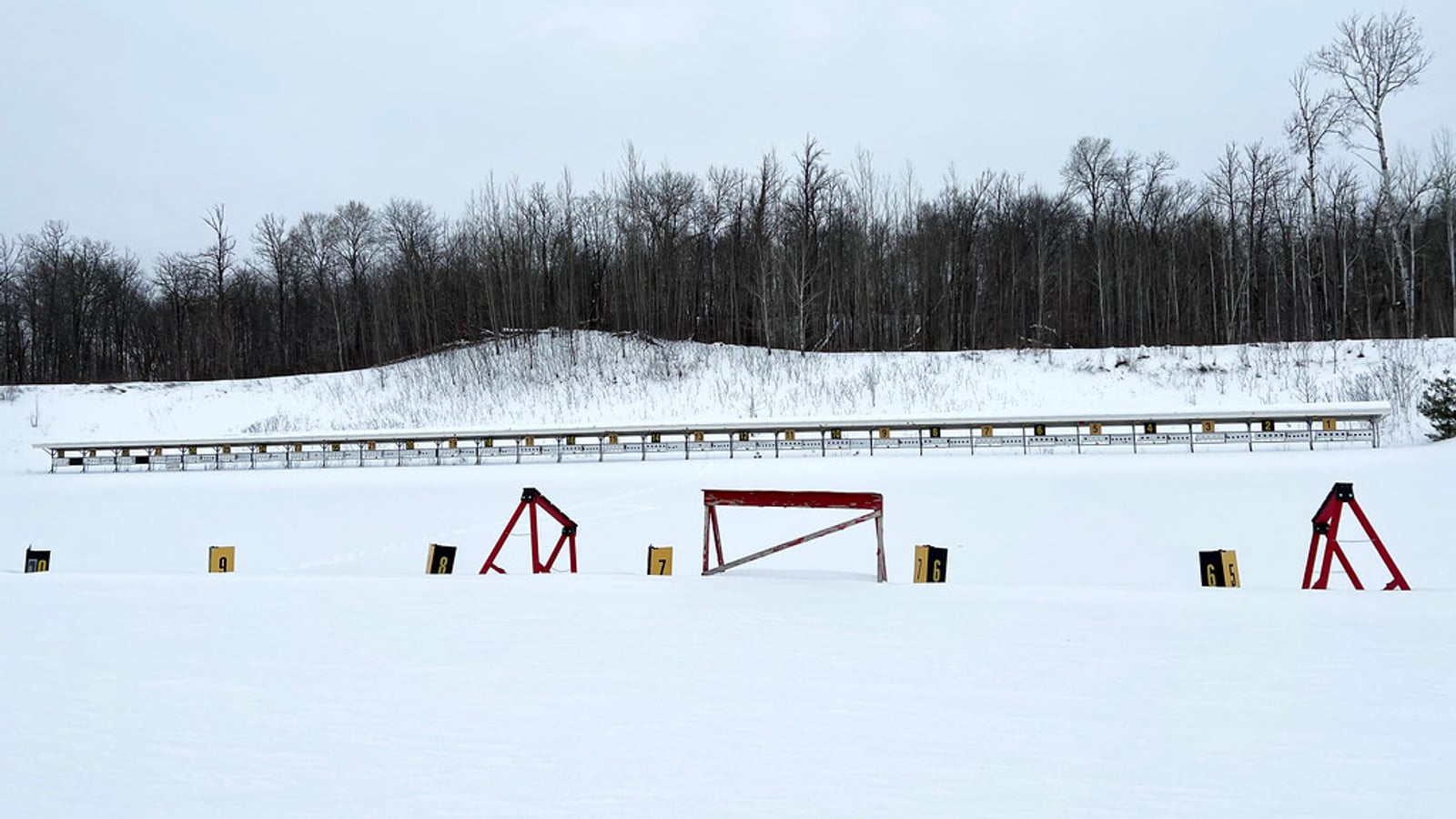
A hybrid sport unlike any other
Biathlon marries two disciplines that, on the surface, have nothing in common. On one side, cross-country skiing: a long, cyclical cardio effort. On the other, precision shooting, which demands calm and stillness. The sport consists precisely in switching between the two, over and over, within a single race.
This constant alternation is what makes biathlon fascinating for any shooter. You might be an excellent range shooter, capable of tight groups at 50 meters in the calm of a classic firing point. Get yourself out of breath after an intense cardio effort, though, and your entire shooting technique has to be rebuilt from scratch.
The Olympic format rests on this permanent tension between two opposing physiological qualities. It’s an endurance sport that’s also decided, and perhaps above all, by the ability to bring heart rate and tension back down for the span of a few shots. Understanding this mechanic helps explain why biathlon fascinates spectators and competitors alike.
For a civilian sport shooter who has never strapped on cross-country skis, biathlon remains an interesting gateway into a different way of thinking about precision. It’s no longer an isolated absolute, but a skill that has to be summoned under heavy physiological stress.
Historically, this discipline traces its roots to Scandinavian practices of winter travel combined with shooting, long before it became a codified Olympic event. Sport shooting has been part of the Olympic Games since 1896, and biathlon joined the Winter Olympic program in the 20th century, with the rules that structure today’s discipline consolidating over the decades since.
What strikes a shooter discovering biathlon for the first time the most is the visual contrast between the frenzy of skiing and the complete silence of the firing point. The crowd holds its breath, competitors slow their stride, and for a few seconds the entire race hinges on five motionless shots. Then everything starts again, just as fast as it stopped.
This contrast isn’t just spectacle: it literally embodies the sport’s technical difficulty. Every trip to the firing point is a mini-test of composure inserted into a sustained cardiovascular effort, repeated several times within the same race. No other civilian shooting sport discipline forces such a fast, repeated alternation between these two bodily states.
Physiologically, biathlon is often cited as an example in elite sport to illustrate the coexistence of two very different energy systems within the same athlete: the aerobic endurance of the skier and the fine neuromuscular control of the precision shooter. Few sports demand such physiological versatility from a single practitioner.
This dual demand also explains why a biathlete’s preparation differs noticeably from that of a pure skier or a pure sport shooter. Training has to make room for both components, without ever sacrificing one for the other, which makes season planning particularly complex for coaches in this discipline.
The Olympic format: skiing and shooting in alternation
The reference format of Olympic biathlon alternates cross-country skiing loops with visits to the firing range. Depending on the event (individual, sprint, pursuit, mass start, relay), the number of loops and shooting bouts varies, but the principle stays the same: ski, shoot, ski again.
Each shooting bout involves a series of shots at a target dedicated to biathlon, in prone or standing position depending on the point in the race. A missed target usually incurs a penalty, either a penalty loop to ski or added time depending on the exact event format.
The prone position generally comes when the torso is at its most stable, with the rifle resting partly on the shooter’s lying body. The standing position is the most demanding: with no support, the body — still loaded from the skiing effort — has to stabilize itself in a matter of seconds.
This systematic alternation between skiing and shooting is what structures a biathlete’s entire training regimen. You never train shooting alone or skiing alone for very long: the real skill being sought is the transition between the two, again and again.
The number of shots per bout is generally fixed at five rounds, whatever the event format, which simplifies score-reading for spectators and competitors alike. This figure of five is one of the sport’s rare constants, whereas the number of ski loops and total distance vary widely from one format to another.
The order of the shooting bouts also follows a constant logic: prone shooting always precedes standing shooting within the same series of bouts, never the reverse. This progression from most stable to most demanding reflects a kind of physiological common sense that’s long been built into the discipline’s rules.
The transition zone between skiing and the firing point, often called the “stadium,” is itself a learning ground in its own right. There, the athlete has to manage removing the poles, moving the rifle from back to hands, and setting up the shooting position, all within a few seconds and without losing focus on the ultimate goal: hitting the target.
The choice of the exact spot on the firing line, called the individual firing point, is generally assigned by draw or by bib order depending on the event. This logistical detail matters: wind or light conditions can vary slightly from one spot to another on the same firing line.
The discipline also imposes strict management of time spent at the firing point, with no official time limit in most formats, but with very strong implicit pressure: every second spent stabilizing your aim is a second lost off the race’s overall clock, which pushes competitors to constantly optimize this trade-off between speed and precision.
Elevated heart rate: the shooter’s number one enemy
The real technical challenge of biathlon isn’t skiing fast, or shooting accurately in the abstract. It’s shooting accurately with a heart rate that can exceed 160 to 180 beats per minute right out of a ski loop. A classic range shooter rarely trains under these conditions.
Physiologically, an elevated heart rate generates visible oscillations in the sight line: the torso vibrates with the heartbeat, breathing stays short and gasping, and muscle tremors linked to fatigue pile on top. Stabilizing a rifle in this state is a skill all its own.
The basic technique is to deliberately slow the approach to the firing point over the last few meters, to trigger a slight drop in heart rate even before setting up the position. This is never enough to return to a resting heart rate, but it does reduce the amplitude of the oscillations.
Next comes managing your breath at the exact moment of trigger pressure: aiming for a breathing window where the body is momentarily more stable, generally at the end of exhalation, exactly as in classic precision shooting but with a much wider tolerance margin imposed by fatigue.
Mental training counts just as much as physical training here. An experienced club-level biathlete learns to accept instability rather than fighting it head-on, seeking the most stable shooting window available rather than an illusory perfect stillness.
Heart rate isn’t the only variable in play: body temperature and peripheral vasoconstriction caused by cold ambient air also alter finger sensitivity on the trigger. A finger numbed by cold doesn’t transmit the same tactile information as a warm one, adding an extra difficulty at the crucial moment of the shot.
Some biathletes specifically train their recovery heart rate, measuring how long it takes them to come down significantly after a given effort. This individual data, specific to each person’s physiology, then allows them to adjust their approach speed to the firing point according to their own recovery capacity rather than a generic model.
Competition stress adds yet another layer to this already complex physiological challenge. A racing heart rate elevated by physical effort is often compounded by an adrenaline surge tied to the stakes, which can amplify tremors further and make the mental work of managing calm all the more necessary.
Some coaches use heart rate monitors during training sessions to precisely pin down the heart rate zone in which a given shooter remains capable of producing an acceptable group. This data, specific to each practitioner, allows realistic training goals to be set rather than chasing a generic performance disconnected from one’s own physiology.
An often underestimated aspect is pacing management before the firing point: an athlete who mismanages their effort on the ski loop will arrive at the range with an unnecessarily elevated heart rate, degrading their precision regardless of their technical shooting ability. Race strategy and shooting performance are thus far more tightly linked than they appear from the outside.
Prone position: relative stability
In the prone position, the shooter rests on the ground, the rifle steadied by a sling and by body weight. It’s the more stable of the two positions, but the still-elevated heart rate after the effort continues to disturb the aim, notably through respiratory oscillations transmitted to the torso.
The sling plays a central role: properly adjusted, it turns the support arm into a genuinely rigid anchor point, limiting the influence of muscle tremors. A poorly adjusted sling, conversely, amplifies every micro-movement instead of absorbing it.
Body placement on the ground has to be identically repeatable at every bout, despite fatigue and race stress. Biathletes drill this positional consistency almost mechanically in training, so the body finds the same reference points even in a state of advanced fatigue.
Breathing in the prone position is managed differently than standing: with the torso partly supported by the ground, the impact of heart rate on the sight line is reduced compared to standing, but it remains a determining factor for shooting precision right after exertion.
The angle of the body relative to the shooting axis is also one of the fine adjustments worked on in training. A poorly chosen angle forces constant compensation with the back and shoulder muscles, adding muscular fatigue to an already demanding situation at the end of a ski loop.
The body’s contact with the ground, often packed snow or a mat depending on the range, also influences perceived stability. Some biathletes slightly adjust their position according to the firmness and slope of the surface, a fine adaptation that only repetition under real conditions can fully master.
Finally, the prone position remains the sport’s most forgiving in terms of margin for error: that’s why hit-rate statistics for prone shooting are, across competitions overall, generally higher than for standing shooting, whatever the competitor’s level.
Managing body weight on the elbows and forearms also deserves particular attention in the prone position. Too rigid a support creates parasitic muscle tension that carries through to the shooting hand, while too relaxed a support leaves the torso exposed to heart-rate oscillations without sufficient damping. Finding the right middle ground is a process refined session after session.
Finally, the gaze should not fixate solely on the target but must incorporate a peripheral view of the front sight and the rear aperture in constant alignment. This sighting triangle, specific to iron-sight shooting, requires an adjustment period for shooters accustomed to the magnifying optical scopes used in other precision disciplines.
Standing position: the most demanding exercise
The standing position in biathlon is reputed to be the harder of the two. With no ground support, the entire weight of body and rifle rests on the shooter’s balance alone, at a moment when the legs are still loaded from the skiing effort and the heart rate remains elevated.
The center of gravity has to be found quickly, with a posture relaxed enough not to add extra muscular tension, but firm enough to limit the oscillations. It’s a difficult balance to hold, particularly late in the race as overall fatigue accumulates.
The trigger has to be pressed with perfect consistency despite this ambient instability, without any jerk, accepting that the sight line will never be fully still. Chasing perfect stillness in the biathlon standing position is a classic beginner’s mistake in this discipline.
An experienced biathlon instructor will instead emphasize the idea of a “shooting window”: accepting a slight residual movement of the rifle and firing at the moment that oscillation crosses the center of the target, rather than waiting for a stability that won’t come under these physiological conditions.
Foot placement, even without direct ground contact for the torso, remains decisive in the standing position. The feet need to form a base wide enough to absorb the body’s natural oscillations, without over-stiffening legs already fatigued by the skiing effort.
The support hand, the one holding the forend of the rifle, plays a disproportionate role in the overall stability of the standing shot. Slight adjustments in tension or relaxation of this hand can be enough to tip a good shot into a missed one, which explains the considerable time biathletes devote to specifically training this grip.
Many clubs offering biathlon introductions actually have beginners work on standing shooting before prone shooting, precisely because it’s the position where bad habits are hardest to correct once they’ve set in. Better to learn the right movement from the start than to have to fix it afterward.
A classic training exercise for standing shooting involves holding the position empty, with no ammunition, simply observing the natural amplitude of the barrel’s oscillations over the target. This exercise, repeated regularly, helps shooters get to know their own movement pattern and learn to anticipate the optimal moment to press the trigger.
Fatigue accumulated late in a race amplifies this difficulty further: the last standing bouts of a long event are statistically the trickiest to negotiate, since the legs and back have already absorbed several loops of intense skiing. This progressive erosion of stability is an integral part of the sport’s tactical difficulty.
Biathlon’s specific equipment
The biathlon rifle is highly specialized equipment, designed for this sport and rarely used elsewhere. It’s distinguished by a fast reloading system, often a side lever operated with the fingertips, which lets shooters run through a series of shots without leaving the aiming position.
The magazine is also designed for quick, reliable handling even with cold, gloved hands, a constraint specific to the discipline’s winter conditions. The stock also incorporates fine adjustments of length and tilt, to adapt to the two very different shooting positions of prone and standing.
Biathlon sights use a rear diopter (peep sight) system and a front sight with interchangeable aperture inserts, with no magnifying optical scope: the discipline’s regulations mandate mechanical iron sights, which fundamentally changes the approach to zeroing compared to a rifle fitted with a scope.
The caliber used in competitive biathlon is overwhelmingly .22 Long Rifle, a low-recoil caliber that eases shot control under already difficult physiological conditions. This caliber choice is also tied to the short shooting distance used on biathlon ranges.
On the skiing side, the equipment is close to classic cross-country skiing gear, but the whole system has to be designed to allow quick access to the rifle carried on the back upon arrival at the firing point, with no loss of time or balance.
The system for carrying the rifle on the back deserves particular attention: it has to keep the weapon perfectly stable during skiing phases, including fast descents and tight turns, while still allowing smooth one-handed release within a few seconds on arrival at the firing point.
In terms of regulatory classification in various countries, a rimfire biathlon rifle in .22 Long Rifle generally falls under a category requiring declaration or a permit, but this varies according to the exact model and its mechanism: it’s best to check the precise classification with a gunsmith or your federation before any purchase.
Maintaining the equipment in winter conditions also demands particular rigor: humidity, snow, and temperature swings can affect the mechanical function of the reloading system if the rifle isn’t properly maintained and adapted to the cold conditions encountered on outdoor ranges.
The rifle’s total weight, generally lighter than that of a classic precision rifle, is designed to limit the load carried during skiing phases while retaining enough inertia to stabilize the shot. This trade-off between lightness and stability is one of the most heavily engineered parameters among manufacturers specializing in this niche equipment.
The gloves used in biathlon are also a technical accessory in their own right: thin enough to retain sensitivity on the trigger, but insulating enough to protect against cold during the skiing phases. This textile trade-off is a matter of personal choice that each practitioner refines over the course of their outings.
Getting started with biathlon
Practicing full biathlon, with combined skiing and shooting, requires access to specific infrastructure found mainly in mountain regions, in clubs affiliated with both cross-country skiing and sport shooting federations. These facilities remain less common than classic sport shooting clubs.
For a shooter without access to this infrastructure, there are adapted introductory formats: “laser biathlon” reproduces the mechanics of alternating effort and shooting without a real firearm, often used for school introductions or public taster events, including outside the winter season.
Other clubs offer sessions combining running and shooting, sometimes called “cross-biathlon” or “sporting run and gun,” which reproduce the same heart-rate-management logic without needing snow or ski equipment. It’s an excellent entry point for a club shooter used to static shooting.
Checking directly with a local shooting club or a regional cross-country skiing committee remains the best approach to find out what’s available in your area, since this varies widely depending on proximity to mountain ranges equipped with certified firing points.
Mountain ranges concentrate the majority of infrastructure dedicated to biathlon, with certified firing points built into cross-country ski resorts. These sites host both licensed competitors and taster groups, often at times scheduled outside periods of heavy tourist traffic.
The cost of an introductory session varies by club and region, generally including rental of laser or rimfire shooting equipment, and sometimes cross-country ski gear for unequipped beginners. This budget remains variable from one site to another; it’s best to inquire directly rather than rely on a generic rate.
For a licensed sport shooter wanting to discover biathlon, it’s also possible to reach out to your own federation to find out about partner clubs or existing agreements with cross-country skiing organizations, as some regions have developed specific bridges between the two disciplines.
Applying biathlon training to classic club shooting
Even without practicing biathlon as such, a club shooter can draw inspiration from its heart-rate-management training methods. The simplest exercise is to do a short, intense cardio effort right before a shooting session, then observe the impact on aiming stability.
This so-called “degraded condition” training develops a valuable skill for all dynamic disciplines of civilian sport shooting, where the sequencing of physical effort and precise shooting phases is also present, albeit to a lesser degree than in pure biathlon.
Working on breathing at the end of an effort, even before picking up the firearm, lets you transpose part of the biathlon method to any club shooting session. A few deep, controlled breaths before settling in at the firing point help bring the heart rate down faster.
An experienced club shooter who has tried this approach often reports better stress management in classic competition, as the biathlon heart-rate-management exercise proves transferable to any situation where the stakes raise nervous tension before an important shot.
A simple protocol involves alternating sets of squats or stair climbs with rounds of rifle or pistol shooting, noting each time how long it takes to recover a satisfactory group. This tracking lets you measure concrete progress in your capacity to absorb effort before shooting straight.
Some club instructors are now incorporating this type of exercise into their group sessions, particularly to prepare shooters in dynamic disciplines to better manage breathlessness between shooting zones. The pedagogical value of the biathlon method extends well beyond the circle of practitioners of this specific discipline.
It remains important to remember that such training under degraded conditions must always respect the range’s usual safety rules: fatigue never excuses laxity in weapon handling, muzzle direction, and keeping the finger off the trigger between shots.
Penalties and scoring: understanding the events
Biathlon’s penalty system varies by race format. In some events, every missed target adds a minute to the final time. In others, the penalty takes the form of an additional penalty loop to ski, generally around 150 meters.
This penalty mechanic completely transforms race strategy: a biathlete may choose to slow their heart rate down before shooting, even at the cost of a few seconds on the ski loop, to secure their shots and avoid a penalty that costs far more time.
The relay adds another dimension: each relay leg generally has spare rounds in addition to the regulation cartridges per series, to make up for a miss without a penalty loop, though in limited number. Managing this reserve is an integral part of relay shooting strategy.
This variety of formats explains why biathlon remains such a closely followed sport: every event tells a different story between skiing speed, risk-taking at the range, and tactical effort management, with frequent turnarounds tied precisely to the variability of shooting under elevated heart rate.
The mass start, where all competitors set off together, pushes this logic even further: the social pressure of seeing rivals right beside you at the firing point adds an extra psychological dimension to the already complex management of heart rate and breathing.
The sprint format, shorter and with only two shooting bouts, rewards a more measured approach to risk instead: a single missed target can be enough to ruin a placing, which pushes some competitors to favor a more cautious approach and a slightly longer setup time at the firing point.
Understanding these nuances between formats helps you appreciate the discipline better as a spectator, but also helps you calibrate your own training if you ever want to take part in this kind of event: preparation won’t be the same depending on whether you’re aiming for a sprint format or a longer individual one.
What biathlon can teach any sport shooter
Beyond its spectacular dimension, biathlon is an unintentional masterclass in managing physiological stress applied to precision shooting. This lesson extends well beyond skiing and snow, and applies to any shooting situation under pressure.
The idea of an “acceptable shooting window” rather than perfect stillness is probably the most transferable lesson. Many beginners in civilian sport shooting chase an illusory total stability, whereas learning to shoot accurately within a controlled oscillation is a far more realistic and useful skill.
The breathing management developed in biathlon, with its precise exhalation windows even in a fatigued state, also remains applicable to classic precision shooting in the standing position, or to any discipline requiring a quick shot after physical effort, including some dynamic civilian sport shooting disciplines.
Finally, biathlon reminds us of a truth too often forgotten at the static firing point: precision is never an absolute disconnected from physiological context. It builds and degrades according to the state of the body, and training to shoot straight under degraded conditions is an investment that benefits every shooting discipline.
Sighting, adjustments, and reading the target at the firing point
Shooting distance in biathlon is fixed and short compared with other precision shooting disciplines, which in theory simplifies adjusting the mechanical sights. In practice, the difficulty doesn’t come from the distance itself but from the changing light and weather conditions encountered on an outdoor range.
The surrounding snow reflects particularly intense light, sometimes dazzling in full sun, which can distort perception of the front sight and rear aperture if the shooter isn’t used to these conditions. Many biathletes adjust their interchangeable aperture inserts depending on the day’s light, a fine adjustment that’s an integral part of pre-race preparation.
Wind, another unavoidable external factor, affects trajectory even over a short shooting distance. On an outdoor range, learning to read the flags or pennants placed around the shooting area is one of the skills biathletes develop with experience, just like heart-rate management.
Reading the target itself requires an adjustment period: the plate system used in biathlon visually flips as soon as a shot hits the zone, giving the shooter immediate feedback. This near-instant visual feedback helps mentally adjust the next shot, within a sequence of five rounds where every piece of information counts.
Nutrition, hydration, and recovery around the effort
The physiological management of biathlon isn’t limited to the moment of the shot: nutrition and hydration before and during a training session or competition directly influence the body’s capacity to withstand the ski-shoot alternation without excessive degradation of precision.
Insufficient hydration before exertion heightens the feeling of muscular fatigue and can worsen tremors at the moment of the shot, particularly during long sessions or competitions with multiple loops. This holds true for any civilian sport shooting discipline involving prior physical effort, not just biathlon.
Recovery between two training sessions deserves the same attention as the training itself. A poorly recovered body shows a higher baseline heart rate, which makes the drop in heart rate needed at the moment of the shot even harder to achieve. This varies by individual and their general fitness level; it’s best to adjust your own pace rather than follow a standard model.
Sleep, often overlooked in discussions of shooting performance, also plays a significant role in movement stability and stress management in competition. A biathlete, like any competitive sport shooter, benefits from factoring this dimension into their overall preparation rather than focusing solely on shooting technique.
FAQ
Q: Do you have to be an excellent skier before taking up shooting in biathlon? A: No, clubs offering biathlon introductions generally welcome a wide range of profiles, adjusting the intensity of the skiing effort. Shooting technique under fatigue conditions is learned progressively, at your own pace.
Q: What’s the main difference between prone and standing shooting in biathlon? A: Prone shooting benefits from ground support and a sling that stabilize the rifle, making it more accessible despite the elevated heart rate. Standing shooting, with no support, demands better body balance and finer management of residual instability.
Q: Can you train heart-rate management without practicing cross-country skiing? A: Yes, an intense cardio effort followed by a shooting session reproduces part of biathlon’s physiological demand. It’s a training method that can be transposed to a civilian sport shooting club, with no snow or ski equipment needed.
Q: Why doesn’t the biathlon rifle have an optical scope? A: The discipline’s regulations mandate mechanical sights, a rear diopter and front sight, to keep a constant level of difficulty and preserve sporting fairness between competitors, without the magnification an optic would provide.
Q: Is .22 Long Rifle caliber sufficient for the precision required in biathlon? A: Yes, this low-recoil caliber is perfectly suited to the short shooting distances used in biathlon and eases control of the shot in a context of elevated heart rate, which explains its near-universal adoption in the discipline.
Q: Are there biathlon competitions accessible to amateur shooters? A: Some regional committees and affiliated clubs organize competitions open to amateurs, notably in a summer version with running. Checking locally with a shooting club or a cross-country skiing committee remains the best way to get access.