
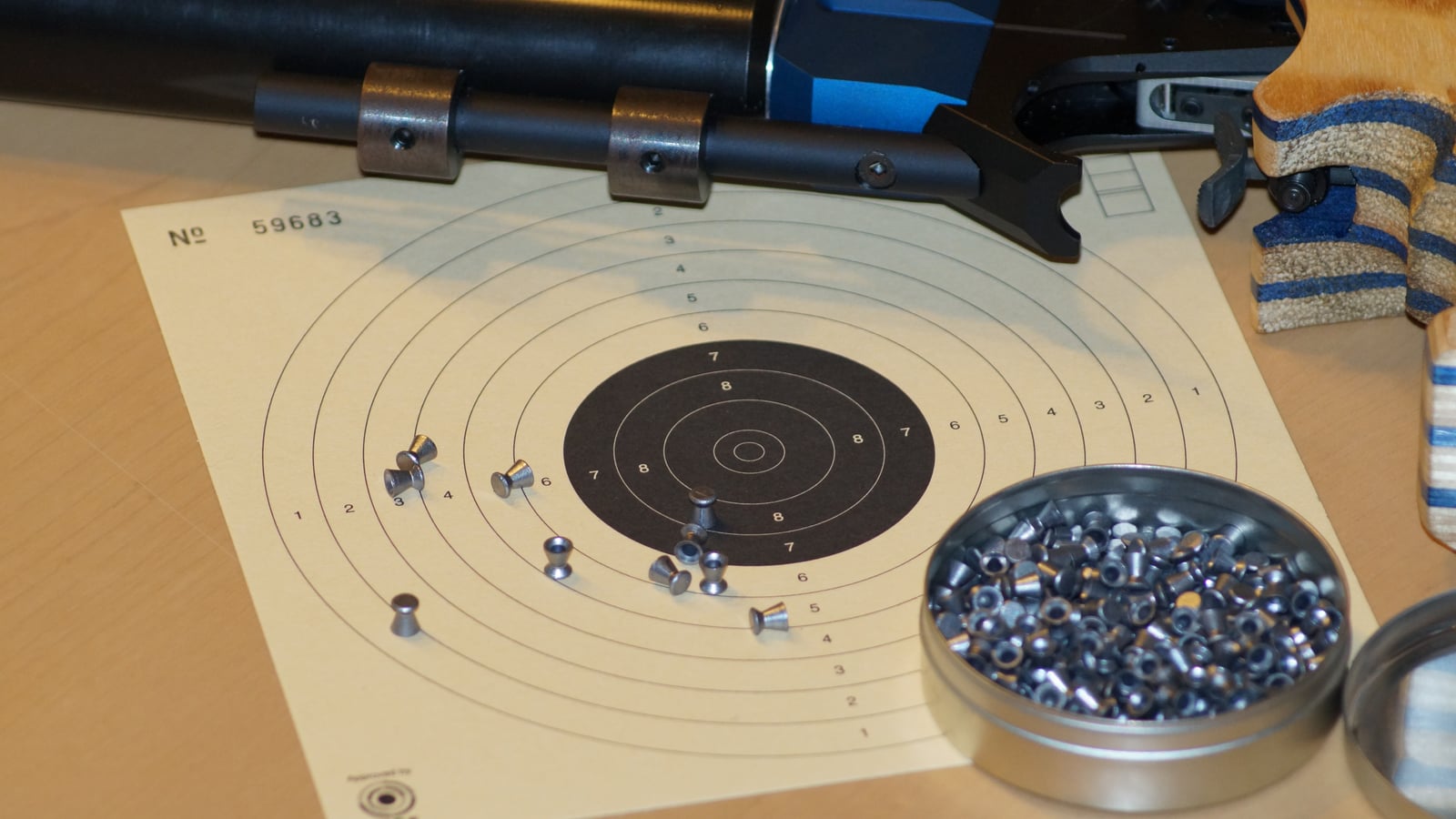
What benchrest actually is
Benchrest is a fully-supported shooting discipline, practiced from a dedicated bench, where the shooter barely holds the rifle at all. The rail, the sandbags, and the front and rear rests do the stabilizing work; you handle the trigger, the wind, and the timing between shots.
The single goal: produce the smallest possible group over a series of shots, usually 5 or 10, measured to the hundredth of a millimeter. There’s no classic scoring zone like in 50m rifle or 25m pistol. Ranking is based on the size of the group itself, often expressed in inches or millimeters center-to-center.
This discipline exists in several variants depending on the federation and weapon category: rimfire (22LR) at short distances, and centerfire at longer distances where wind becomes the dominant factor. Some clubs run benchrest sessions alongside PRS or field precision shooting, with equipment adapted to each format.
What fundamentally sets benchrest apart from every other precision discipline is the near-total elimination of the human factor in holding the rifle. Your posture, your breathing, whether you’re standing or prone — none of that comes into play anymore. What’s left is pure mechanics: the rifle, the ammunition, the rail, and the atmospheric conditions.
The term itself comes from “bench” (the table) and “rest” (the support, the repose): literally, shooting from a bench in complete support. This linguistic origin says everything about the discipline’s philosophy, which developed historically around a simple question: what is the intrinsic accuracy of a rifle and a round of ammunition, once you strip out every human variable of holding and stabilizing?
That question has a use that goes well beyond competition itself. A gunsmith, an ammunition manufacturer, or a shooter developing a custom handload often uses techniques close to benchrest to isolate the equipment’s real performance, independent of their own hold. The bench becomes a measurement tool as much as a competition station.
There’s also an important distinction between so-called “sportsman” or recreational benchrest, practiced in clubs with accessible equipment, and top-level benchrest, where the rails and stocks sometimes cost more than the rifle itself. Both versions share the same logic, but the equipment gap between them is considerable, which makes this discipline particularly progressive: you can start modest and scale up at the pace of your investment and your appetite.
What draws many shooters to benchrest, beyond pure performance, is the nature of the challenge it offers. Unlike a discipline where the main opponent is often the shooter’s own stress or fatigue, benchrest pits the shooter against a set of largely identifiable and measurable external variables: wind, ammunition consistency, mounting rigidity. It’s as much an engineering game as a shooting one, and that dual dimension attracts a particular kind of practitioner, often meticulous and analytical by nature.
The gear: a rail, not a bipod
The heart of benchrest is the front rail, a rigid mechanical piece on which the front of the rifle rests in a fitted cradle. Unlike a field-precision bipod, which stays flexible and mobile, a benchrest rail is designed to move strictly only along the recoil axis, locked down for everything else.
The rear of the rifle rests on a dedicated rear bag, often filled with silica beads or finely calibrated sand, allowing millimeter-precise vertical adjustment with no spring and no mechanical play. The shooter adjusts the height of the rear bag with the palm of the hand to bring the scope exactly onto the aim point, never touching the stock directly during the shot.
Benchrest stocks have a specific shape: flat on the bottom, wide, often without a pronounced pistol grip, designed purely to slide cleanly on the rail and the bag. Nothing like the ergonomics of a field-precision stock meant to be shouldered and carried.
Barrels are heavy, sometimes over 3 kg for the barrel alone, with a constant cylindrical profile that maximizes rigidity and heat dissipation. That mass reduces the barrel’s harmonic vibration on every shot, a factor that becomes critical when you’re trying to repeat a group under a millimeter.
The scope magnifies enormously, often a fixed 30x to 45x, with a reduced depth of field that demands extremely precise parallax adjustment for every shooting distance. The slightest uncorrected parallax error introduces an aiming mistake that, at this level of the game, can be enough to throw a shot out of the group.
The scope’s mounting system matters just as much as the scope itself. The rings and the mounting rail must be torqued to a precise value and checked regularly, because the slightest play or micro-movement between scope and barrel instantly cancels out all the rigidity work done elsewhere on the rifle. A serious benchrest shooter re-checks this before every important session.
The action — the mechanism that receives the cartridge and locks the bolt — gets particularly thorough tuning. Many top-level shooters have their action “blueprinted” by a specialized gunsmith: rectifying threads, perfectly aligning the barrel axis with the bolt axis, eliminating any residual play. This operation is expensive but removes error sources invisible to the naked eye that, cumulatively, degrade shot repeatability.
The total weight of rifle plus rail plus scope can exceed 8 to 10 kg in a heavy configuration — a weight that would be completely impractical for any discipline where the rifle has to be carried or shouldered. In benchrest, that mass is a sought-after asset, since it absorbs recoil and further stabilizes the entire system during the firing cycle.
Ammunition, the most closely watched variable
In benchrest, ammunition isn’t a consumable — it’s an engineering variable. In centerfire, many shooters handload their own rounds with a tolerance control that goes well beyond what you’d find in standard field precision shooting.
Every parameter is weighed and measured: powder charge to a tenth of a grain, bullet seating depth in the neck, weight and consistency of cases sorted by manufacturing lot. A consistent lot of ammunition can make a measurable difference in group size, where in recreational shooting that variation would go completely unnoticed.
In rimfire benchrest, the ammunition isn’t reloadable, so the variable shifts: shooters test dozens of boxes of match ammo to identify the lot that performs best in their specific rifle. This practice, called “lot testing,” involves shooting several groups with different boxes and comparing results before an important competition.
This obsession with detail isn’t gratuitous perfectionism. At this level of competition, the difference between good ammunition and exceptional ammunition can represent half the final group size. It’s a direct relationship between preparation investment and result on target, with no room for approximation.
The choice of the bullet itself gets specific attention. Centerfire shooters test different weights and different tip profiles to find optimal stability relative to their barrel’s twist rate. A bullet that’s too heavy or too light for a given barrel loses flight stability, which directly translates into a more dispersed group, regardless of the quality of the shot itself.
Each round’s muzzle velocity is measured with a chronograph to verify lot consistency. A standard deviation in velocity that’s too high across cartridges in the same series indicates an irregular powder charge, which will show up on target as vertical dispersion even if the shooter reproduces a perfectly identical motion on every shot. This chronograph check is part of the usual prep protocol before an important competition.
Cleaning the barrel between strings also directly influences ammunition consistency. A barrel that’s unevenly fouled, with irregular powder deposits, slightly changes the friction on every bullet passing through it. Many top-level shooters follow a strict, documented cleaning protocol, with a precise round count before each full cleaning, to keep this variable as stable as possible from one session to the next.
Ambient temperature also plays a role on ammunition, particularly on powder, whose combustion varies slightly between hot and cold conditions. Some shooters who compete across multiple seasons slightly adjust their handload between a summer session and a winter session, to compensate for this variation and keep a constant muzzle velocity all year round. This practice remains reserved for shooters who reload their own ammunition, since it’s impossible with off-the-shelf factory ammo.
Reading the wind like a professional of detail
Wind is enemy number one in benchrest, even more so than in field precision, because the margin of tolerated error is incomparably smaller. A puff of wind that would be imperceptible to a field shooter can be enough to deflect a bullet by several millimeters on target at this level of precision.
Benchrest shooters use wind flags, several of them placed at regular intervals between the firing line and the target. Each flag gives a local reading of wind direction and strength at that precise point along the bullet’s path, which lets you spot variations that wouldn’t be visible from the firing line alone.
The skill isn’t just reading one flag, but understanding the coherence or incoherence between several flags at once. Wind blowing differently at 50m and at 150m from the line creates a shear effect that greatly complicates the correction needed.
The real know-how of an experienced benchrest shooter is choosing the right moment to fire: waiting for a lull, a wind condition that repeats predictably, rather than firing into a chaotic wind window. This timing management often represents more than half the mental work during a string.
The flags themselves are a whole technical subject of their own. Many shooters build or modify their own: a lightweight ribbon mounted on a pivot, sometimes paired with a small propeller, calibrated to react even to the subtlest air movements. A flag that’s too heavy or poorly balanced won’t move enough to reveal the fine wind variations that matter most at this level of precision.
“Mirage,” that optical distortion caused by heat rising off the ground or the barrel, is another reading source for the experienced shooter. At high scope magnification, mirage looks like a ripple moving in the direction of the wind, almost like water flowing horizontally. A shooter who knows how to read mirage gets an additional indication, complementing the flags, about wind direction at mid-distance between the line and the target.
There’s also a collective dimension to reading wind in competition: neighboring shooters on the line sometimes watch other competitors’ groups to guess the wind conditions that affected a recent string, before firing their own. This cross-observation is part of benchrest culture, without ever replacing your own reading of your personal flags.
The ritual of the shot: what happens behind the bench
A benchrest string doesn’t resemble any other discipline in its rhythm. The shooter settles in, adjusts the rail and rear bag, checks the scope’s parallax, then watches the wind flags for long seconds before even chambering the first round.
Between each shot, there’s often a deliberate pause, sometimes several minutes, waiting for the barrel to cool or for wind conditions to turn favorable again. Managing this dead time is an integral part of the shooting strategy, unlike dynamic disciplines where speed of execution is valued.
The trigger itself is set to a very light pull, sometimes just a few dozen grams, so that the release doesn’t disturb the aim at all. This ultra-light trigger demands extremely disciplined handling: a poorly trained shooter who rests a finger too early on such a sensitive trigger risks an accidental discharge.
After each shot, the shooter observes the impact through a spotting scope, a high-magnification scope mounted separately on a tripod, which lets you see exactly where each bullet hit without moving toward the target. This immediate observation guides the decision to fire the next shot or wait.
The shooter’s position behind the bench follows its own precise logic. Contrary to what you might think, the shoulder and cheek stay in light contact with the stock, but never pushing or steering the rifle: the body follows the recoil without ever constraining it. A shooter who pushes too hard on the stock reintroduces exactly the human variable the whole rail-and-bag system is meant to eliminate.
Breathing, while less critical than in standing or kneeling shooting, is still monitored. Most shooters release their breath and hold a natural pause before the release, a reflex inherited from other precision disciplines, even though the bench’s full support makes this step less decisive here than elsewhere.
Some top-level shooters keep a detailed shot log, noting for each round the time, the flag reading, the chronograph velocity, and the observed impact. That level of documentation lets you cross-reference the data after the session and understand precisely which shot was affected by which variable, rather than relying on a general impression of the string.
Benchrest versus field precision: two different worlds
Confusing benchrest with PRS- or long-range-style field precision is a common mistake among beginners curious about these disciplines. They share the word “precision,” but everything else diverges: the gear, the posture, the rhythm, and even the ultimate goal.
In field precision, the shooter must be able to set up quickly in varied, often improvised positions, using a light bipod or a portable shooting bag. The physical constraint and the speed of adaptation are as much part of the test as the accuracy of the shot itself.
In benchrest, there’s no movement, no improvised position, no tight time constraint. The shooter stays seated at the same station for the entire string, with equipment that would never survive on real terrain, being as heavy and bulky as it is. A complete benchrest rail with its stand can weigh several kilograms, while a field bipod has to stay light enough to be carried for miles.
The other major difference concerns the target itself. In field precision, you often shoot at steel plates or targets at variable, sometimes unknown-in-advance distances, which tests the shooter’s ability to estimate distance and correct the shot accordingly. In benchrest, the distance is fixed and known, and all the preparation work focuses on eliminating every variable other than ammunition and wind.
Finally, the philosophy behind each discipline differs. Field precision values versatility and the shooter’s adaptability to changing terrain. Benchrest values absolute mechanical repeatability: the same motion, the same rifle, the same ammunition, reproduced identically shot after shot. These are two forms of precision, but they don’t measure the same skill.
How a group is measured and compared
A group is generally measured using the “center-to-center” method: you identify the two impacts furthest apart in the series, then measure the distance between their respective centers, adding or subtracting the projectile’s diameter depending on the convention used by the rulebook. This measurement produces a single figure, in millimeters or inches depending on local habits, that serves directly for ranking.
Some competition formats require shooting several 5-shot groups in a single session and averaging the results, rather than counting a single group. This approach smooths out one-off accidents, like an isolated gust of wind or a single botched shot, and rewards consistency across the whole session rather than one lucky group.
Other formats use the notion of an “aggregate,” combining several groups fired at different times or with different settings, to evaluate the overall performance of a rifle-ammunition combination over a longer stretch. This method is particularly used when the goal is validating a handload rather than ranking competitors against each other.
The measurement itself is done either with a physical graduated instrument applied directly to the paper target, or via image-analysis software that scans the target and automatically calculates the distance between impacts. This second method reduces human measurement error, a non-trivial point when the gaps between competitors come down to a tenth of a millimeter.
You also have to understand that a very good group remains a statistical event, not an absolute guarantee. Even with a perfectly tuned system, consistent ammunition, and stable wind, there’s always residual variance from mechanical and ballistic micro-imperfections that no adjustment can fully remove. Accepting that share of randomness is part of a benchrest shooter’s maturity — judging their progress on the trend over time rather than on a single exceptional or disappointing result.
Competition formats and equipment classes
Benchrest competitions are generally organized by equipment classes, so shooters compete with a comparable level of gear rather than letting equipment budget alone decide the ranking. A “light” or “sportsman” class caps the rifle’s total weight, while a “free” or “unlimited” class allows the heaviest, most specialized configurations.
This class structure lets a shooter starting out with club equipment compete against other competitors on a fair footing, without being immediately crushed by configurations worth several thousand euros. It’s an important point for the discipline’s vitality, keeping it accessible to a wider audience than the cost of top-tier gear would suggest.
Competition distances also vary widely depending on the format chosen: some rimfire events are shot at short indoor distances, while some centerfire formats are contested beyond 300 meters, where wind management becomes the totally dominant factor in the result. The greater the distance, the more the relative weight of wind reading in the final performance overtakes the pure mechanical group quality of the rifle.
The number of shots per string and the number of strings per competition are also set by the event’s rulebook, and vary from one federation to another, or from one club to another for local competitions. Before signing up for your first competition, check precisely the format adopted by the organizer, since the details can differ noticeably from what you’ve read or practiced elsewhere.
Progressing in benchrest: where to start
Benchrest isn’t the most accessible discipline for getting into competitive shooting, because of the cost of specialized gear and the technicality of tuning. Most shooters who take it up come from other precision disciplines and are looking for an even deeper challenge in mechanical repeatability.
A club offering benchrest generally lets you start with club equipment before investing in personal gear. It’s a chance to understand rail setup, wind flag reading, and ammunition logic without committing a large budget right from the start.
An experienced benchrest coach will first insist on the rigor of the protocol before talking about high-end gear: the repeatability of your setup on the rail, the consistency of your position behind the bench, and systematic observation after every shot. Early on, these habits matter more than the quality of the barrel.
Training in pure group shooting, even at short distances and with modest equipment, already develops the right reflexes: reading wind, managing timing between shots, controlling the release on a light trigger. Those skills transfer once you move to more specialized gear.
Tracking your groups over time, along with wind conditions and the ammunition lot used, lets you quickly identify what actually improves your accuracy rather than swapping gear at random. A shooting-log app that archives your sessions by discipline helps you compare settings objectively rather than trusting the day’s impression.
The entry budget is something to plan for honestly. A club configuration, with a shared rail and a standard 22LR rifle, lets you discover the discipline for a reasonable cost. Investing in dedicated personal equipment, heavy barrel and rail included, represents a noticeably bigger budget, one that varies a lot depending on the level of competition targeted and the brand of gear chosen. It’s worth discussing that budget with already-equipped club shooters before diving in, rather than trusting a generic estimate that can quickly turn out too optimistic or, conversely, discouraging.
Joining a community of benchrest shooters, at a club or at regional competitions, also speeds up the learning curve enormously. This discipline is passed on a lot through direct observation: watching how a seasoned shooter sets up their rail, positions their flags, or picks their moment to fire often teaches faster than any text or video, however detailed.
Common mistakes beginners make in benchrest
The first classic mistake is neglecting mounting rigidity before investing in a high-end scope or ammunition. An impatient beginner often wants to improve accuracy through the most visible piece of equipment, while a poorly tuned rail or a loosely torqued scope mount instantly ruins any potential gain from a more expensive component.
The second common mistake is changing several variables at once between two strings: ammunition, rail setting, and rear bag position, all at the same time, for example. This approach makes it impossible to identify what actually improved or degraded the next group. Good practice is to isolate a single variable per change, even if that requires more patience and more test strings.
Another common mistake is shooting in wind conditions that are too unstable simply because the session is already scheduled or club time is limited. An experienced shooter sometimes prefers to skip an entire string rather than produce data skewed by chaotic wind, even if it means coming back another time in better conditions.
Finally, many beginners underestimate the importance of regular barrel cleaning and maintenance, or on the contrary clean too often without letting the barrel “season” enough to regain its stable accuracy. Finding the right maintenance rhythm for your specific rifle takes methodical experimentation — again, documented rather than improvised session after session.
Weapon categories and the regulatory framework
Rifles used in benchrest, whether in 22LR or centerfire caliber, fall in France under a declaration or authorization regime depending on their mechanism and exact caliber. Manually-operated repeating rifles used in centerfire benchrest generally fall under category C, subject to declaration.
22LR rimfire manually-operated repeating rifles, widely used in rimfire benchrest, are most often classified as category D, sold freely or subject to simple registration depending on the exact model. The precise classification always depends on the repeating mechanism and the caliber, so systematically check the exact category of your rifle with your gunsmith or your federation before any purchase.
As a reminder of the general French framework: category A covers weapons banned for private individuals, category B covers weapons requiring prefectural authorization, category C covers weapons subject to declaration, and category D covers weapons sold freely or subject to simple registration. This classification applies to every discipline, benchrest included, and the precise thresholds can change, so checking with your prefecture or your club always remains the most reliable source.
Official benchrest competitions in France generally run through clubs affiliated with the FFTir, which organize shooting days and provide access to suitable facilities, rails included for beginners. Check directly with your club about available slots and equipment on loan, since the details vary from one club to another.
Benchrest and F-Class: two cousins often confused
F-Class is another long-range precision discipline that allows the use of a bipod or front rest and a rear bag, which makes it superficially look close to benchrest to an uninitiated observer. Yet the two disciplines answer to different rulebook logics, and this equipment proximity often causes confusion among newcomers to precision shooting.
In F-Class, the shooter generally stays in a prone position, with more pronounced body contact with the rifle than in benchrest, and ranking is done using a zone-based scoring system on the target, as in most classic disciplines, rather than on group size alone. The human factor, though reduced compared to field precision shooting, therefore remains more present than in pure benchrest.
Benchrest, conversely, excludes any zone-based scoring system: only the measured dispersion of the group counts, with no notion of a “center” to hit in the classic sense, since the goal is to cluster the impacts together rather than aim at a precise point scored by concentric zones. This difference in scoring logic fundamentally changes the shooter’s mindset during the string.
Some clubs that offer both disciplines organize cross-discovery days, where a shooter used to F-Class can try a full benchrest station, and vice versa. This bridge is often a good way to concretely understand where the differences lie, beyond pure theory, and many shooters end up practicing both, alternating based on the day’s mood.
FAQ
Q: Does benchrest require a lot of physical strength? A: No, it’s one of the least physically demanding disciplines in competitive shooting, since the rifle rests entirely on the rail and the support bags. The skill required is above all mental and technical: reading wind, patience, and rigor in following protocol.
Q: Can you practice benchrest with a standard hunting rifle? A: Technically yes, to start and understand the principle, but a standard hunting rifle has neither the heavy barrel, nor the flat stock, nor the rigidity needed to compete. Most shooters move on to dedicated gear once they’ve absorbed the principle.
Q: What’s the difference between rimfire and centerfire benchrest? A: Rimfire uses 22LR caliber at shorter distances, with non-reloadable ammunition where the work is finding the right lot in a box. Centerfire is shot at longer distances, where custom handloading and wind management take on even greater importance.
Q: Is benchrest compatible with a club that also practices field precision? A: Yes, many clubs offer both disciplines side by side, since they share part of the audience interested in precision shooting. Gear and facilities differ though, so check that your club actually has a benchrest station before committing to this path.
Q: Do you need to reload your own ammunition to progress in benchrest? A: It’s not mandatory to start, especially in rimfire where reloading doesn’t exist. In centerfire, however, most serious shooters eventually end up reloading themselves to master every ammunition variable, but that requires a time and equipment investment that usually comes after the basics.
Q: How is a group officially measured in benchrest? A: Measurement is generally done center-to-center between the two furthest-apart impacts in the group, using a dedicated measuring instrument or image-analysis software depending on the club’s or competition’s rules. Exact measurement methods and tolerances vary by organizer, so check the precise rules before a competition.
Q: Is benchrest suitable for a shooter who’s just starting competitive shooting? A: It’s not the most common entry point, since the cost of specialized gear and the technicality of tuning make the discipline more comfortable after a first experience with other precision formats. Nothing stops you, though, from discovering benchrest early at a club that loans equipment, as long as you accept a real technical learning curve.
Q: What’s the main factor limiting group size in benchrest? A: Wind generally remains the most decisive factor once gear and ammunition are well tuned, particularly at long centerfire distances. At shorter rimfire distances, ammunition consistency itself takes on relatively more weight against wind effects.