
Why become a referee when you’re already a shooter
You’ve held a licence for years, you know your club inside out, and you’re starting to wonder how to get involved beyond firing your own strings. Refereeing is one of the most natural answers to that urge, and probably the least known to shooters who have never set foot in an organized competition.
A shooting sports referee isn’t a bystander at the firing line waiting for something to go wrong. It’s the person who guarantees that every competitor shoots under the same conditions as their neighbor, that the displayed scores match the actual hits, and that everyone’s safety remains the absolute priority from start to finish of the event. Without trained referees, no official FFTir competition can take place.
This simple fact explains why regional leagues actively recruit new referees every season. The number of competitions organized each year keeps growing in most disciplines, while the pool of trained referees doesn’t always keep pace, especially in the more niche disciplines where few clubs have a dedicated referee.
This role particularly appeals to experienced shooters who have plateaued in their own personal progression and are looking for a new source of engagement in their discipline. Many find it a way to stay at the heart of the sporting action after slowing down their own competition pace, or simply a way to give back to a club that gave them a lot.
It’s also not reserved for an elite or for very high-level competitors. The vast majority of referees officiating every weekend at departmental or regional events are perfectly ordinary club shooters: a youth-section instructor, a seasoned shooter who has scaled back their own competition schedule, a former club president who keeps one foot in sporting organization. What unites them isn’t an impressive track record, but a genuine desire to keep the collective machine running.
This article covers what the role actually involves, how to get trained, what you really do on competition day, which personal qualities truly matter, and why this role deserves serious consideration from any experienced shooter who wants to get involved in their club’s life beyond their own practice.
What a referee actually does during a competition
A referee’s role starts well before the first shot. They must check that facilities are compliant, ensure firing distances are respected, verify that competitors’ equipment matches the category they’re entered in, and confirm safety procedures with the range officers.
During the event itself, the referee monitors the strings: compliance with firing commands, managing allotted time depending on the discipline, immediately applying safety procedures if there’s any doubt about a firearm or behavior. A careless movement, a stoppage, a firearm left loaded off the firing line: the referee must step in without hesitation, regardless of the shooter’s reputation.
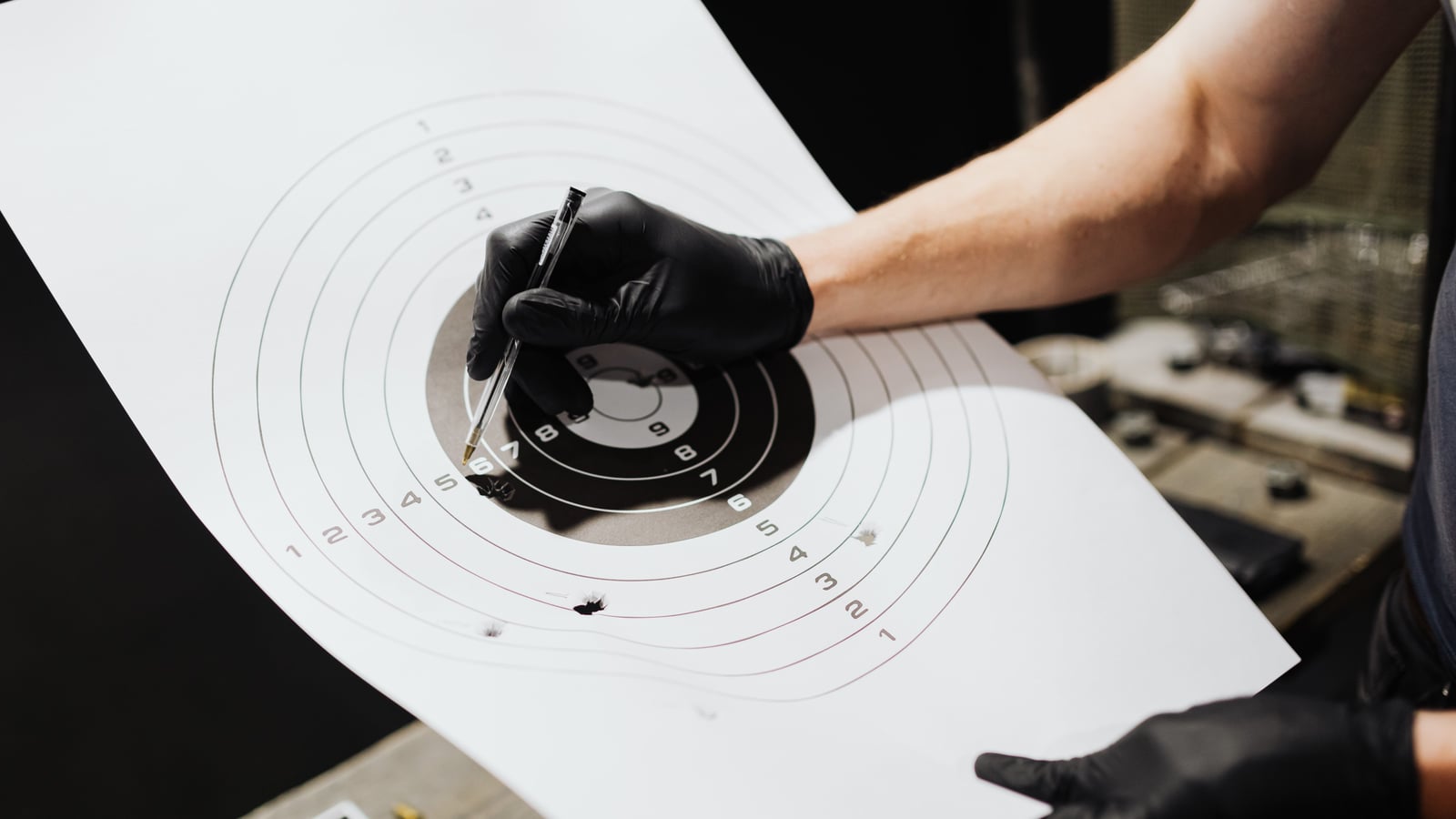
Then comes scoring, often the least visible part of the job but one of the most demanding. Targets must be read rigorously, discipline-specific scoring grids applied, and disputed cases (a shot on a line, a damaged target, doubt over a hit) settled according to precise rules rather than personal impression.
Finally, the referee also handles protests. A competitor contesting a score or decision has the right to file a formal protest, and it’s often a panel of referees, or a more experienced referee, who must rule with clear, documented reasoning. This dimension of arbitration in the strict sense — settling a dispute — is the one that demands the most composure.
There’s also a whole layer of coordination with the event organizer that stays invisible to competitors. The chief referee of a competition must make sure the number of referees present matches the number of firing lanes or active stations, split roles among fellow referees (scoring, lane supervision, managing the rotation schedule), and stay in constant contact with the range director to adjust the schedule if something unexpected happens — deteriorating weather at an outdoor event, a delay in attendance, an equipment problem at a station.
Administrative responsibility is also part of the role, even though it’s less visible than watching the firing line. Referees often need to sign match sheets, validate results that then go up to the league or federation, and sometimes write a report if a notable incident occurs during the event. This documentation rigor protects both the competitors and the referee themselves in case of a later dispute.
This administrative dimension becomes even more important at qualifying events, where the homologated result determines some competitors’ access to a higher-level competition. A poorly filled-out match sheet, a misreported score, or a final ranking published with an error can have very real consequences for a shooter’s competitive path, which explains the rigor expected at this stage of a referee’s work.
Becoming a referee isn’t something you improvise: you need to follow training organized by the FFTir, usually run at regional or departmental level through your league. The first requirement is holding an FFTir licence for a certain amount of time and knowing the rules of the discipline(s) you want to referee thoroughly.
The training includes a substantial theoretical part: detailed sporting regulations, safety procedures, scoring grids, handling protests, the referee’s role and limits with respect to the event organizer. This part usually ends with a written exam that validates your understanding of the rules.
A practical part then completes the theory: hands-on experience on an actual firing line, often shadowing an experienced referee during a real competition before you can officiate solo. This immersion shows how unforeseen situations play out under real conditions, far from the textbook cases in the training material.
Referee levels are progressive: a first level generally allows you to officiate at departmental or regional competitions, while higher levels (national, even international depending on the discipline) require several years of field experience and regular additional training. Timelines and exact content vary by discipline and regional league, so the best approach is to check directly with your FFTir league for the nearest training schedule.
Ongoing training is an integral part of the path, even once you’ve reached the first level. Sporting regulations evolve regularly — an adjustment to a scoring grid, a clarification of a safety procedure, a new equipment category — and a referee who doesn’t keep their knowledge current risks applying outdated rules. Most leagues organize annual or biennial refreshers for already-trained referees, often bundled with the general assembly or a regional course.
Mentorship also plays an important role in many leagues, beyond the official curriculum. A referee candidate is often paired with an experienced referee from the same club or area, who becomes a kind of informal mentor during the first solo-officiated competitions. This trusting relationship lets you ask questions without fear of judgment and speeds up skill development well beyond what initial training alone would allow.
The cost of training varies depending on the league and discipline — some training is covered in whole or in part by the club or league in exchange for a commitment to officiate a minimum number of events per season, while others remain the candidate’s responsibility. Again, this varies too much from league to league to give a reliable figure; it’s a question to ask directly during your first contact with your regional committee.
Renewal of referee status generally depends on a minimum number of officiated events over a given period, set by each league according to its own terms. A referee who stays inactive too long may be asked to retake part of the training, or at minimum a refresher, before returning to service at official competitions.
The qualities that make a good referee
The technical side is learned in training, but certain personal qualities really make the difference on the ground. Rigor is one of them: applying the same rule to every competitor, including those you know well or particularly like at the club, without ever making a comfort exception.
Composure matters just as much. A tense event, a competitor unhappy with a score, a safety situation that escalates within seconds: the referee must stay calm and methodical when everyone around them is under pressure. It’s often this ability not to be swept up by the emotion of the moment that separates a respected referee from one who is merely tolerated.
Teaching skill also matters, especially with young competitors or newcomers to competition who are discovering the norms of an official event. Explaining a decision rather than simply imposing it builds trust and avoids misunderstandings that escalate into conflict.
Finally, availability remains a practical factor that’s too often underestimated. Competitions take place on weekends, sometimes over several consecutive days, and a club short on trained referees quickly finds itself having to cancel or postpone events. An experienced shooter who can make themselves regularly available quickly becomes a valuable resource for their club and league.
Physical and mental stamina also deserves a mention, since it’s rarely anticipated by new referees. Staying on your feet and focused for several hours straight, sometimes outdoors in extreme heat or cold, requires a resilience you don’t really gauge until you’ve lived through a full competition day on the refereeing side rather than the shooting side. Vigilance can’t drop, even during the quiet stretches of an event.
The ability to work as a team rounds out this picture. A competition rarely involves just one referee: you need to coordinate with colleagues you sometimes barely know, accept following a chief referee’s instructions even when you have more seniority in another discipline, and clearly communicate information that needs to flow between stations. Individual ego really has no place in a refereeing team that works well.
Why this role is particularly rewarding for an experienced shooter
Many shooters who reach a certain level of practice look for a new field of engagement once pure personal progression hits a plateau. Refereeing offers exactly that fresh momentum: staying in contact with competition, but from a different angle, with collective rather than individual responsibility.
It’s also a concrete way to pass things on. An experienced club shooter who becomes a referee shares their experience of the rules, of managing competition stress, and of good safety practices with a younger or newer generation of shooters. This transmission has real value for a club’s life, often harder to achieve than simple technical coaching.
Refereeing also lets you see competition from a radically different angle. A referee observes dozens of different shooters within a single event, which gives a valuable perspective on managing nerves, shooting routines, or recurring mistakes — a perspective you never get while staying focused solely on your own performance.
Finally, this role is recognized and valued within the FFTir. Referees are essential to organizing any official competition, from departmental events up to regional championships, and a club with several trained referees among its members gains autonomy to organize its own events rather than systematically relying on outside referees.
There’s also a more personal aspect that many experienced referees mention: the role extends a sporting career in a different way when your body or schedule no longer allows the same level of commitment as a competitor. A regional champion who has scaled back her own competition volume for professional or family reasons finds, through refereeing, a way to stay fully in the circuit without having to maintain the same intensive training pace as before.
This role also feeds a sense of belonging to a wider community than just your own club circle. Refereeing brings you into contact with shooters from other clubs, other departments, sometimes disciplines completely different from the one you practice yourself. This broader network enriches your overall understanding of French competitive shooting, well beyond what a practice confined to your usual range allows.
An experienced club shooter who takes the step into refereeing often describes a fairly marked shift in perspective on their own discipline. Spending years focused solely on your own string, your own score, your own nerve management, then finding yourself observing dozens of different shooters in a single day, permanently changes the way you perceive competition.
This shift in perspective often benefits the personal practice of the shooter who became a referee in return. Observing other competitors’ recurring mistakes — poorly controlled breathing, an unstable stance, rushed time management — paradoxically helps you better identify your own flaws once you’re back on the firing line as a competitor.
Many experienced coaches actually recommend that their most committed licence holders take referee training fairly early in their path, precisely for this pedagogical reason. Understanding the rules from the inside, from the point of view of the person who has to apply them, gives a finer grasp of the rules than simply reading the rulebook.
This dual role of shooter and referee, however, requires thoughtful personal organization. You need to alternate between weekends of personal competition and weekends of refereeing, without ever mixing the two roles at the same event. An experienced club shooter who manages this balance well often finds, over time, that the two activities feed each other rather than competing.
Getting involved in your club beyond refereeing
Refereeing is often just a gateway to broader involvement in club life. Many referees end up also taking part in organizing the competitions themselves: setting up the range, managing entries, coordinating with the league, logistics on the day.
Some referees also move into instructor or coaching roles alongside their refereeing role. The two functions differ in purpose — one guides learning, the other guarantees fairness and safety in competition — but they feed off each other: an instructor who has refereed better understands what an event really requires, and a referee who has taught explains their decisions better.
Others get involved in club or league governance bodies, driven by the same desire to contribute beyond their individual practice. Refereeing gives you on-the-ground legitimacy that later helps carry projects or decisions at the association level.
Either way, the starting point remains the same: an experienced shooter who decides they have something to offer their discipline beyond their own results. It’s a choice that takes time and rigor, but one that often gives real second wind to a practice you thought you’d explored from every angle.
A typical competition day from the referee’s side
A competition day starts early for a referee, generally well before the first competitors arrive. You need to check the firing line, check the safety signage, make sure timing or display equipment is working, and touch base with the organizer on the planned schedule for the day.
Welcoming competitors is also a key moment: checking licences, verifying entry categories, answering last-minute questions about the rules. It’s often at this point that practical issues arise which, if poorly anticipated, can create tension later in the day.
During the strings, the referee alternates between actively watching the firing line and managing timing depending on the discipline concerned. Some disciplines demand constant attention over very short windows, others allow more slack to observe the whole field of shooters.
At the end of the day comes final scoring, validating the rankings, and sometimes the awards ceremony. A referee who has managed their day well generally leaves tired but with the feeling of having directly contributed to the event running smoothly for all competitors.
Common mistakes made by beginner referees
Lack of firmness at the start is probably the most common mistake. A new referee often personally knows several competitors from their own club, and the temptation to overlook a small rule infraction to avoid creating tension is real. Yet that’s exactly what you shouldn’t do: a referee’s credibility is built on consistency, not popularity.
Conversely, excessive rigidity can also cause problems, especially with newcomers to competition who don’t yet know all the customs. There’s a real difference between applying the rules firmly and wielding them punitively in the face of a good-faith mistake.
Time management is another classic pitfall. Underestimating the time needed for scoring, or poorly anticipating downtime between shooter rotations, can throw an entire event’s schedule off track, with knock-on effects for later competitors.
Finally, many beginner referees hesitate to ask a more experienced colleague for help with an ambiguous case, for fear of seeming unsure of themselves. That’s a mistake: consulting an experienced referee on a borderline case is an integral part of the job, and no one in the community sees it as a sign of weakness.
Refereeing and disciplines: different realities
The referee’s role doesn’t look the same from one discipline to another. In a 10m or 25m precision event, most of the work centers on equipment checks, compliance with firing commands, and meticulous target scoring, often in a calm and quiet setting.
In dynamic disciplines, refereeing looks more like observation in motion: following a competitor moving between several shooting stations, validating hit counts on cardboard targets or steel plates, and constantly watching over safe handling of the firearm during movement.
In clay disciplines, the referee needs an eye perfectly synchronized with the trajectory of the thrown target to judge whether the shot was successful or missed — a skill that requires specific visual experience and that you really only learn on the ground.
In regulation or historical events, the technical dimension of equipment checking often takes up more space: verifying a firearm’s compliance with the event category, ensuring compliance with rules specific to black powder or antique firearms, on top of the usual refereeing functions.
In crossbow or archery events, the scoring logic is close to paper precision, but the pace of rotations and managing the windows for retrieving bolts or arrows require particular coordination with competitors to avoid any premature access to the target zone.
This diversity of contexts explains why most leagues encourage referees to specialize first in one or two disciplines rather than trying to cover everything at once. Deep mastery of one set of rules and its nuances is worth more than shallow knowledge spread across too many disciplines at once.
The referee’s role in collective safety
Above any other consideration, safety remains the primary mission of any referee on a firing line. Before even thinking about scores and rankings, the referee must make sure no firearm is loaded outside the shooting area, that firing angles are respected at all times, and that waiting and target-retrieval areas are clearly separated from the active line of fire.
This safety vigilance takes priority over any other consideration, including sporting ones. A referee who spots a dangerous movement must stop the event immediately, even if it means penalizing a competitor mid-string or delaying an entire group of shooters. No ranking stake justifies taking the slightest risk with the safety of people present on the range.
Communicating safety instructions at the start of an event is also part of the role, especially with competitors from other clubs who aren’t familiar with the specifics of the hosting range. Clearly reminding people of restricted zones, direction of movement, and stoppage procedures prevents most risky situations before they even occur.
Finally, the referee must know how to handle a real incident without giving in to panic or downplaying the situation. Whether it’s a stoppage, a firearm left pointed in the wrong direction, or equipment falling on the firing line, the procedure must be applied calmly, firmly, and without exception, regardless of the pressure of the clock or the ongoing rankings.
How to actually get started
The first step, often overlooked, is simply to bring it up openly with your club’s board. Most presidents and sports officers welcome a spontaneous application to referee very favorably, since the chronic shortage of trained referees is a recurring difficulty for many clubs, including those that regularly organize competitions.
The club can then point you to the right contact at the regional league, which generally centralizes the referee training calendar for the whole department or region. This contact is also a chance to clarify the exact prerequisites: how long you must have held your licence, expected level of practice, disciplines covered by the next available training session.
Before signing up for training, it’s useful to attend one or more official competitions as a simple observer, deliberately positioning yourself near a working referee to watch how they operate. Many leagues actually encourage this informal step before formal enrollment, since it confirms genuine motivation before committing training time.
It’s also advisable to reread the sporting rules of your discipline of choice even before training begins, not to memorize them ahead of time, but to arrive with questions already in mind. A candidate who has already spotted the points that seem unclear or counterintuitive in the rules gets much more out of the theoretical sessions than someone discovering the text at the same time as the trainer presents it.
Once initial training is validated, repeated practice remains the most important thing. A referee who officiates just once a year progresses much more slowly than one who regularly takes on assignments, even at modest departmental-level events. Real skill development comes almost exclusively from field experience accumulated competition after competition.
What refereeing changes in a club’s life
A club with several trained referees among its members gains valuable autonomy. It can organize its own homologated internal competitions without systematically depending on the availability of outside referees, which considerably simplifies the annual sporting calendar and reduces the risk of last-minute cancellation for lack of adequate supervision.
This autonomy directly benefits the club’s competitors, who get a richer internal competition schedule to prepare for regional or national deadlines. A club that regularly organizes its own homologated events gives its licence holders far more opportunities to shoot under competitive conditions than one that just participates in events organized elsewhere.
The presence of recognized referees also enhances the club’s image with the regional league. A club identified as reliable and well-structured, capable of supplying competent referees for major regional events, is often offered priority in organizing higher-stakes competitions, which in turn strengthens its visibility and appeal to new licence holders.
Finally, the culture of rigor carried by a club’s referees often spills over into the whole association’s life. A club where several active members have a fine understanding of the rules and the logic of collective safety naturally develops a more rigorous everyday culture, well beyond just official competition days.
Balancing refereeing with work and family life
Refereeing requires a real time commitment that’s best planned for honestly before getting started. Competitions are often concentrated on weekends, sometimes several consecutive Saturdays or Sundays during regional qualifying phases, which can clash with other personal or family commitments.
Most active referees find a sustainable pace by setting their own level of commitment with their club and league, rather than letting requests overwhelm them. Accepting every other assignment rather than systematically saying yes remains a perfectly respected option in the community, as long as the commitment made is honored.
Some referees deliberately choose to concentrate their activity on a season or period of the year that better matches their professional availability, especially those whose work rhythm follows a school or seasonal calendar. This flexibility is generally well received by leagues, which prefer a reliable referee with reduced but clearly announced availability over one who’s theoretically available year-round but unreliable in practice.
You also need to anticipate travel, sometimes significant depending on the size of the department or region covered by the league. A regional event can take place more than an hour’s drive from the referee’s home club, which adds a travel-time constraint to factor into the overall organization of your refereeing weekend.
The relationship between the referee and competitors
A good referee builds a particular relationship with the competitors they oversee, made up of both professional distance and mutual respect. It’s neither about becoming so distant as to seem cold, nor about seeking approval to the point of losing credibility on your decisions.
This relationship is built above all through the consistency of decisions over time. A competitor who sees a referee consistently apply the same rules, event after event, develops lasting trust even when a specific decision doesn’t go their way at that moment. Conversely, a referee perceived as inconsistent or easily influenced quickly loses all authority, even if they master the rules perfectly on paper.
Active listening also matters enormously in this relationship. A competitor voicing a complaint or a misunderstanding deserves genuine listening before any response, even when the referee already knows, from the first words, that the original decision won’t change. This listening isn’t a mere formality: it often helps spot legitimate confusion about the rules rather than simple momentary dissatisfaction.
Over time, many experienced referees develop a kind of recognized reputation within their league or discipline, built on this consistency and this listening. This capital of trust greatly eases the handling of tense situations, since competitors who already know a referee’s rigor accept their decisions more easily, even unfavorable ones, than they would from an unfamiliar face.
This trusting relationship is also built outside of tense moments. A referee who takes a few minutes before or after an event to simply chat with competitors, unrelated to any specific ruling, humanizes the role and reminds everyone that they remain, above all, someone who loves the same discipline as those they’re overseeing that day.
FAQ
Q: Do you have to be a very good shooter to become a referee? A: No, that’s not a selection criterion. What matters is your knowledge of the rules, your rigor, and your availability. A shooter of average level who’s serious and available makes a better referee than an excellent shooter who’s barely committed.
Q: Can you referee in several different disciplines? A: Yes, but each discipline has its own rules and generally its own training or additional module. Many referees specialize first in one discipline before gradually expanding to others.
Q: Is refereeing paid? A: It varies by club, league, and type of event: some competitions provide compensation or reimbursement for travel expenses, others rely entirely on volunteer work. Ask your league directly to find out what applies in your region.
Q: How long does the initial training take? A: Duration varies by discipline and regional league, from a condensed weekend course to a path spread over several sessions. Best to contact your FFTir league for the exact format offered near you, keeping in mind that real skill development mostly comes from repeated practice on the ground after this initial training.
Q: Can a referee also compete as a shooter? A: Yes, nothing stops you from continuing to compete. You simply must never referee an event you’re taking part in yourself as a competitor, for obvious reasons of impartiality.
Q: What should you do if you want to get into refereeing? A: The first step is to talk to your club and your regional FFTir league, who know the training calendar and can point you toward the discipline and level suited to your licence-holder profile.