
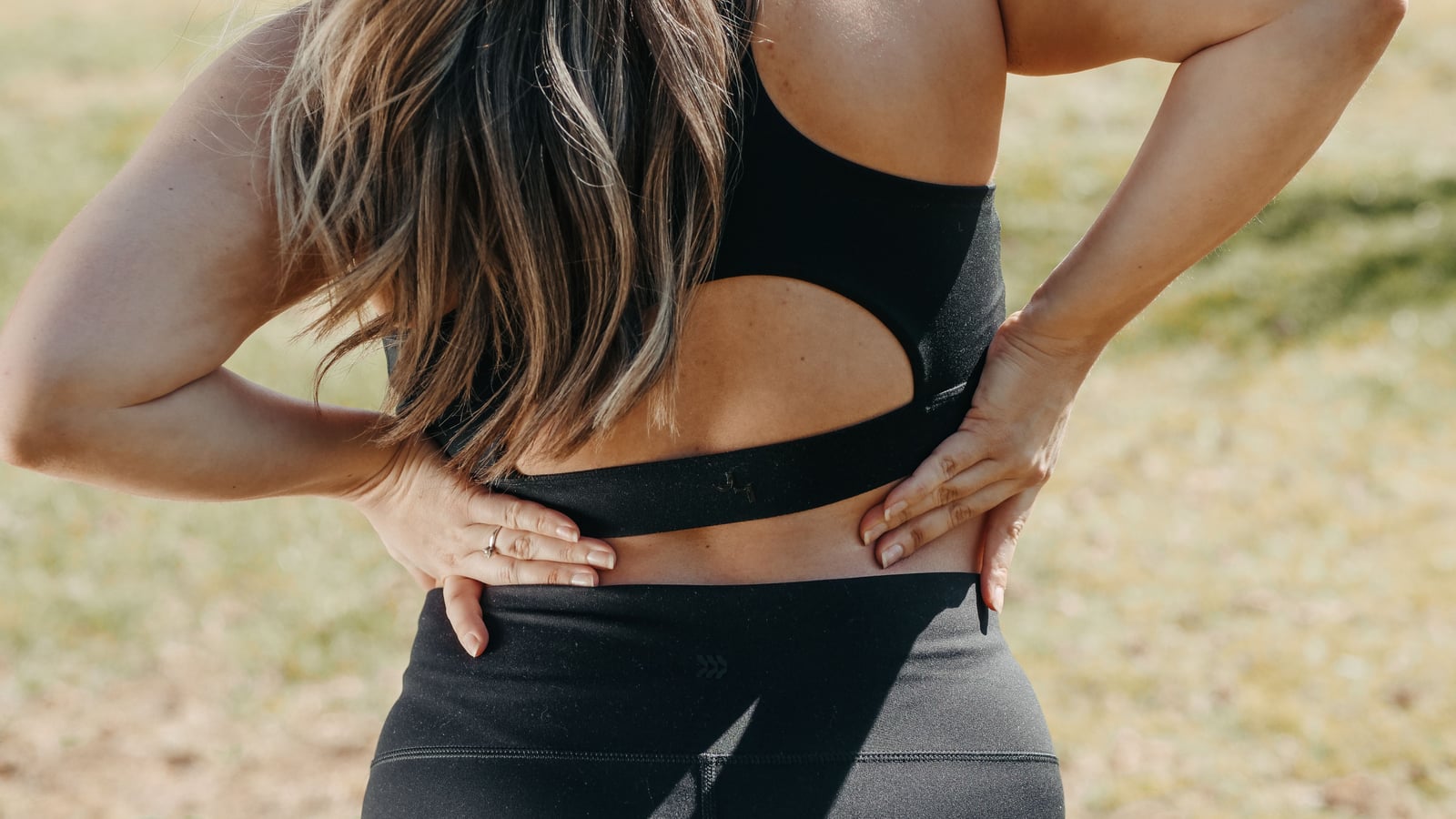
Why your back takes more of a beating than your arms
When you think about shooting sport injuries, shoulders or wrists usually come to mind first. Yet for a regular shooter who trains session after session over years, it’s often the back that speaks up first: lower back pain after a long standing session, chronic neck tension, diffuse pain between the shoulder blades by the end of the day.
Shooting sports demand prolonged static postures, and that’s exactly what makes them treacherous for the spine. Unlike a dynamic sport where the body keeps moving and spreads the load around, shooting freezes a posture for long seconds — sometimes several minutes in the prone or kneeling position — repeated dozens of times per session.
This stillness isn’t neutral for the deep back musculature. Stabilizing muscles (spinal erectors, transverse abdominis, multifidus) work in near-continuous isometric contraction, which fatigues differently than dynamic effort and leaves less recovery time between bouts of strain.
Add to that the weight of the gear: a position rifle often weighs several kilos, held in asymmetric support against the shoulder and braced by an arm that transmits part of that load to the spine through the shoulder girdle. Over a 60-shot standing series, postural fatigue accumulates well before any fatigue is felt in the arms.
The problem is compounded by the fact that most shooters don’t think of their back as a “shooting tool” in its own right. You maintain your trigger, you clean your barrel, but you neglect the upkeep of the structure that supports everything else: the spine and the core.
This neglect isn’t unique to shooting sports, but it takes a particular shape here: in many sports, pain shows up quickly and prompts a quick correction of the faulty movement. In shooting, postural strain is often moderate and diffuse, which makes it easier to ignore in the moment, even as it quietly builds up session after session until it becomes an entrenched chronic discomfort.
Another aggravating factor lies in the very nature of progress in shooting sports: the more precise a shooter becomes, the more they seek to repeat the exact same motion hundreds of times per session to lock in consistency. This pursuit of repeatability, essential to performance, is precisely what turns a fixable posture into a source of cumulative strain, since the same imbalance is reproduced identically on every shot instead of being corrected naturally by movement variability.
This article covers the risky postures for each discipline, the targeted stretching and strengthening that make a difference over time, and the concrete equipment adjustments that reduce strain without sacrificing performance.
Three-position rifle: the most demanding case
Three-position rifle (standing, kneeling, prone) is probably the toughest discipline on the back, precisely because it imposes three different postural demands within the same session, each with its own risk profile.
In the standing position, the shooter often adopts a slight compensatory lumbar arch to balance the weight of the rifle held out in the forward arm, counterbalanced by leaning the torso back. This prolonged hyperlordosis, repeated session after session, heavily loads the lower lumbar facet joints.
The kneeling position compresses differently: resting on the heel folded under the pelvis changes pelvic tilt and can amplify asymmetric trunk rotation, especially if the shooter compensates for a lack of ankle or hip mobility by twisting the back rather than adjusting their base.
The prone position, often perceived as the most restful, actually hides a prolonged cervical extension: the head is lifted and turned to align the eye with the sight line for long minutes, loading the upper neck and potentially radiating into the trapezius.
An experienced club shooter who practices all three positions in a single multi-hour session thus accumulates three different types of strain with no real muscular recovery time between position changes. It’s this accumulation, more than any single position taken in isolation, that explains the frequency of chronic pain among regular practitioners of this discipline.
The jacket and sling used in three-position shooting add another layer: this equipment deliberately stiffens the torso to stabilize aim, which shifts part of the core-stabilizing work normally handled by deep muscles onto the passive constraint of the gear. The body gets used to this external rigidity and can lose active tone if there’s no strengthening work done outside the range.
Transitioning from one position to another also deserves particular attention, often neglected in favor of focusing solely on the shooting work within each isolated position. Getting up from prone, or moving from kneeling to standing with full gear on, requires a rapid flexion then extension of the back under load — a movement few shooters consciously train even though it repeats several times per training session.
An experienced club shooter generally learns, with experience, to break this position change down into several steps rather than one abrupt movement: first setting the rifle down safely, unrolling the spine progressively rather than standing up in one block, and taking time to readjust the gear before moving on. This breakdown, which seems to slow the transition, actually reduces the instantaneous load placed on the lower back compared to an abrupt rise done in haste.
Pistol and prolonged static positions
Pistol shooting seems at first glance less demanding on the back, since the shooter stays standing and relatively mobile between shots. Yet the precision events that require holding a stable position through long strings create their own form of postural fatigue.
The classic pistol shooter’s posture — torso slightly turned relative to the target, arm extended on one side — creates a load asymmetry that isn’t trivial when repeated over hundreds of shots per session. The side of the body holding the gun works in static tension while the other remains largely passive.
This chronic asymmetry, if never offset by symmetric strengthening work outside the range, can eventually favor a muscular imbalance between the two lateral chains of the back. It isn’t inevitable, but it’s a recognized risk factor among regular practitioners who neglect the compensatory work.
Rapid-fire events add another dimension: the repeated, fast changes in posture between strings tax the back more dynamically, but with less conscious postural control than in slow static positions. The body has less time to adjust its alignment before each movement.
A point often overlooked concerns prolonged standing itself, independent of the shooting motion: standing still for an hour of competition fatigues the posterior chain (calves, hamstrings, lower back) well before the shooter feels any discomfort directly linked to the shooting motion. This underlying fatigue progressively degrades the quality of shooting posture by the end of the session.
Clay targets and dynamic disciplines: repeated torsion
Clay-target disciplines (trap, skeet, sporting clays) impose a completely different type of strain: rapid, repeated rotation of the torso to track the target’s trajectory, combined with mounting the shotgun, which adds an asymmetric load at the exact moment of the twist.
This combination of rotation plus load is identified by sports physical trainers as one of the most stressful for the intervertebral discs, particularly at the lower lumbar level and the thoracolumbar junction. A rotational movement under load, repeated dozens of times per session, is mechanically more demanding than an equivalent static posture.
Dynamic shooting such as IPSC or Steel Challenge, where the shooter moves between multiple stations engaging cardboard targets or steel plates, adds yet another dimension: rapid transitions between crouched, semi-crouched, and standing positions, often performed under time pressure, load the back explosively rather than progressively.
This explosiveness is precisely what makes dynamic shooting more prone to acute lower back injury than a static precision discipline: a poorly engaged rotation or flexion under the pressure of the timer can trigger an isolated bad movement, whereas chronic fatigue tends to dominate in precision disciplines instead.
An experienced dynamic-shooting coach generally insists on dynamic warm-up before the session, precisely because these disciplines load the back in fast movement from the very first drills, without the gradual load buildup that a static precision discipline offers.
The weight of gear carried over time
Independent of the shooting posture itself, the weight carried during a session or competition contributes directly to back fatigue. A position rifle with its accessories, a weighted vest, a gear bag carried on one shoulder on the way to the firing point: every element adds up.
Asymmetric equipment transport — a bag on one shoulder, or a case held on one side only — is a largely underestimated aggravating factor. It isn’t the shooting itself that causes the discomfort in this case, but the repeated back-and-forth between the parking lot, the range, and the car, often over several dozen meters and several times per session.
A properly adjusted two-strap backpack, rather than a shoulder bag, distributes the load symmetrically across both shoulders and reduces compensatory trunk twisting. This simple change, often overlooked because it seems disconnected from the act of shooting, has a real impact on cumulative fatigue by the end of a competition day.
The weight of the firearm itself is also worth questioning depending on the shooter’s profile. A heavier rifle stabilizes aim better but imposes a larger load over the course of a session; a shooter who already suffers from chronic back pain may benefit from discussing with a gunsmith or coach an adjustment or model that lightens the strain without sacrificing the stability needed for precision.
Targeted stretching before and after the session
Warm-up before a shooting session is too often reduced to a few arm movements, even though the back, hips, and neck benefit directly from specific preparation before holding a prolonged static position.
A dynamic warm-up of the pelvis and lower back (pelvic rotations, gentle lateral bends, hip mobilization while standing) prepares the lumbosacral junction to absorb the asymmetric postures of shooting without excessive compensation from the very first shots of the session.
For the neck, particularly loaded in the prone rifle position, slow head flexion-extension and rotation movements before the session reduce the stiffness that would otherwise set in within the first minutes in position.
After the session, passive stretching takes over. Stretching the psoas-iliac group, often shortened by prolonged kneeling and prone positions, helps restore hip range of motion and reduces the resulting lumbar compensation for the next session.
Stretching the hamstrings and lower back while seated or lying down, held gently without forcing, usefully rounds out an end-of-session routine. The goal isn’t flexibility performance but the gradual restoration of normal ranges of motion after a prolonged, frozen posture.
An experienced coach generally recommends dedicating these few minutes of stretching right after putting the gear away, while the body is still warm, rather than postponing them to the evening, when stiffness has already set in.
Building deep core strength
Beyond occasional stretching, it’s regular deep core strengthening that best protects the back over years of practice. A stable trunk reduces the amount of lumbar compensation needed to maintain a prolonged shooting posture.
Classic core work (front plank, side plank) remains a solid foundation, provided it’s performed with good pelvic alignment rather than an arched or rounded back, which would reverse the intended effect. A few short but well-executed sets beat one long hold in poor form.
Strengthening the shoulder blade stabilizing muscles (rhomboids, mid and lower trapezius) deserves particular attention for shooters, since these are the muscles that keep the shoulder stable during a prolonged mount, reducing the compensation transmitted to the upper back.
Working the obliques and transverse abdominis rounds out this strengthening, particularly for disciplines that require torso rotation such as clay-target shooting. A trunk capable of stabilizing rotation limits how much of the movement is offloaded onto the intervertebral discs rather than the musculature.
A regional rifle champion often mentions integrating two to three short strengthening sessions per week, outside of shooting sessions themselves, as the most cost-effective addition for pain prevention over a full season. It isn’t spectacular work, but foundational work that pays off over time.
Breathing usefully rounds out this core work, since it directly conditions trunk stability at the exact moment of the shot. High, shallow breathing, confined to the upper chest, deprives the shooter of the diaphragmatic support that naturally stabilizes the lumbar spine during static effort.
The classic breath-control technique before the release, which involves holding the breath at the end of exhalation for a few seconds, relies on properly engaged diaphragmatic support. A shooter who maintains high chest breathing during this phase loses part of the trunk’s natural stability, forcing the superficial back muscles to compensate more to maintain the stillness being sought.
Training diaphragmatic breathing outside of shooting sessions, through simple slow, deep breathing exercises while lying down, helps automate this support reflex before applying it in shooting position. Active core bracing during the shot itself — a slight, conscious contraction of the transverse abdominis held through aiming and release — rounds out this approach without ever freezing the movement in maximal contraction.
Equipment adjustments that reduce strain
Beyond the body itself, an important part of prevention comes through simple adjustments to equipment and the shooting position, often accessible without any major investment.
The height and tilt of the shooting stand or table, for disciplines that use one, should allow the back to stay in a neutral position rather than leaning forward to reach the gear. A poorly adjusted setup forces repeated back flexion with every handling task between strings.
For position rifle, stock length and buttplate adjustment directly influence torso alignment relative to the rifle. A stock that’s too short or too long forces a postural compensation that repeats on every shot of the session; this varies a lot depending on the shooter’s build and is worth checking with a coach or gunsmith rather than adjusting at random.
The mat or pad used in the prone position also deserves attention: a support that’s too thin or poorly positioned under the pelvis and hips increases the lumbar twist needed to maintain sight alignment. A mat suited to the shooter’s build reduces this strain from the very first minutes in position.
For standing shooting, suitable shoes with good ankle and foot support promote better overall postural alignment, starting from the base rather than compensating higher up the chain. This often-overlooked detail has a direct effect on pelvic stability and therefore on lumbar load.
The sling used in rifle shooting to stabilize the forward arm also deserves careful adjustment rather than arbitrary tightening. A sling that’s too short forces excessive forward lean of the torso to compensate for the pull, while one poorly positioned on the arm can create a compensatory shoulder rotation that directly affects the upper back. A gradual adjustment, tested over several sessions rather than set once and for all, helps find the tension that stabilizes without forcing compensation elsewhere in the chain.
For pistol shooters, the height of the loading and ammunition storage stand between strings also influences how often the back bends during a session. A setup organized to limit repeated bending toward the ground — by raising ammo boxes or using a belt-height stand — removes a source of cumulative strain that has nothing to do with the shooting itself but adds to the overall fatigue of the session.
Finally, for equipment transport, favoring a rolling bag or a structured rigid backpack over a hard case carried at arm’s length noticeably reduces the cumulative asymmetric strain on the way in and out, particularly during competition travel that often involves carrying gear over long distances between the parking lot and the range.
Ergonomics of the shooting position at the club and at home
The shooting range itself, independent of individual posture, has characteristics that influence the strain placed on the back. A poorly lit firing point often forces you to lean forward to better see the target or sights — a postural compensation that repeats with every shot without the shooter always being aware of it.
The height of the firing point relative to the target and the available setback distance also influence the viewing angle and therefore the natural lean of the torso. A club with several types of stations benefits from letting members choose the one that best suits their build rather than imposing a single station on every body type.
For shooters who also practice mental training or video analysis of their position at home, the ergonomics of the observation setup deserve the same attention as the firing point. Watching a video recording hunched over a small phone screen, shoulders rounded and neck bent, adds a neck and back strain that piles onto the strain from shooting itself, even though the whole point of this practice is to improve technique, not create additional discomfort.
A well-designed gear storage area, at a reasonable height and not requiring repeated back bending to grab a rifle or ammo box, also reduces a source of strain that’s often invisible because it doesn’t happen during the shooting itself, but in the surrounding movements. A club that pays attention to this detail for its regular members directly helps reduce cumulative fatigue over a full season.
This environmental question actually extends beyond the club, since many regular shooters also practice dry-fire training at home, without ammunition, to work on aiming and trigger control outside of range hours. This practice is excellent for technique, but it faithfully reproduces the risky postures mentioned earlier, often in a home environment far less considered than a club firing point.
A living room or family room generally offers neither the flat, stable floor of a range, nor a suitable mat for the prone position, nor enough setback for a properly aligned standing posture. The shooter then compensates without realizing it, often twisting the torso to avoid a piece of furniture or keeping a cramped posture for lack of space, which can reinforce poor postural patterns faster than the aiming technique itself progresses.
The solution isn’t to abandon dry-fire training, which remains valuable for technical progress, but to give it the same postural attention as at the club: clear enough space, check torso alignment relative to a fixed target, and limit the duration of prolonged static sessions as you would with live ammunition. A shooter who logs the duration of their dry-fire sessions in their training notebook can more easily spot whether a discomfort coincides with intensive home practice rather than range sessions.
Warning signs not to ignore
Certain signs deserve immediate attention rather than a simple adjustment to the stretching routine. Pain that radiates down a leg, persistent numbness or tingling in a limb, or pain that doesn’t ease with rest between sessions fall outside the scope of normal muscular fatigue.
A strictly localized pain that eases with rest and responds well to stretching generally falls under the classic postural fatigue discussed in this article. Pain that progressively worsens session after session, or that comes with neurological signs, warrants a medical consultation rather than prolonged self-management.
A regular shooter who ignores these signs out of habit or fear of having to cut back on practice takes on a risk disproportionate to the benefit of a few extra sessions. Timely rest and a health professional’s opinion always cost less than an established chronic injury.
A physiotherapist or osteopath used to working with athletes can also identify discipline-specific postural imbalances, often invisible to the shooter themselves since they’ve built up gradually over several seasons of practice.
Recovery, sleep, and overall training load
Preventing back pain isn’t only decided during the shooting session itself. The quality of recovery between two sessions directly influences the body’s ability to absorb repeated postural strain without accumulating chronic fatigue.
A back that hasn’t had time to recover from an intensive three-position session enters the next one with stabilizing muscles already partly fatigued. This residual fatigue often shows up as more pronounced postural compensation from the very first shots, speeding up the onset of discomfort compared to a session tackled well-rested.
Sleep plays a direct role here: it’s during deep recovery phases that muscle tissue and ligament structures regenerate after prolonged strain. A shooter who runs through a full competition weekend with little rest between events exposes themselves to a buildup of postural fatigue that good technique alone can’t compensate for.
Overall training load also deserves consideration as a whole, not discipline by discipline. A shooter who practices rifle during the week and clay targets on the weekend accumulates two different strain profiles on the same spine, with neither one “resting” the other. Spacing out these sessions or alternating with active recovery days (walking, light stretching) helps limit this invisible buildup.
An experienced club shooter who plans their season calendar with built-in recovery periods, the same way they plan their reloading cycles or equipment checks, noticeably reduces the risk of overuse injury compared to someone who runs from one competition to the next without ever easing off.
Build, age, and individual adaptation
No prevention routine applies identically to every shooter, and both age and individual build significantly change how the back responds to the demands of shooting sports.
A shooter who takes up the discipline after forty or fifty generally no longer has the same joint flexibility or recovery capacity as a younger practitioner. That doesn’t mean they have to give up the most demanding disciplines like three-position rifle, but that progressing training volume and paying attention to warm-up deserve to be more cautious and gradual.
Individual build also plays a real role in how each position distributes load. A difference in torso length, pre-existing hip stiffness, or a past back injury change the optimal shooting posture compared to a standard build. This is precisely why generic settings found in a manual never replace individual fitting with a coach who observes the shooter in real conditions.
A shooter with a history of herniated disc or mild scoliosis, for example, may need specific adaptations to position or equipment that don’t concern most practitioners. In this kind of situation, coordination between the sports coach and a health professional experienced with athletes helps build an adapted practice rather than following a generic routine that ignores the specific constraint.
This also works the other way: a young shooter with no particular history doesn’t necessarily need the same precautions as an older practitioner, and excessive, poorly calibrated caution can needlessly slow technical progress. The goal is to adjust the prevention routine to the shooter’s actual profile, not to apply the same caution uniformly to everyone.
Shooting jackets, slings, and support gear: benefits and limits
Support equipment used in position rifle, notably the rigid shooting jacket and the sling, deserve a closer look, since their role in back ergonomics is double-edged and often misunderstood by shooters new to the discipline.
This equipment deliberately stiffens the torso to reduce micro-oscillations and stabilize the sight line, which objectively improves precision. That same stiffening effect, however, shifts part of the stabilizing work normally handled by the deep back muscles onto a passive, external constraint, which can have two opposite consequences depending on how it’s used.
Used alongside good core work, the jacket complements an already active musculature rather than replacing it, letting the shooter benefit from mechanical stability without losing their own tone. Used alone, with no compensatory strengthening outside the range, it can instead accustom the body to a postural passivity that backfires as soon as the shooter removes the gear, whether for another discipline or simply in daily life.
The tightness setting of this equipment also directly influences the strain the shooter perceives. Excessive tightening, often sought out of excessive caution to maximize stability, can hinder the diaphragmatic breathing discussed earlier and force high chest breathing that actually degrades the trunk’s natural support. A gradual adjustment, made with a coach who watches both sight stability and the shooter’s breathing ease, generally gives better results than a default maximum tightening.
It’s also worth regularly removing this support gear during warm-up or low-volume technical work, in order to directly engage the deep musculature without help from the external constraint. This alternation, practiced consciously rather than out of mere habit, helps maintain an active trunk capable of stabilizing posture even outside the specific context of the jacket.
Building a lasting prevention routine
Preventing back pain in the regular shooter doesn’t rest on one miracle move, but on the coherent stacking of several modest habits: warm-up before the session, regular core work outside the range, periodically checked equipment adjustments, and attention paid to early warning signs.
A good habit is to log in your training notebook not only shooting results, but also physical sensations after each session: localized fatigue, unusual stiffness, persistent discomfort. This tracking makes it possible to spot a trend before it becomes an established chronic pain, by cross-referencing the data with shooting volume and the positions worked.
This methodical approach, comparable to the one a shooter already applies to their equipment settings or ammunition data, turns prevention into an active process rather than a delayed reaction to pain. A back maintained with the same rigor as a well-tuned rifle remains an ally throughout an entire shooting career, rather than a burden that imposes itself with age.
FAQ
Q: Is back pain inevitable if you shoot regularly? A: No, it isn’t a foregone conclusion. The vast majority of shooting-related pain comes from repeated postures without compensation or strengthening, not from the practice itself. A shooter who keeps up their core work and adjusts their equipment considerably reduces this risk.
Q: Which discipline is riskiest for the back? A: Three-position rifle stacks up the most different strains within a single session, while clay-target shooting requires fast rotations under load. Each discipline has its own risk profile, but none is harmless without proper preparation.
Q: Should you stop shooting if you have back pain? A: Mild muscular discomfort that eases with rest doesn’t necessarily warrant a full stop, but pain that radiates, persists, or worsens should be assessed by a health professional before resuming. Continuing to shoot while ignoring a clear signal generally makes things worse.
Q: How much time should you dedicate to strengthening for it to make a difference? A: Two to three short sessions of core and postural strengthening per week, outside of shooting sessions, are generally enough to notice a difference over several months. Consistency matters more than the length of each session.
Q: Are pre-session stretches really useful, or only before competition? A: They’re useful for every session, not just competition. It’s precisely the repetition through regular training that builds long-term protection — competition is just one session among many for the body.
Q: Can simply switching your carry bag really make a difference for your back? A: Yes, insofar as repeated asymmetric carrying over several years contributes to a cumulative load that’s often underestimated. It’s not a dramatic change, but one factor among others that adds up positively with the other adjustments covered in this article.