
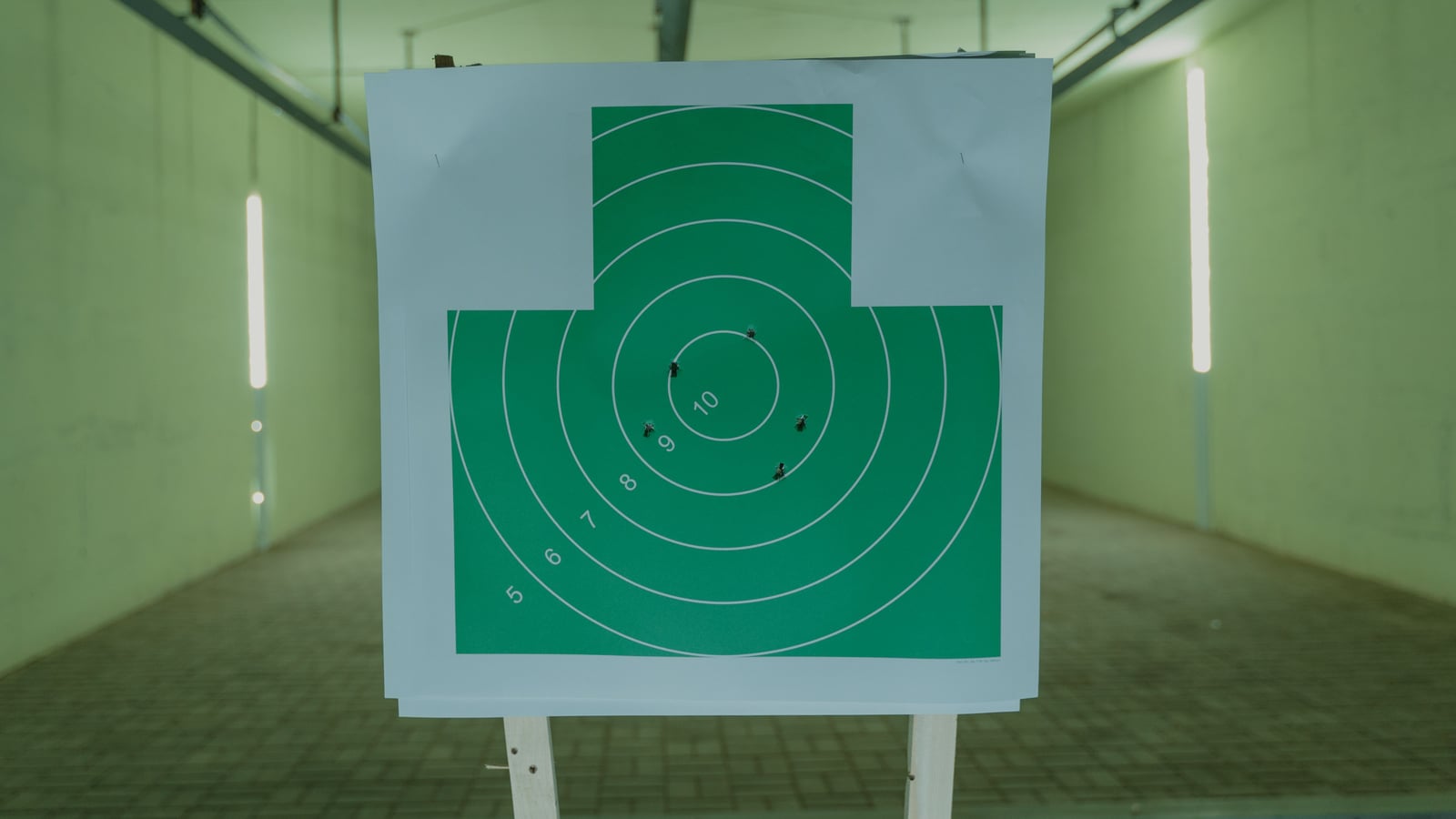
The Raw Score Barely Tells You Anything
You come home from a competition with one number stuck in your head: your total. It’s the only number the ranking remembers, but it’s probably the worst indicator for understanding what actually happened during your string of series. Two shooters can finish with the exact same score after living through two radically different competitions.
The first shot consistently from start to finish, no disasters, with a clear improvement on one or two specific series. The second made up for a total collapse on one series with a stroke of luck on another. On paper, they’re tied. In reality, one knows exactly what to work on before the next event, while the other is flying blind.
That’s where statistical analysis comes in. Not to turn you into a data scientist obsessed with spreadsheets, but to stop judging your performance on a single number that flattens every nuance. A digital shooting log exists for exactly this: capturing fine-grained data while you shoot, then cross-referencing it afterward to see what the final score never shows.
This article breaks down the indicators that actually matter beyond the total, how to read them series by series, and how to use a digital history to turn a pile of competitions into a real, coherent, measurable progress trajectory. The goal isn’t to add needless complexity to your prep, but to replace vague impressions with concrete benchmarks you can calmly build your next training sessions on.
Consistency, the Most Underrated Indicator
A seasoned club shooter often tells the younger ones: “I’d rather shoot a very consistent 570 than a 580 with one bad hole.” Consistency measures the gap between your best and worst series in the same competition. The smaller that gap, the more stable and repeatable your technique — which is exactly what competition rewards over the long haul.
Concretely, consistency is calculated by comparing each series’ score to the day’s average. If you shoot five series at 96, 94, 97, 95, 96, your spread is minimal: you’re a stable shooter. If you shoot 98, 85, 96, 99, 92, your total might be identical or even higher, but that huge spread signals a one-off problem you need to identify before it becomes recurring.
Standard deviation is the best statistical tool here, even without doing fancy math. A digital shooting log that records every series can calculate this deviation automatically and display it as a curve. You immediately see whether your points cluster tightly around the average or scatter erratically.
Consistency should also be read over time, not just within a single competition. A shooter whose standard deviation shrinks month after month is genuinely progressing, even if their average score temporarily plateaus. That’s often the early signal of a score jump that arrives a few weeks later, once the stability of the technique has settled in.
Identifying Your Strengths and Weaknesses Series by Series
Not every series in a competition carries the same meaning. The first series often reveals how you handle stress and get into the zone, the middle series show your concentration endurance, and the last series exposes how you manage fatigue and the pressure of the approaching result.
By analyzing your scores series by series across several competitions, recurring patterns emerge. Some shooters systematically lose points on their first series — a sign of insufficient warm-up or a start-up routine that needs revisiting. Others fall apart on the second-to-last series, which points more toward a mental fatigue-management issue than a technical one.
This series-by-series reading completely changes how you structure training. A shooter who identifies a recurring weakness on their last series will deliberately train at the end of a session under similar fatigue conditions, rather than always practicing fresh. That’s a precise adjustment, made possible only because the data was isolated series by series instead of drowned in an overall total.
It’s also worth cross-referencing strengths and weaknesses by target zone, when the discipline allows it. A shooter who consistently loses points in the lower left of the target has a different hold or trigger-release issue than one who loses points randomly across the whole target. The first case points to targeted technical work, the second to concentration work.
Score is only one output of your competition. The time it takes you to shoot each series, when the discipline allows you to record it, is just as valuable a data point. A shooter who progressively speeds up on their last series to “get it over with” usually loses precision exactly when they should be slowing down instead.
Recording the duration of each series, even roughly, lets you spot this pattern. If your scores drop at the same time your shooting time drops on the last series of a competition, you’ve identified a rushing pattern linked to fatigue or impatience to finish. That’s a clear mental work axis: consciously slow down toward the end, even if it feels like “over-controlling.”
Conversely, some shooters slow down too much on decisive series, which can feed doubt and over-analysis of every shot. A shooting time that stretches out significantly toward the end of a competition, without a corresponding score gain, often points to a mental-management issue rather than a technical one.
A digital shooting log that lets you note the start and end time of each series turns this qualitative data (“I felt rushed”) into quantitative data comparable from one competition to the next. This kind of cross-referencing is what distinguishes a hunch from a trend confirmed over several months.
Many shooters carefully analyze their training sessions but treat every competition as an isolated event, judged only on its final ranking. That’s a mistake: competition is precisely the richest context for information, because that’s where pressure, stakes, and an unusual environment reveal things invisible in training.
Comparing your competition stats to your training stats over the same period reveals a very telling performance gap. If you shoot 15 points lower on average in competition than in training at the same distances with the same gear, that’s not a technical problem — it’s a pressure- and context-management problem, which is worked on differently.
Once identified in black and white, this gap becomes a training goal in its own right. A regional champion once said it took her several seasons to understand that her training-competition gap didn’t shrink by shooting more, but by more often incorporating artificial pressure elements into her sessions: a stopwatch, spectators, simulated stakes.
Without a structured history, this gap remains a vague impression (“I’m just worse in competition”). With a digital shooting log that centralizes both training sessions and competition results, the gap becomes a precise, measurable number, tracked over time to check whether it’s actually shrinking.
Tracking Your Progress Over Time Rather Than Competition by Competition
A single competition, even a bad one, rarely means much in isolation. The natural variance of competitive shooting means a shooter who’s genuinely improving can perfectly well have a one-off bad outing, just as a plateaued shooter can pull off an excellent result through a lucky set of circumstances.
That’s precisely why the trend observed over several months matters far more than the raw result of a single competition day. A moving average over your last five or ten competitions smooths out these blips and shows the real direction of your progress — far more reliable than reading competition by competition, which is too sensitive to statistical noise.
A digital shooting log that automatically archives every result lets you build this longitudinal view without any re-entry effort. You see your progress curve displayed directly, with competitions positioned chronologically, which is far more telling than a list of scores in a paper notebook you’d have to reopen one by one to compare.
This long-term view also helps put dips in form into context. A plateau or a slight dip after rapid progress is often normal and part of the learning process, as long as you confirm it over several months rather than panicking after a single bad outing.
Score alone, without context, hides external factors that directly influence performance. Weather conditions for outdoor disciplines, the type of firing point, the time of the competition, the ammunition used: all these elements deserve to be noted alongside the score so they can be cross-referenced later.
A shooter who systematically records wind conditions during their 300-meter competitions can, after several seasons, identify their personal wind thresholds where their precision starts dropping significantly. That’s information that’s useless in isolation for a single competition, but becomes very useful once aggregated over a sufficient history.
Likewise, noting the ammunition lot used lets you spot whether a drop in consistency coincides with a lot change rather than a hold or mental issue. That’s a cross-reference human memory alone can’t reliably make by the tenth competition of the season, but a structured digital log retrieves instantly.
This level of detail is only worthwhile if entry stays quick and non-intrusive. The goal isn’t to fill out a ten-field form after every series, or you’ll abandon the tool after three competitions. A well-designed digital shooting log offers optional fields that are quick to check, not an extra administrative burden.
The Trap of Comparing Yourself to Other Shooters
Ranking gives you a relative position, but it’s polluted by the level of the field present on that particular day. Finishing third in a competition with few seasoned shooters isn’t worth the same as finishing tenth in a strong regional competition. Focusing solely on your ranking pushes you to misread your own progress.
The most reliable indicator remains comparing yourself to yourself over time, not to the other shooters present on a given day. An experienced coach often reminds their most ranking-obsessed students: the only opponent that truly matters over the course of a season is your own progress curve from the previous month.
That doesn’t mean ranking has no value, just that it should be read alongside personal stats, never in their place. A disappointing ranking with markedly improved consistency is a much better signal than a good ranking achieved on an isolated, non-reproducible peak in form.
This distinction matters especially for shooters just starting out in competition, who can get discouraged by a modest ranking even though their personal stats show real progress. Anchoring to your own indicators, rather than the day’s rank, helps you get through competitions calmly where the field’s level was simply higher than usual.
Using a Digital Shooting Log to Centralize Analysis
Everything above assumes one thing: having a data history complete and structured enough to be cross-referenced. A paper log archives scores, but makes it nearly impossible to calculate a standard deviation over twelve months or overlay several progress curves without tedious re-entry work.
A digital shooting log automates this centralization. Every series you enter becomes usable data, comparable to previous series, aggregatable by discipline, distance, or period. What you lose in the charm of a hand-annotated paper notebook, you gain many times over in real long-term analytical capability.
The challenge isn’t the sophistication of the tool but the consistency of the entry. An irregularly filled-in digital log produces patchy, unreliable statistics, exactly like a paper log abandoned after two months. The value of the analysis depends directly on the discipline with which data is entered, session after session, competition after competition.
Once this entry consistency is established, the digital tool enables views no paper log can simply offer: consistency trends over the year, direct comparison between two training periods, or automatic identification of the weakest series over the last ten competitions. This shift from raw data to analyzed data is what turns a simple logbook into a real progress tool — as long as you keep in mind that the tool serves the shooter, never the other way around.
Defining Your Own Success Indicators
As you pile up statistics, it’s easy to get lost in numbers and forget the original goal: making progress on what actually matters to you. Every shooter should define two or three priority personal indicators rather than tracking ten different measures with no hierarchy.
For a shooter just starting out in competition, the priority indicator is often consistency rather than absolute score. For a seasoned shooter aiming for a regional podium, the gap between training score and competition score becomes central. For a shooter preparing for a specific event, tracking the last series across prep competitions can be the indicator that matters most.
This prioritization avoids the classic trap of analysis for analysis’s sake, where you collect statistics without ever translating them into a concrete training decision. An indicator only has value if it leads to a real adjustment: more warm-up, specific work on the end of a series, a simulated pressure situation at the club.
A well-designed digital shooting log lets you highlight exactly these two or three chosen indicators, rather than burying the shooter under a dashboard impossible to interpret. Technology should serve a simple, actionable reading, not gratuitous complexity that ends up discouraging regular entry rather than encouraging it.
Analyzing Your Statistics by Firearm and Equipment Category
A shooter who practices several disciplines or regularly changes gear benefits from separating their statistics by firearm rather than blending everything into one general average. A Category C rifle zeroed for 50 meters and a Category B pistol used at 25 meters don’t produce comparable data, and merging them dilutes the useful signals.
This separation becomes especially important when you’re testing a new setting or new ammunition. If you change your sight or your grip and then look at your overall average across every firearm, the effect of the change gets lost in the noise of the other disciplines. By isolating statistics to a single firearm and a single configuration, you also isolate the real effect of the change.
A seasoned club shooter who alternates between several federation disciplines readily tells how he initially kept a single global log, before realizing his average blended completely different scoring standards from one discipline to the next. Separating the histories made each progress curve far more readable and usable, and let him notice his consistency was improving noticeably faster in one discipline than the other, which redirected how he split his training time between the two.
A digital shooting log that lets you filter history by firearm, caliber, or discipline makes this work easier without requiring you to keep several physical logs in parallel. You can switch from an overall view to a filtered one in a few seconds, which would be far more laborious with scattered paper log pages.
Spotting Warning Signs Before They Become Entrenched Problems
The main benefit of rigorous statistical tracking isn’t just understanding the past — it’s catching a drift early, before it settles in for good. A drop in consistency appearing over two consecutive competitions deserves a look before it becomes a months-long trend that’s hard to correct.
The most telling signals are often changes in form rather than changes in absolute level. A shooter whose standard deviation gradually increases over three competitions, even if their average score stays stable, is sending a clear signal: something is starting to come undone — technically, materially, or mentally — before the overall score even visibly suffers.
Similarly, a gradual lengthening of shooting time without an associated precision gain, or a weak series that keeps repeating at the same point in the competition, are patterns better addressed as soon as they appear rather than waiting for them to become an ingrained habit. The earlier a pattern is caught, the easier it is to correct with a targeted adjustment.
A digital shooting log that displays these trends as curves makes this spotting almost automatic. Where a paper log requires manually comparing several pages to notice a repeating pattern, an aggregated view surfaces the drift as soon as it starts, giving you a valuable head start to adjust training before the next competition.
This early detection does come with a caveat worth watching: statistical analysis has its limits, and the main trap is over-interpreting a variation that’s simply normal randomness in the discipline. Every athletic performance carries a share of natural variance, and wanting to explain every small fluctuation with a precise cause often leads to unnecessary, even counterproductive adjustments.
A single weak series in a single competition isn’t a reliable pattern. It’s the repetition of the same pattern on several occasions that turns an isolated observation into an actionable signal. An experienced coach often stresses this point with shooters discovering statistical analysis: don’t react to every individual data point, but to the trend that emerges over a sufficient number of occurrences.
It’s also important not to turn analysis into a source of extra pressure. The point of statistics is to inform training, not to add a layer of performance anxiety before every competition. A shooter who obsessively checks their numbers right before stepping up to the line risks feeding doubt rather than confidence.
A well-used digital shooting log serves as a post-event review and upfront preparation, not a stream of information to check on a loop during the competition itself. Keeping that distance lets you reap the benefits of analysis without suffering its side effects on concentration on the big day.
This necessary distance only has value if it becomes a systematic reflex rather than an occasional practice reserved for major events. A shooter who only opens their log every two or three months loses much of the subtlety of the signals, because the contextual details of each competition fade quickly from memory.
The right time to analyze a competition is the same day or the next, while the sensations are still fresh. A simple ritual is to jot down, right after entering the scores, two or three qualitative observations: how the start-up went, at what point concentration wavered, whether one particular series felt harder than the others. These qualitative notes give meaning to the raw numbers when you reread them later.
This ritual doesn’t need to be long. Five minutes is enough to log the scores series by series, add one or two context notes, and glance at the progress curve to see where this competition sits relative to previous ones. What matters is the regularity of the habit, not its sophistication.
A seasoned club shooter who’s kept up this habit for several seasons says the main benefit isn’t so much fine-grained number analysis as the discipline this ritual imposes. The simple need to summarize your competition forces you to step back from the performance, rather than staying stuck on the emotion of the final ranking, positive or negative.
A digital shooting log greatly eases the adoption of this ritual by reducing entry friction to a strict minimum. A reminder notification after a competition logged in the calendar, or simply the habit of pulling out your phone while packing up your gear, is enough to turn a good intention into a practice actually kept up over time.
Solo analysis does have its limits, though, because a shooter naturally struggles to be objective about their own data, especially after a competition marked by strong emotion. Sharing your stats with a coach, a training partner, or a more experienced club shooter brings a valuable outside perspective.
An outside eye often spots patterns the shooter involved doesn’t see, simply because they’re too emotionally invested in the result. An experienced coach reviewing several seasons of a student’s history can identify in a few minutes a trend that would have taken months to notice alone, particularly around fatigue patterns or stress management at the end of a series.
This collective review doesn’t require making all your personal data public. A simple export or a one-off share of a progress curve with the person concerned is enough to open the discussion, without turning your log into a performance social network. The goal remains technical exchange, not exposure.
A digital shooting log that lets you easily export a competition summary or a trend curve simplifies this compared to a paper log you’d have to photograph page by page to show someone else. This ease of sharing encourages seeking outside input more regularly, which often speeds up progress well beyond what solo analysis alone would allow.
Adjusting Your Training Plan Based on Collected Data
All this statistics-gathering is pointless if it doesn’t ultimately lead to concrete adjustments in how you train. The final step of analysis is translating each identified signal into a precise action scheduled for the coming weeks, rather than keeping it as a mere abstract observation.
If series-by-series analysis shows a recurring weakness on the first series, the logical adjustment is to revisit your warm-up and start-up routine, testing it over several sessions before the next competition to check whether the pattern corrects itself. If instead it’s the last series that consistently falls apart, training needs to include sessions deliberately placed at the end of a long practice, to reproduce that fatigue under controlled conditions.
When the gap between training and competition scores stays significant despite several months of practice, the adjustment leans more toward mental preparation than pure technique. Incorporating simulated-pressure elements into regular sessions, like strict timing or a staged situation with an audience, gradually brings training conditions closer to those experienced in competition.
This adjustment cycle itself needs to be tracked over time to verify its effectiveness. A change in warm-up routine only makes sense if you can compare, a few competitions later, whether the originally identified problem has actually resolved. Without this feedback loop, the analysis remains an intellectual exercise with no real impact on performance.
A digital shooting log that lets you easily compare two distinct periods, before and after a training change, makes this feedback loop far more rigorous than a subjective impression of “feeling better.” It’s this complete loop — from raw data to adjustment to verifying its effect — that distinguishes a genuine progress approach from a mere collection of numbers with no follow-through.
Visualizing Your Data to Spot What Raw Numbers Hide
A column of aligned scores in a table takes significant mental effort to extract a trend from, especially when the history spans several seasons. Visualizing it as curves or charts radically changes how easily a pattern reveals itself, because the human eye instantly spots a slope or a break that aligned numbers conceal.
A consistency curve displayed over twelve months immediately shows whether the trend is improving, plateauing, or declining, without needing to mentally recalculate moving averages. Likewise, a histogram of scores per series over a full season instantly highlights which series is structurally the weakest — information that would stay buried in a table of numbers.
This visual readability also has a real motivational effect. Seeing a progress curve climb, even slowly, over several months, builds confidence differently than a list of scores checked one by one. Conversely, a curve that visibly plateaus or declines prompts you to react earlier than a series of individual scores which, taken in isolation, never seem alarming.
A digital shooting log that automatically generates these visualizations from entered data spares you the tedious work of building charts yourself in a spreadsheet. This automation considerably lowers the barrier to regular analysis: you just open the app after entering your scores to see your trend appear, with no extra data-formatting step.
This readability becomes even more useful when several curves are overlaid, for example consistency and average shooting time over the same period. A shooter who sees both curves decline together over a window of three competitions gets immediate visual confirmation of a link between rushing and loss of precision, something two separate tables of numbers would never have made obvious so naturally.
Distinguishing Real Progress from Equipment Effects
One final analysis trap deserves mention: confusing an equipment-driven improvement with genuine progress by the shooter. Switching to better-suited ammunition, a more precise sight adjustment, or a new ergonomic stock can push the score up without the shooter’s technical level having genuinely deepened.
This distinction matters because it changes how you interpret the progress curve. If the score gain coincides exactly with an equipment change documented in the log, it’s more honest to attribute it to that change rather than read it as proof of personal progress. Conversely, an improvement in consistency with no identifiable equipment change is a much stronger signal of genuine progress in technique.
Systematically noting equipment changes in the same log as results allows this distinction to be made after the fact. Without this contextual information, it becomes impossible to know, months later, whether a performance jump came from the shooter or the gear, which throws off the entire long-term progress analysis.
A digital shooting log that ties an equipment-change date to the score history lets you clearly visualize the plateaus tied to equipment and mentally separate them from training-driven progress. That’s an extra level of rigor that avoids drawing false conclusions about your own progress, in either direction.
This rigor benefits both the shooter who’s improving and the one going through a period of apparent stagnation. A score plateau that coincides with a recent switch to less effective ammunition doesn’t mean the same thing as a plateau that occurs with strictly identical equipment over several seasons. The first case calls for simply going back to the old setting; the second calls for real groundwork on technique or mental game. Without this traceability, the two situations are easily confused and often lead to fixing the wrong problem — for instance, tweaking a technique that was working perfectly well when it was actually the equipment that had quietly changed in the meantime.
FAQ
Q: What’s the first indicator to look at after a competition, besides the total score? A: Consistency between your different series is generally the most useful starting point. It reveals whether your performance was stable or whether a one-off mishap masked an actual level higher or lower than the displayed total.
Q: Should you compare your results to those of other shooters in the ranking? A: Ranking gives you a useful relative position, but it depends on the level of the field present that particular day. The most reliable comparison remains your own progress over time, not your rank against different opponents at every competition.
Q: How long does it take for a statistics history to become genuinely useful? A: It varies depending on competition frequency and the discipline practiced, but a trend generally starts to emerge after several months of regular logging. What matters is the consistency of the record-keeping, not a precise number of competitions.
Q: Is a paper log enough for this kind of analysis? A: A paper log lets you keep a raw history, but makes calculating standard deviations or overlaying progress curves much more laborious. A digital tool automates these cross-references and saves considerable time over the long run.
Q: Should you note weather conditions and equipment used at every competition? A: It’s useful as long as entry stays quick, since it lets you later identify correlations between conditions and performance. Better to systematically note a few simple fields than a detailed form abandoned after a few competitions.
Q: Is the gap between training score and competition score normal? A: A slight gap is common and expected given the pressure specific to competition. A gap that stays large over time instead signals a mental work axis to build into your sessions, like simulating pressure or timing.