
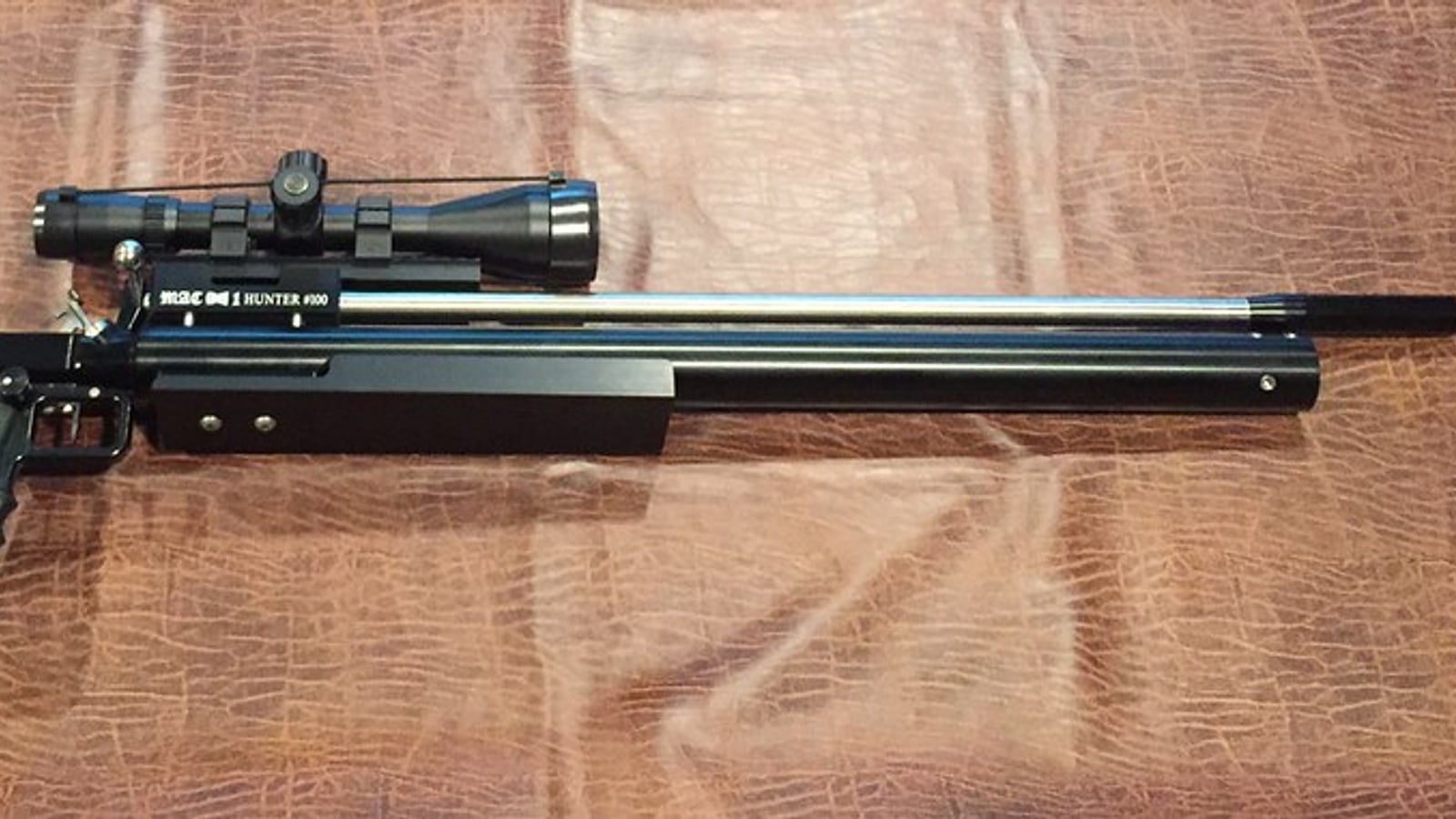
A discipline that simulates hunting without ever aiming at a living creature
Field target is about recreating the sensations of stalking game without ever aiming at a real animal. You move along an outdoor course, often through a forest or over hilly terrain, and shoot at metal animal-shaped silhouettes at distances that change at every lane.
The principle that makes this discipline hard: you never know the exact distance in advance. Unlike fixed-distance paper target shooting, every lane here confronts you with an unknown you have to solve in a few seconds, juggling terrain reading and trajectory calculation.
The target itself is a mechanical trap. A metal animal silhouette (usually styled as a rodent, bird, or small game, never human) pierced by a hole known as the “kill zone.” That hole tips a paddle when hit dead center, which validates the shot. An impact outside the zone, even by a few millimeters, tips nothing and counts as a miss.
The discipline was born in England in the 1980s, championed by hunters who wanted to train year-round without depending on hunting seasons or permits. It later developed into a full competitive discipline with its own equipment classes and its own circuit of cups.
In France, it remains a niche but loyal discipline. The clubs that offer it often recruit former paper-target precision shooters looking for an extra challenge: distance estimation, which changes everything compared with a classic range.
Course format and how a match unfolds
A field target course usually consists of thirty to fifty shooting lanes, spread over an outdoor circuit. Each lane presents one or more targets positioned at variable distances, from very close (sometimes under 10 meters) to long shots that can exceed 50 meters depending on the organizers.
The shooter moves lane to lane with their group, in an order set by the organization. At each lane, they have a limited number of pellets available, generally one or two per target, fired from a mandated position: standing, kneeling, sitting, or prone, according to ground markers.
The kill zone’s diameter varies according to distance and the difficulty the organizer wants. On short lanes it can shrink to very small dimensions, on the order of a few millimeters. On long lanes it widens slightly to stay playable, but it always remains more demanding than a classic paper target.
Ranking is based on the number of targets validated across the whole course, cumulated over one or several rounds depending on the competition format. A regular competitor mainly aims for consistency: better to reliably clear 70% of lanes than to chase a heroic run on a few shots and blow the rest through overconfidence.
The time allotted per lane is limited, which prevents over-analyzing every shot. This pacing constraint sets field target apart from other precision disciplines where preparation time is essentially unlimited.
The gear: the PCP rifle at the center of it all
Nearly all field target competitors use PCP (Pre-Charged Pneumatic) rifles, meaning air rifles powered by pre-compressed air stored in a built-in reservoir. This system delivers far more consistent velocity than spring-powered or CO2 rifles, which is essential for repeatable precision shooting.
In France, these rifles fall under category D: free sale or simple registration depending on power, as long as muzzle energy stays under the 20-joule threshold set by regulation. This limit directly shapes the caliber used: field target rifles fire almost exclusively in 4.5mm (.177), the caliber that gives the flattest trajectory while respecting the power limit.
The 5.5mm (.22) caliber exists in field target but remains a minority choice in competition, because its more curved trajectory complicates long-distance estimation. Some recreational shooters use it for pest control, where the sporting discipline’s competition constraints don’t apply.
The air reservoir is refilled via a manual high-pressure pump or an adapted diving bottle, itself filled at a specialized filling station. Pressure management is a real technical subject: a PCP rifle delivers a constant velocity over a given pressure range, then velocity progressively drops as the reservoir empties. A serious competitor knows their “curve” and knows at what shot count their velocity starts to drift.
A field target rifle’s trigger is almost always adjustable in travel and let-off weight. Many shooters fine-tune their trigger to get a clean, jolt-free break, a trait shared with every precision discipline where the final movement before the shot must not disturb the sight picture.
The rifle’s overall weight is another trade-off depending on the shooter’s profile. A heavier rifle stabilizes the shot better but tires the shooter more over a multi-hour course with elevation changes, while a lighter rifle carries more easily but amplifies natural body tremor if the shooter still lacks core stability. Many competitors add or remove removable weights on the barrel or stock to adjust this balance depending on the day’s course.
Field target also generally distinguishes two broad equipment classes, which separate shooters by the aids allowed. The so-called “open” or “PCP” class allows the use of a bipod, arm rest, and various supports depending on the position mandated at the lane, whereas the so-called “hunter” class imposes rules closer to real field use: no bipod at certain lanes, a rifle silhouette closer to a standard hunting model, sometimes a limit on allowed optical magnification.
The choice of class mainly depends on what the shooter is after. A beginner wanting to progress quickly will often favor the open class, more permissive on supports, before switching to the hunter class once position fundamentals are acquired. A club organizing field target always communicates these class limits before the competition, and it’s worth checking your gear beforehand rather than discovering it’s non-compliant on the day.
Distance estimation, the technical heart of the discipline
What truly sets field target apart from classic paper precision is that distance is never announced. The shooter must estimate it themselves, by eye or via a rangefinding reticle built into their scope.
Many competitors use a “mil-dot” reticle or a specific graduated reticle, calibrated to estimate distance from the target’s known size. The principle: knowing the silhouette’s approximate diameter, you compare its apparent size in the reticle to a scale of graduations, and deduce the distance through a proportion calculation.
Some competition rules allow laser rangefinders, others ban them to preserve the “visual estimation” dimension of the discipline. This rule is a real philosophical divide in the community: purists consider eye estimation the heart of the event, while others view the rangefinder as just one tool among others.
A distance estimation error has a direct and disproportionate impact on the shot’s outcome, far more than in fixed-distance shooting. Being off by a few meters on a distant target can be enough to place the impact outside the millimeter-precise kill zone, whereas the same error would have no consequence on a classic paper target where the entire surface counts.
Distance estimation training is worked on independently of shooting itself. Many clubs offer dedicated exercises: guess a distance by eye, verify it with a rangefinder, repeat. This visual gymnastic improves with repetition, like any athletic skill.
The difficulty of this estimation also varies according to the actual size of the silhouette placed at the lane. A small distant silhouette and a large close silhouette can occupy the same apparent size in the reticle if the shooter doesn’t know in advance the exact size of the model used on that course, hence the importance of scouting before shooting begins. This is one of the reasons organizers generally communicate the standard sizes of the silhouettes used before the competition, so the calculation stays reliable from lane to lane.
Low-velocity trajectory calculation
A 4.5mm pellet in category D, capped at 20 joules, travels much slower than a centerfire rifle bullet. This reduced velocity has a direct consequence: the projectile’s trajectory is far more curved, and gravity drop becomes significant starting at medium distances.
Concretely, a pellet zeroed to hit the point of aim at 20 meters can drop several centimeters at 40 meters, and that drop continues to increase non-linearly beyond that. The shooter must know their own trajectory curve, generally memorized or written on a card, to know how many “mil-dots” or compensation graduations to apply depending on the estimated distance.
Wind has a magnified impact on a projectile as light and slow as a pellet. A moderate breeze that would be negligible for a centerfire rifle can deflect a pellet by several centimeters on a thirty-meter shot. Reading wind in field target is worked on with the same tools as in long-range disciplines: watching vegetation, feeling the air on your skin, watching mirage when conditions allow.
The full calculation therefore combines three unknowns to solve in a few seconds: the estimated distance, the corresponding drop compensation, and the adjustment for the moment’s wind. It’s this accumulation of variables that makes the discipline as mentally demanding as it is physically.
Some shooters use a printed compensation chart, attached to the rifle or quickly checked between lanes. Others prefer to memorize everything after hundreds of repetitions, which speeds up decision-making but requires a long training period before it’s reliable in competition.
This trajectory curve isn’t fixed: it shifts slightly with ambient temperature, which influences air density and therefore the resistance the pellet encounters along its path. A shooter who competes over a whole season, from spring to autumn, learns to perceive these small variations rather than treating their compensation chart as an absolute, fixed truth.
Shooting position and managing it under time pressure
Field target requires varied shooting positions depending on the lane: standing, kneeling, sitting, or prone, sometimes with natural supports like a tree trunk or a rock depending on the terrain. This variety forces the shooter to master several solid positions, unlike other disciplines where a single position is worked in depth.
The sitting or kneeling position with a bipod is often the most stable and most used when the rules allow it. The shooter seeks a stable bony support point, elbows resting on the knees or on a rest, to minimize the body’s natural tremor on such a demanding target.
The limited time per lane prevents endlessly searching for the perfect position. An experienced competitor already has in mind, even before reaching the lane, the two or three positions they can adopt depending on the available terrain, which saves precious seconds.
Eye dominance directly influences the choice of position and how the rifle is mounted at the shoulder. A shooter who belatedly discovers their dominant eye isn’t the one they thought sometimes has to rebuild their position from scratch, which happens more often than one might think among beginners coming from other disciplines where this setting was never seriously checked.
Breathing remains a fundamental shared across all precision disciplines: holding your breath at the right moment of the cycle, just before the release, to stabilize the sight line. In field target, this timing must be executed faster than in classic precision shooting, because of the per-lane time constraint.
The scope is the other critical piece of gear in field target, according to many competitors even more so than the rifle itself. High magnification, often higher than what’s used in fixed-target shooting, helps better estimate distance and precisely aim at a reduced kill zone. Parallax adjustment is fundamental here, because poorly adjusted parallax shifts the apparent point of impact depending on eye position behind the eyepiece; most field target scopes actually include a parallax ring graduated in approximate distances, which indirectly helps with estimation.
The choice of reticle depends on the estimation method chosen by the shooter: a fine-graduated reticle allows a more precise calculation but requires a longer reading time, which weighs on the lane’s time constraint. Some seasoned competitors go so far as to customize their vertical adjustment turret with graduations that correspond directly to their own trajectory curve, in distance rather than generic clicks, which further reduces calculation time at the lane at the cost of a long calibration effort beforehand.
Training for field target without a dedicated course
Not every shooter has access to a club with a full course nearby. Many train beforehand on isolated field target targets, set up in a garden or private land, scrupulously respecting the safety rules tied to the range of a category D pellet and the presence of a suitable backstop behind the target.
Training at home mainly allows working on shooting mechanics: position, breathing, trigger management, without the variable of distance estimation, which requires a real course or varied terrain. It’s a useful complement, not a substitute for training under real competition conditions.
A logbook helps progress faster in this precise discipline. Noting the actual distance of each target, the distance estimated before firing, the gap between the two, and the shot’s outcome helps identify one’s own estimation biases: some shooters systematically underestimate long distances, others overestimate short ones.
Using a shooting-tracking app makes this analysis easier over time, particularly for spotting trends that only appear after several dozen outings. A shooter who regularly logs their estimation gaps progresses faster than one who relies solely on their in-the-moment feel.
Consistency beats intensity in this discipline. A few dozen estimation training shots per week, repeated over several months, build a far more reliable sense of distance than an occasional intensive session.
Getting started at a club and progressing in competition
The best entry point remains an affiliated club that offers the discipline, where an experienced instructor can correct position and safety basics before letting a beginner loose on a full course. These clubs often lend appropriate gear for the first sessions, avoiding the need to invest before knowing whether you really enjoy the discipline.
The first outings on a course are mainly an opportunity to discover the discipline’s particular rhythm: walk, observe, estimate, shoot, move on. This rhythm contrasts with the fixed range and requires an adjustment, even for shooters already experienced in other precision disciplines.
Progress in field target comes from repeating varied courses, in different clubs if possible, to multiply the terrain and distance configurations encountered. An experienced club shooter often recommends varying practice locations rather than always training on the same course, which ends up being memorized rather than truly read.
Regional and then national competitions follow a calendar specific to the discipline, with separate classes depending on equipment and sometimes on level. A regional champion starting her season often recommends first entering friendly events before targeting ranked competitions, to gauge the level of play without ranking pressure.
Equipment also evolves with experience. A beginner can very well start with an entry-level PCP rifle and a decent scope, then refine their setup (trigger, adjustable stock, finer-reticle scope) once the fundamentals of position and estimation are acquired.
Choosing the pellet and its influence on precision
The pellet used in field target has a weight that directly affects trajectory and wind resistance. A heavier pellet retains its energy better and drifts less under wind, but its initial trajectory is slightly more curved than a lighter pellet fired at the same power.
A serious competitor tests several pellet brands in their own rifle before settling their choice for the season. Two rifles identical on paper can produce very different groupings with the same pellet, due to minute variations in the barrel or compression chamber.
The shape of the pellet’s head (flat, domed, with a reinforced skirt) also influences flight behavior and how the impact triggers the target’s tip. A pellet poorly matched to the exact barrel diameter can produce irregular velocities from shot to shot, which ruins any attempt at reliable trajectory calculation.
Once a pellet is validated, most competitors buy several boxes from the same manufacturing batch. Manufacturing tolerances vary slightly from batch to batch, and switching batches mid-competition-season can shift the point of impact very slightly, a detail that matters at the scale of a millimeter-precise kill zone.
Pellet storage also deserves attention: even a minor deformation of the skirt, caused by an impact or poor loose storage, degrades precision disproportionately relative to the size of the flaw. Many shooters handle their pellets one by one before loading, to visually discard any damaged piece.
Reading the terrain and adapting to changing conditions
Field target is practiced outdoors, which means dealing with light, weather, and vegetation that change over the course of the match and the day. A lane in full sun and a shaded lane right after don’t offer the same sighting comfort, and the shooter must readjust their eye at every change in brightness.
The terrain’s slope changes the shooting angle relative to horizontal, which has a real effect on trajectory once the angle becomes pronounced. A strongly downward or strongly upward shot doesn’t behave exactly like a flat shot at the same apparent distance, a phenomenon experienced shooters learn to correct more through experience than through a strict formula.
Vegetation around the target also serves as a clue for reading the wind, often more reliable than a feeling on the skin. Watching the movement of leaves or tall grass between the shooter and the target gives a sense of wind intensity and direction at different points along the pellet’s path, which is more useful than a single reading taken from the shooting lane.
The ground itself sometimes forces uncomfortable positions: roots, rocks, sloped terrain. The shooter has to accept shooting from an imperfect position rather than wasting precious time searching for an ideal support that doesn’t exist at that particular lane.
Conditions during the same competition can change completely between morning and afternoon, especially if wind picks up or light shifts direction. A competitor who scouted the course in the morning must remain ready to revise their estimates in the afternoon if conditions have evolved.
This constant adaptation to terrain comes with a real mental dimension over a course that lasts several hours and demands sustained concentration across a large number of consecutive lanes. Mental fatigue sets in gradually, and estimation or execution errors tend to multiply in the last third of the course if the shooter hasn’t anticipated this drop in vigilance.
Handling a miss is a skill in its own right in this discipline. A lane missed because of a bad distance estimate must not contaminate the next lane: a shooter who dwells on their failure arrives less focused at the next lane, which often triggers a second error by ricochet.
Many competitors develop a fixed mental routine at each lane, independent of the previous lane’s result: observe, estimate, position, breathe, shoot. This identical, mechanically repeated routine limits the influence of stress or disappointment on subsequent lanes.
The walking between lanes, often underestimated, is also part of the course’s physical effort. Hilly terrain over several hours tires the legs and back, which degrades shooting stability toward the end of the course if the shooter doesn’t have sufficient physical conditioning to go the distance.
Competition experience itself matters as much as pure technique. An experienced club shooter often points out that a technically solid beginner can underperform in their first competitions simply because the format (the crowd, the waiting, the stakes of ranking) disrupts a shooting mechanic that worked very well in training.
Maintenance and reliability of PCP gear
A PCP rifle depends on a high-pressure sealing system, which requires different maintenance than a classic firearm. The O-rings that ensure the reservoir’s seal wear out over time and fill cycles, and a slow leak can throw off shooting velocity without the shooter noticing immediately.
Checking the reservoir’s pressure hold before every important outing avoids bad surprises mid-course. A rifle losing pressure faster than usual generally signals a seal that needs changing, an operation many shooters learn to do themselves after a few seasons of practice.
A field target rifle’s barrel needs regular but measured care: cleaning too often or too aggressively can, on the contrary, degrade precision by altering the natural fouling that builds up with use. Most competitors follow the manufacturer’s recommendations rather than improvising an overly intensive cleaning routine.
The scope also deserves regular checking of its mount on the rifle’s rail. A scope ring slightly loosened by repeated vibration can insidiously shift the point of aim, a drift that’s hard to detect without a systematic tightness check before every important competition.
Many competitors keep a maintenance log separate from their shooting logbook, noting the dates of seal changes, barrel cleaning, and pressure checks. This maintenance rigor, which can seem excessive to a beginner, quickly becomes natural once a mechanical incident has cost an important competition.
What the discipline brings to a shooter and how to prepare for it
Many shooters who already practice a precision discipline (10m rifle, TAR, 50m precision) discover field target as a complement rather than a replacement discipline. The fundamentals of position, breathing, and trigger management transfer directly from one discipline to another, which speeds up initial pickup.
What field target adds is precisely what those fixed-distance disciplines don’t work on: estimation, terrain reading, fast decision-making under time pressure. A shooter coming from paper precision shooting often progresses very quickly on the mechanical side of shooting, but has to rebuild everything on the estimation side, which resembles nothing they already know.
Conversely, a hunter discovering field target finds familiar sensations (outdoor terrain, distance to assess, improvised position) but must learn a competitive rigor they’re not used to: managing time per lane, strict adherence to a rulebook, an equipment class to respect. This meeting of two shooting cultures is one of the reasons the discipline remains popular among very different profiles.
Some clubs organize mixed days where shooters try several disciplines in the same day, which makes it possible to concretely gauge these skill differences. An experienced instructor often notes that the best preparation for field target still remains repeated practice of field target itself, more than transfer from another discipline.
The discipline also remains accessible on a more modest budget than other sport shooting practices, making it a good entry point to discover competition without a disproportionate initial investment. An entry-level PCP rifle and a decent scope are largely enough to get started and enjoy the first courses.
Field target also attracts a public varied in age and physical condition, precisely because the discipline values precision and terrain reading more than strength or pure speed. An experienced instructor often notes that some of a club’s most consistent shooters aren’t the youngest or most athletic, but those who’ve developed the patience and mental discipline needed for reliable estimation, lane after lane.
Organization and logistics of a competition day
A field target competition generally starts early in the morning, with a scouting period for the course before the official start of shooting. This moment is precious for spotting the trickiest lanes, observing the day’s light and wind conditions, and mentally adjusting your strategy before the first lane.
Shooters are split into small groups that progress together along the course, in a rotation order that avoids bottlenecks between lanes. This group organization also creates a social dynamic specific to the discipline: you watch others’ shots, discuss compensation choices between two lanes, without this slowing the pace of progress.
The gear needed for a full day goes well beyond just the rifle: enough pellets with a safety margin, a pump or refill bottle depending on the reservoir’s range, clothing suited to weather that can change over several hours, and enough to drink and eat between rounds.
Referees or lane judges validate every target tip and settle disputed cases, notably when an impact right at the edge of the kill zone is debated. This human presence at every lane sets field target apart from other, more automated competition formats, and demands a certain sporting fairness from the shooter in how they announce and accept their results.
Weather remains the most unpredictable factor of an outdoor competition day. Light rain, wind picking up during the day, or heat that tires you faster: an experienced competitor always plans an adaptation margin in their gear rather than betting on stable conditions from the first to the last lane.
The final ranking is generally posted at the end of the day, once all scoresheets have been centralized by the organization. This convivial moment at the end of the competition, when groups reunite to compare their courses and their compensation choices lane by lane, is an integral part of the experience for many regular practitioners, almost as much as the shooting itself.
FAQ
Q: Is field target dangerous for bystanders or neighbors? A: A category D rifle stays under the 20-joule threshold, with a range and energy far below a centerfire weapon. Following basic safety rules (a backstop behind the target, a clear shooting zone, the rifle never loaded outside the lane) makes the practice safe, whether at a club or on suitable private land.
Q: Do you need a permit or a license to practice field target? A: Buying a category D rifle under 20 joules doesn’t in itself require a hunting permit or a shooting license, but joining a club and taking part in official competitions generally requires a federal license. The precise rules vary depending on the club and the organization running the competition.
Q: What’s the difference between field target and classic air rifle shooting at a range? A: Range shooting happens at a fixed, known distance, generally indoors, on a target identical at every lane. Field target adds the variable of unknown distance and varied outdoor terrain, which makes it a discipline much more oriented toward estimation and reading real conditions.
Q: Can you practice field target with a spring-powered rifle rather than a PCP? A: It’s possible, and some do, but a spring rifle has more complex shot behavior (internal recoil, sensitivity to hold) which complicates the consistency sought in competition. The vast majority of serious competitors go with a PCP rifle for this reason.
Q: How can you quickly improve at distance estimation? A: Dedicated training, independent of shooting itself, is the most effective method: guess a distance by eye then verify it with a rangefinder, repeating the exercise across dozens of different targets. A logbook noting the gap between estimated and actual distance helps identify and correct your personal biases.
Q: Is the kill zone the same size across the whole course? A: No, it varies according to distance and the difficulty the organizer wants: smaller on some short lanes to offset how easy the distance is, sometimes larger on long lanes to stay playable. Every course has its own settings, which change from one competition to another.