
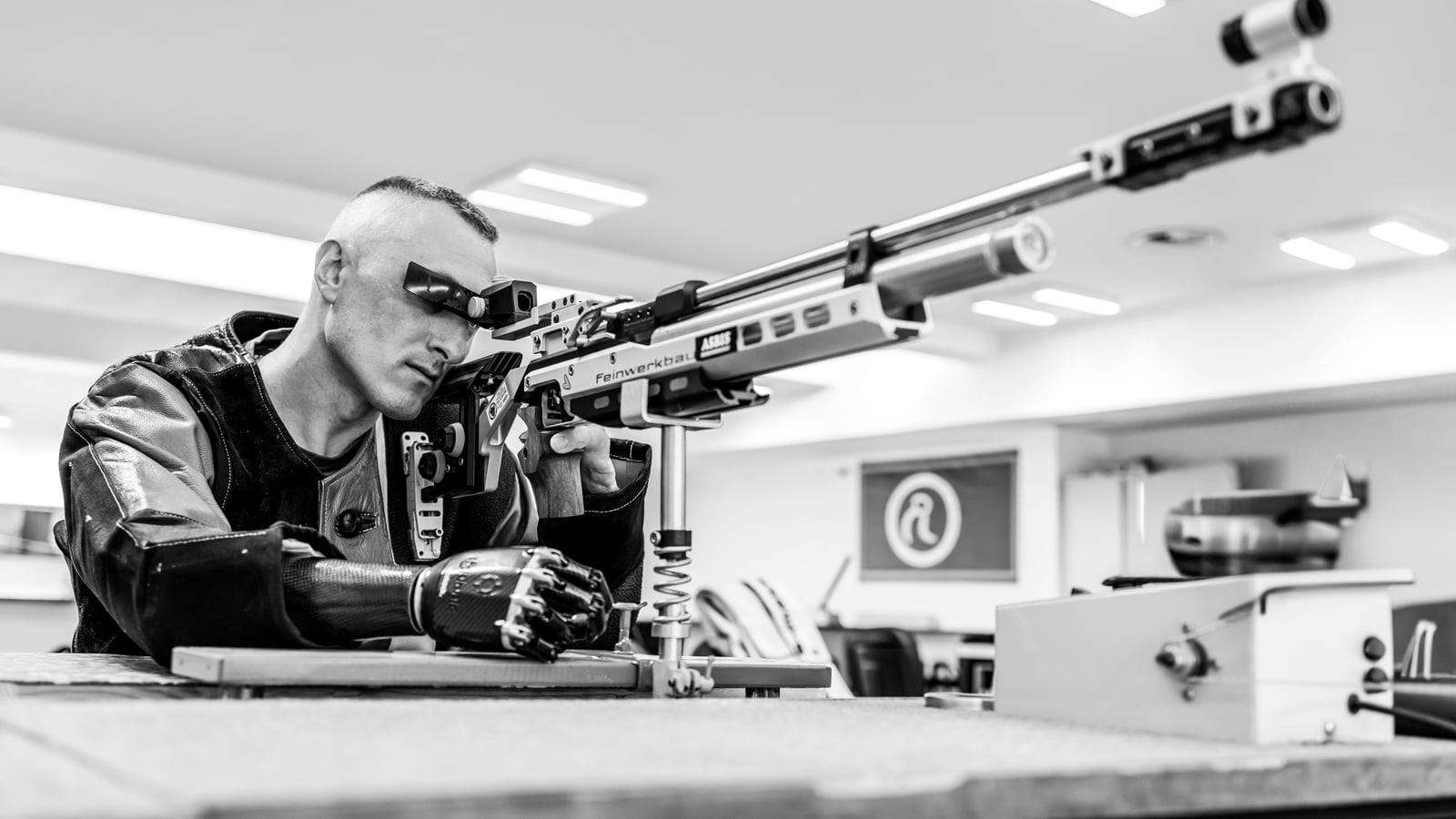
An Olympic discipline accessible from day one
10m air rifle has been part of the Olympic programme since 1984, making it one of the most codified and universally practised shooting disciplines in the world. It’s shot indoors, over a short distance, with equipment that has nothing to do with a hunting rifle or a long-distance competition rifle. It’s precisely this apparent simplicity that makes it formidably demanding.
Unlike other disciplines that require a heavy upfront investment, 10m air rifle can be learned in most clubs from the very first sessions, often with equipment loaned by the club. A beginner can therefore try the discipline before deciding to invest in their own gear, which makes it a natural gateway into precision sport shooting.
The principle is deceptively simple: ten metres of distance, a freely available Category D air rifle, a fixed target, and limited time to fire a series of shots from the standing position. No speed, no dynamic movement, no violent recoil to manage. Everything comes down to postural stability, breath control, and the consistency of a motion repeated dozens of times in a row.
This apparent slowness often throws off newcomers who arrive with an image of shooting tied to action or speed. 10m air rifle is the exact opposite: it’s a discipline of patience, meticulousness, and mental endurance, where the slightest variation in posture or breathing shows up immediately in the score. This article covers the fundamentals: the regulation position, the mandatory technical gear, the scoring system, and why this discipline remains one of the best for learning the basics of precision shooting.
The regulation standing position, the cornerstone of the discipline
In 10m air rifle, the shooting position is set by the rules: standing only, with no support of any kind. Unlike other rifle events that allow prone or kneeling positions, here the shooter alone must stabilise the entire weight of the rifle and their own body, arm either extended or bent depending on the technique chosen.
The basic posture distributes body weight evenly across both legs, spaced roughly shoulder-width apart, with the torso often counterbalanced slightly to offset the weight of the rifle held on one side. Each shooter refines this posture over the months according to their own build: there isn’t a single standing position, but a common base that everyone then adjusts.
The arm supporting the rifle usually rests against the torso or the hip, never fully extended in the air, so as to transfer part of the weapon’s weight onto the skeleton rather than onto the arm muscles alone. This technique, known as bone support, allows the static position to be held for long minutes without excessive fatigue, an essential condition when a full series can demand more than an hour of concentration.
The hand operating the trigger must remain completely independent of the rest of the holding motion. One of the most heavily practised technical points in clubs is precisely to separate the progressive pressure on the trigger from any parasitic tension in the supporting arm, a reflex that often takes several months of regular practice to become natural.
Head position and the alignment of the dominant eye with the sight line complete the picture. An experienced coach will insist from the very first sessions that the head must stay upright and relaxed, without tensing the neck, because any tension there directly affects the stability of the barrel.
The feet play a role often underestimated by beginners. Their orientation relative to the target, generally close to perpendicular but never fixed as an absolute rule, determines the whole natural axis of the body. An experienced club shooter takes the time, at the start of every new session, to find that same anchoring point on the floor before even raising the rifle, because a shift of a few degrees in foot orientation shifts the entire line of fire, without the shooter always being aware of it.
The concept of “natural point of aim” structures a large part of initial learning. It consists of adjusting the position of the feet and torso, rather than forcing with the arms, so that the barrel naturally points toward the target once the posture is set and the eyes are closed. If the shooter has to correct with their arms after reopening their eyes, that’s a sign their natural point of aim is poorly set, not that their aim itself is at fault.
This idea completely changes how a beginner should correct their deviations. Rather than forcing the rifle toward the target on every shot, which tires the stabilising muscles and adds extra tension, good practice is to go back to the feet, readjust the stance, and find a natural alignment again without unnecessary muscular effort. It’s a reflex that takes most shooters several months to fully internalise.
Why stability matters more than physical strength
One of the most common misconceptions among beginners is believing physical strength is decisive in 10m rifle. That’s false: what matters is postural endurance and the ability to hold a static position without trembling, which has more to do with deep core control and nervous system control than raw muscular power.
An experienced club shooter often explains to newcomers that the best results rarely come from the most athletic profiles, but from those who manage to slow their heart rate and manage their breathing consistently over the duration of a series. This physiological dimension often surprises people who discover the discipline thinking it’s purely technical.
Dry-fire training, without ammunition, plays a central role in learning this stability. Repeating the setup, aiming, and trigger release without even firing lets you work on balance and muscle memory without the constraint of noise or recoil management, even minimal as it is with air rifles. It’s often the exercise recommended most to beginners during their first few months.
Breathing follows a precise pattern: inhale, partial exhale, then a short hold of a few seconds during which the shot is fired, before resuming normal breathing. This cycle, repeated dozens of times per session, must stay consistent from one shot to the next to guarantee the movement regularity essential to the precision being sought.
Postural fatigue, distinct from classic muscular fatigue, generally appears after several dozen minutes of repeatedly holding the standing position. It shows up as a slight tremor in the barrel that gradually amplifies, a sign that the body is starting to compensate with bad reflexes rather than the posture originally trained. Recognising this moment and taking a break before it degrades the rest of the series is one of the skills coaches explicitly teach.
Deep core bracing, often associated with other sports, has a direct application here. A shooter who regularly trains their core outside the range generally notices better postural endurance on long series, without this requiring intensive or overly specific physical training. A few simple core exercises, done two to three times a week, are often enough to see a difference over several months.
The mental side deserves as much attention as the physical one. The ability to stay focused, shot after shot, over a series that can last a full hour is a training area in its own right. Many clubs offer visualisation or breathing exercises inspired by other sports requiring prolonged concentration, adapted to the context of precision shooting.
The shooting jacket, the centrepiece of the equipment
The shooting jacket is arguably the most distinctive piece of equipment in 10m air rifle. Rigid, thick, and fitted to the shooter’s body, it stabilises the torso and reduces the micro-movements caused by breathing and heartbeat, which would otherwise be transmitted directly to the weapon.
A quality jacket is characterised by controlled rigidity, regulated by the rules to prevent it from becoming a simple corset that would replace the shooter’s muscular work rather than support it. Federations impose flexibility tests that every homologated jacket must pass before being allowed in competition.
Lacing and fitting the jacket requires its own learning process. A jacket that’s too tight hinders breathing and tires quickly, one that’s too loose doesn’t fulfil its stabilising role. Most shooters fine-tune this setting over several sessions with the help of an experienced coach, until they find the balance that suits them.
To get started, most clubs have loaner jackets in several sizes, letting you try the discipline without immediately investing in personal gear. Buying a custom jacket usually only happens once the practice has been confirmed over several months, when the shooter wants to move to equipment fitted precisely to their build.
Caring for the jacket is one of those practical aspects rarely discussed but very real for anyone equipping themselves personally. A rigid jacket keeps better laid flat than rolled up, and its lacing naturally loosens with use, which requires regular readjustment to maintain the desired level of support. Neglected upkeep can, over time, noticeably change the sense of stability a shooter feels from one season to the next.
The question of the “right time” to invest in a personal jacket comes up often among regular practitioners. Most coaches recommend waiting until you’ve stabilised your base position and have a clear idea of your shooting build before buying, since a jacket fitted too early can prove unsuitable if the shooter’s posture still evolves a lot in the first few months.
Some clubs organise trial sessions with several jacket models or brands, often during clinics or open-house days. This is a chance for a shooter already familiar with the basics to compare different levels of rigidity and clear up uncertainty before a purchase that, by nature, remains a fairly substantial investment once you move to competition-grade gear.
The glove and trousers, essential complements
The shooting glove, worn on the hand supporting the rifle, plays a role similar to the jacket: it slightly stiffens the wrist and improves contact between the hand and the fore-end of the weapon. It also reduces fatigue linked to holding the rifle’s weight for long series.
Shooting trousers, less systematic among beginners but common among regular practitioners, add complementary rigidity at the hip, which bears part of the weapon’s weight in the standing position. They complete the jacket-glove-trousers ensemble that characterises the technical outfit of the discipline at the advanced level.
Specific shoes are the last piece of this technical equipment. Rigid at the sole and ankle, they promote a stable anchor on the floor and limit lateral swaying of the body while aiming. Unlike a classic sports shoe designed for cushioning and movement, the shooting shoe seeks stillness and support.
This whole set of technical equipment may seem impressive at first glance, but it’s absolutely not necessary to get started. A club affiliated with the national federation systematically offers loaner gear so you can discover the discipline in simple clothing, jeans or ordinary trousers, before even considering any purchase.
The dedicated carrying bag for this equipment is also worth mentioning, even though it plays no role during the shooting itself. Jacket, glove, trousers, and adjustment accessories pile up quickly once practice is confirmed, and a regular shooter usually organises their gear in a dedicated bag or rolling case to limit setup time before each session.
The combined weight of this equipment, while modest compared to other sports, isn’t entirely negligible for a child or teenager just starting out. Some manufacturers offer lightweight ranges or reduced sizes designed specifically for young shooters, an option that clubs with youth sections generally know well and can recommend based on the beginner’s age and build.
Finally, there’s a notable difference between equipment used for pure leisure practice, where full rigidity isn’t always sought, and that used in official competition, where every piece must meet precise flexibility standards controlled by the federation. A shooter who practises purely for enjoyment, with no competitive ambition, can very well make do with simpler, less costly equipment for a long time.
The air rifle, a Category D weapon
In France, air rifles developing less than 20 joules of power fall under Category D, the most accessible category in the weapons classification: freely sold or subject to simple registration depending on the point of sale, with no prefectural authorisation or prior declaration required. This classification contrasts with Category B weapons, which require authorisation, or Category C, which requires declaration.
This regulatory accessibility largely explains why 10m air rifle is often the discipline recommended for discovering club sport shooting, before considering other disciplines that involve heavier administrative steps. That obviously doesn’t exempt anyone from following the strict safety rules in force at every affiliated club.
Technically, a modern competition 10m air rifle is a pre-compressed air mechanism, fed by a rechargeable air cylinder, that delivers constant pressure on every shot to guarantee a perfectly consistent initial pellet velocity. This mechanical consistency is essential: a pressure variation from one shot to the next would immediately show up as extra dispersion on the target.
The stock is adjustable along numerous axes: length, height of the buttplate, grip angle, position of the cheekpiece. These adjustments let you fit the weapon precisely to the shooter’s build, an essential point since the unsupported standing position makes every shooter particularly sensitive to the slightest mismatch between their frame and their rifle.
To get started, the vast majority of clubs make loaner rifles available, set up in a standard configuration. A coach then helps the new shooter adjust the essential elements (stock length, cheekpiece position) without requiring the purchase of a personal weapon before several months of regular practice.
The total weight of a competition 10m rifle, often close to the upper limit allowed by the rules, also contributes to the sought-after stability. Unlike a lighter hunting or leisure weapon, a relatively heavy 10m rifle naturally dampens the shooter’s micro-tremors, a physical phenomenon that explains why competition models never aim to be as light as possible.
The air cylinder feeding the weapon has a range measured in number of shots, generally enough to cover a full session without refilling. Regularly checking pressure before each series is one of the habits coaches teach early on, since a cylinder nearing the end of its charge can slightly alter the pellet’s initial velocity and thus affect precision in the last third of a series.
Maintaining the rifle remains generally simple compared to other weapon types, since compressed air produces no powder residue or barrel fouling comparable to a firearm. Light, regular cleaning of the barrel, combined with periodic checks of the cylinder’s seals, is usually enough to keep the weapon in good working order over many seasons.
The sighting system and the line of sight
The competition 10m air rifle uses a diopter (aperture) rear sight and an interchangeable front sight tunnel, with no magnifying optical device whatsoever, unlike other disciplines that allow scopes. This technical choice requires the shooter to master a precise optical alignment between the eye, the diopter, the front sight, and the target.
The diopter generally offers fine adjustment in elevation and windage, as well as an iris whose opening can be adjusted according to lighting conditions and the shooter’s visual preference. An iris opened too wide lets in too much stray light; one closed too much darkens the image excessively and tires the eye over the course of a long series.
The front sight, at the front, takes the form of a tube in which the shooter sees a clear circle (the target) surrounded by a regular black ring. The visual goal is to perfectly centre this clear circle inside the front sight tunnel, a task that requires specific visual training, different from that used with a red dot or a magnifying scope.
This lack of optical magnification is one of the most disorienting quirks for a beginner coming from other shooting disciplines. It takes time to learn to interpret this relatively abstract image, a circle within a circle, without ever seeing the ten zones of the target sharply with the naked eye.
The interchangeable front sight tunnel comes in several diameters, and choosing the right one depends as much on the shooter’s visual preference as on the lighting conditions of the firing point. A tunnel that’s too wide leaves a large margin of error in visual centring; one too narrow makes quick perception of alignment harder. Most shooters test several diameters before settling on their final choice.
Eye fatigue, over a long series, is a factor often underestimated by beginners. Fixing on an aiming point for long minutes, repeated several dozen times per session, strains the eye in a way that’s unusual in everyday life. Some shooters deliberately alternate the dominant eye used during very long training sessions, or take regular visual breaks to prevent fatigue from degrading the quality of aim toward the end of a series.
The initial diopter adjustment, usually made with a coach’s help during the first sessions, often starts from a neutral centring before being progressively refined based on the groupings observed on the target. It’s an iterative process: you fire a series, observe the dispersion, slightly adjust the diopter, and start again, until the impacts naturally centre on the intended zone.
The official target and its ten zones
The 10m air rifle target consists of ten concentric zones, numbered from 1 at the periphery to 10 at the centre, with the black bullseye at the heart of the target itself subdivided to allow for the decimal scoring used in high-level competition. This target is strictly generic and geometric: no human shape appears on it, only concentric circles.
The 10 zone itself, at the centre, is small enough that a beginner can barely make it out with the naked eye on the physical target set up at ten metres, which explains why training relies as much on the feel of aiming as on the immediate visual feedback of the impact.
In clubs equipped with electronic systems, a virtual target displayed on screen provides instant feedback after every shot, with the exact position of the impact and the associated decimal score. This kind of setup greatly eases learning, since the shooter immediately sees the effect of their position and motion on the result.
In more traditional setups, the paper target is checked manually after each series, a slower method that nonetheless remains widely used in many clubs, particularly for non-competitive leisure sessions.
The distance between each zone marking is small in absolute terms, but perceptible enough on a physical target for a beginner to quickly learn to tell tight groupings from scattered ones, even without precisely reading each individual score. It’s often the first visual reading a new shooter learns to do: even before counting points, looking at whether the impacts are clustered or spread across the target.
The target carrier and its movement mechanism, present in most club setups, let the target move forward and back between series without the shooter having to move themselves. This system, common in indoor shooting, saves valuable time during group sessions where several shooters share the same firing point.
A technical point sometimes overlooked concerns target lighting. Insufficient or poorly aimed lighting can distort the perception of the clear circle in the front sight, particularly for beginners who haven’t yet developed a fine sensitivity to these variations. Serious clubs pay attention to standardised, consistent lighting across the whole firing point, a detail that matters more than it seems for the consistency of aiming feel.
The decimal scoring system explained simply
The decimal scoring system, specific to precision disciplines like 10m rifle, makes it possible to separate shooters who would otherwise achieve the same whole-number score across several series. Each impact is measured with fractional precision, generally down to the first decimal, giving scores like 10.3 or 9.7 rather than a simple round number.
This level of precision is only relevant at confirmed competitive level, where the gaps between top-level shooters are decided by fractions of a point accumulated over dozens of shots. For a beginner discovering the discipline, the classic whole-number scoring (from 1 to 10 per shot) is more than enough to track their own progress.
An official competition series generally consists of several dozen shots, with the final score being the sum of each individual impact. Over a shooter’s career, tracking the evolution of these average series scores, session after session, is one of the best objective indicators of technical progress, far more reliable than the mere subjective impression felt during shooting.
It’s precisely this kind of numerical tracking, series after series, that lets you objectify progress over several months. Systematically noting scores, equipment settings, and shooting conditions in a dedicated logbook turns a practice where you “feel” you’re improving into one where you can actually measure it and adjust your training accordingly.
Official competitions also feature a final ranking decided by a shoot-off in top-level phases, where a small number of qualified shooters compete in front of an audience, each shot announced and scored immediately in decimal form. This more spectacular format remains reserved for structured competitions and never comes into play in a beginner’s usual club practice.
The difference between raw score and relative score is also worth clarifying for a new shooter. The raw score corresponds to the sum of points earned over a series; the relative score compares that result to a personal average or a goal set in advance. It’s this second, more personal indicator that really helps measure individual progress rather than constantly comparing yourself to other shooters at different levels.
Many beginners focus solely on their best shot of the session, often a lucky hit more than a reflection of their actual level. An experienced coach will instead encourage looking at the average of the full series, and especially its consistency from one shot to the next, a far more telling indicator of real technical level than a single isolated best impact.
Why this discipline is an excellent entry point for beginners
10m air rifle brings together several advantages that are rare for a beginner: Category D equipment accessible without heavy administrative steps, indoor practice unaffected by weather conditions, very low ammunition cost compared to powder disciplines, and an extremely structured teaching framework in almost all affiliated clubs.
An experienced club coach often sums up this discipline as a school of rigour: it forces the beginner to work on posture, breathing, and mental management before even thinking about speed or power, notions that simply don’t come into play here. This initial rigour then benefits every other discipline a shooter might go on to practise.
The absence of significant recoil, specific to Category D air rifles, also lets you focus entirely on technique without the parasitic burden of apprehension about noise or impact, a psychological hurdle common among beginners with other weapon types. This makes it a discipline particularly well suited to learning the fundamentals of precision shooting in a reassuring setting.
Finally, progress is measurable from the very first sessions: a beginner who starts with groupings scattered across the whole target generally sees, after a few months of regular, supervised practice, their groupings tighten noticeably, a concrete and motivating result that keeps up the drive to continue.
The social dimension of the club also plays a significant role in this accessibility. Unlike solitary practice, starting out in a club lets you exchange with other shooters of all levels, observe different positioning techniques, and benefit from varied feedback beyond just your assigned coach. This diversity of perspectives often speeds up the identification of small flaws that a single eye wouldn’t immediately notice.
The overall cost of entry into the discipline also remains one of the lowest among sport shooting disciplines, ammunition included, which allows for regular practice without budget becoming an obstacle to progress. That said, this varies depending on clubs and regions, since licence and membership fees differ noticeably from one organisation to another.
For a shooter who eventually plans to try other disciplines, 10m air rifle forms a valuable transferable foundation: breath management, trigger control, and the discipline of a training logbook show up, in one form or another, in nearly all precision sport shooting disciplines.
How to progress efficiently in the first few months
Progress in 10m air rifle rarely follows a straight line. A regular beginner often experiences plateaus: a phase of rapid progress during the first weeks, followed by a plateau where the score stalls despite consistent practice, before a new phase of progress once a specific technical flaw is identified and corrected.
These plateaus shouldn’t be discouraging. They generally correspond to the moment when the body has absorbed the obvious basics (position, simple breathing) and it’s now time to refine more subtle details: postural micro-adjustments, trigger timing management, mental stability over the course of a full series.
Dry-fire practice, already mentioned, remains the tool most recommended by coaches to progress quickly without multiplying ammunition costs. Fifteen to twenty minutes of setting up position and dry triggering, several times a week, often produce faster progress than spaced-out live-fire sessions without this complementary work.
Consistency matters more than intensity. A short but frequent session builds a more solid muscle memory than long, spaced-out sessions. A club coach generally advises new shooters to aim for a stable weekly frequency rather than occasional marathon sessions, which are more tiring and less productive for learning.
Analysing groupings, rather than just the final score, is another progress lever often underused by beginners. A tight grouping shifted off-centre points to a sight-adjustment issue rather than a technique flaw; a grouping scattered across the whole target, conversely, points to a problem with postural stability or trigger management. Knowing how to tell these two situations apart avoids correcting the wrong parameter.
Filming your own position, with the club’s and coach’s agreement, also helps many shooters spot flaws invisible from the inside: a slight swaying of the torso, tension in the shoulder, a head that gradually tilts toward the end of a series. This external visual feedback usefully complements the internal, sometimes misleading, sensations felt during shooting itself.
Finally, regularly seeking a coach’s eye remains the most effective progress lever, especially in the first few months. A postural flaw that’s settled in over several sessions quickly becomes a habit that’s hard to correct alone; an experienced outside eye usually spots it within a few minutes of direct observation during a series.
Joining a club and equipping yourself gradually
Starting 10m air rifle almost always involves joining a club affiliated with the national shooting federation, the only structure authorised to legally oversee practice with loaned equipment and teaching support suited to complete beginners.
The first sessions generally take place with equipment entirely supplied by the club: rifle, jacket, glove, ammunition. This approach lets you try the discipline over several months before making any purchasing decision, a choice that varies according to each person’s means and priorities.
Personal investment, when it happens, is generally made gradually: first the glove and possibly a used or entry-level jacket, then a personal rifle once the shooter confirms their long-term commitment to the discipline. Prices vary widely depending on the club, the region, and the level of equipment targeted, which makes it hard to put forward a single figure relevant to every case.
The shooting logbook, whether paper or digital, quickly becomes the central tool for this progress. Noting rifle settings, series scores, sensations, and the corrections given by the coach makes it possible to build an objective record of your practice, far more reliable than the mere approximate memory of one session to the next.
The federal licence, mandatory to practise in a club, generally includes insurance coverage suited to sport shooting practice, a reassuring point for beginners wondering about the administrative side before getting started. The exact terms vary by federation and associated insurance contracts, which is why it’s worth asking directly at the club you’re targeting rather than relying on general information.
The choice of club itself deserves a minimum of attention before committing. Beyond geographic proximity, the availability of time slots dedicated to beginners, the presence of coaches specifically trained to support new shooters, and the quality of loaner equipment are all criteria that directly influence the quality of initial learning. Visiting several clubs before signing up, when possible, often allows for a more informed choice.
Finally, don’t underestimate the adaptation time required, even for a shooter who already practises other disciplines. The unsupported standing position, fine breath management, and the absence of optical magnification demand a specific learning curve, independent of experience gained elsewhere. Approaching this discipline with patience, without premature comparison to other practices, remains the best way to fully benefit from it over time.
FAQ
Q: Do you need authorisation to practise 10m air rifle? A: No, air rifles under 20 joules fall under Category D, freely sold or subject to simple registration depending on the point of sale. No prefectural authorisation is required, unlike Category B weapons.
Q: What’s the minimum age to start this discipline? A: It varies by club and their insurance policies, but many affiliated clubs welcome young shooters from a relatively early age, under a coach’s strict supervision. Check directly with the club you’re targeting for its exact conditions.
Q: Do you have to buy all the equipment (jacket, glove, rifle) before starting? A: No, absolutely not. Nearly all affiliated clubs loan out all the equipment needed for the first sessions, letting you discover the discipline before investing personally.
Q: Why is the standing position considered the hardest? A: Because it has no external support whatsoever: the shooter alone must stabilise the weight of the weapon and their body, relying only on posture, core bracing, and bone-support technique. It’s the most demanding of the three rifle positions in terms of postural endurance.
Q: Does decimal scoring apply to beginners? A: Not necessarily. It’s mainly used in high-level competition to separate very close scores. A beginner can track their progress with classic whole-number scoring from 1 to 10, which is more than enough to measure improvement.
Q: Can you practise this discipline year-round, including in winter? A: Yes, that’s actually one of its strengths. 10m air rifle is practised exclusively indoors, on a short firing range, which makes it independent of weather conditions, unlike disciplines practised outdoors.