Shooting: a discipline naturally more accessible than you’d think
Sport shooting has a feature few other disciplines share: the static position. You don’t need to run, jump, or hold complex dynamic balance to shoot a clean group at 10 meters. This foundation changes everything for accessibility, far more than in most other sports.
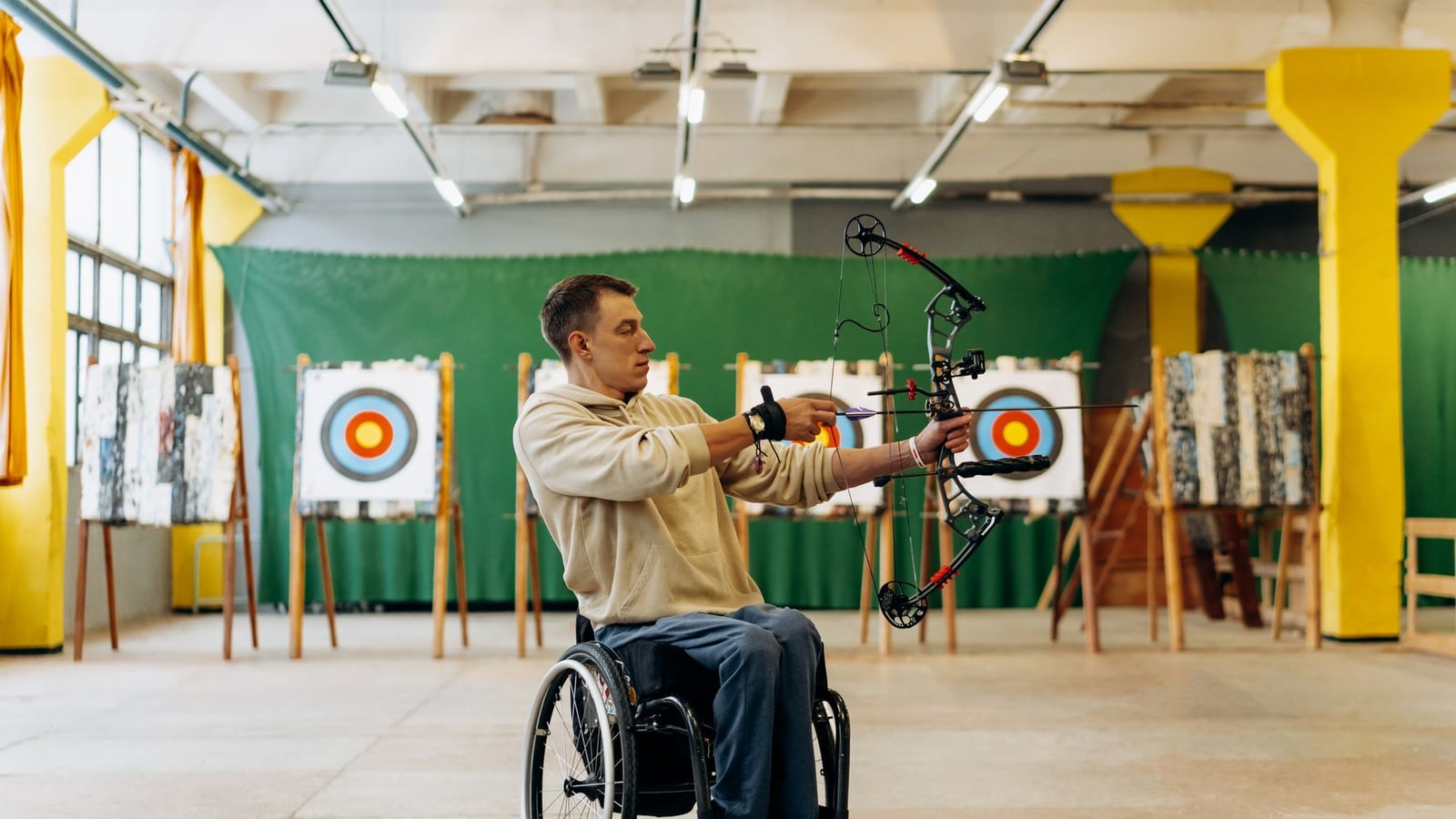
A shooter in a wheelchair can aim, breathe, and release exactly like any other licensed shooter, as long as the shooting position is adapted in height and clearance. A visually impaired shooter can rely on audio or tactile devices to calibrate their aim. A shooter with reduced mobility in one arm can use supports or specific holding systems.
This technical reality is encouraging, but it says nothing about the accessibility actually experienced on the ground. Between the discipline’s theoretical potential and what actually happens in a club on a Tuesday evening, there’s often a gap. That’s the gap this article tries to document honestly, without false optimism or performative pessimism.
It’s also worth remembering that sport shooting has been an Olympic discipline since the very first modern Games in 1896, which shows that top-level competition never required physical prerequisites comparable to endurance or power sports. This long history partly explains why shooting was able, earlier than other sports, to welcome practitioners with very different physical profiles within classic competition itself, even before dedicated para-sport categories emerged.
This baseline accessibility shouldn’t obscure the fact that every disability situation is different, and there’s no single solution that fits every profile. An adaptation designed for a wheelchair shooter won’t meet the needs of a visually impaired shooter, and vice versa. It’s precisely this diversity of situations that makes the subject hard to treat in general terms, and explains why club-by-club approaches vary so much.
What “accessibility” really means in a shooting range
The word “accessibility” is often mentally reduced to a ramp and a reserved parking spot. In a shooting range, the reality is far broader and more nuanced than that. It touches the building, the equipment, human organization, and club culture.
On the building side: the width of corridors between shooting lanes, the height of shooting tables, the presence or absence of steps to reach the firing line, adapted restrooms, accessible changing rooms. A club housed in an old military building or a vaulted cellar often inherits heavy architectural constraints that are difficult, or even impossible, to fix without a substantial budget.
On the equipment side: arm rests, holding straps, risers, weapon-locking systems on stands or tripods for shooters who can’t hold a weapon’s weight unsupported through a string. This equipment exists and is recognized by sporting bodies, but not every club is equipped with it, and its cost isn’t trivial for a nonprofit association.
On the human side, finally: training instructors to coach shooters with disabilities, and the club’s ability to adapt a session without turning the newcomer into a “special case” watched sideways. It’s often this last, purely human factor that makes the difference between a club where you feel welcome and one where you feel merely tolerated.
There’s also an organizational dimension that cuts across all three without reducing to any one of them: how the club schedules its time slots, manages traffic on the firing line, and anticipates a practitioner’s needs before their arrival rather than discovering their constraints during the session itself. A club that simply asks, at sign-up, whether any particular accommodation is needed already takes a different stance than one that waits for the problem to arise before thinking about it.
The current state of play: real but uneven progress across clubs, and the federation’s role
Interviewing practitioners and club officials about accessibility paints a contrasting picture. Some clubs have done remarkable work, driven by a leader personally invested in the topic or strong municipal will when the infrastructure belongs to the local authority. Others have simply never been asked the question, for lack of local demand.
This unevenness is largely explained by clubs’ nonprofit association status. Unlike a public-facing establishment subject to strict regulatory accessibility obligations, a shooting association club often operates with limited means and old buildings, sometimes made available by a town council or a works council. The financial room to maneuver for adaptation work is real but varies from one club to another.
An experienced instructor, asked about the issue, sums it up well: the willingness to welcome is almost always there, and the teaching skill too, but adapted equipment and range fit-out rarely keep pace. You end up with highly motivated clubs cobbling together solutions with whatever’s on hand, for lack of budget for approved equipment.
The paradox is that broad guidelines do exist at federation level, with dedicated para-shooting commissions within the French shooting federation. But actual implementation remains heavily dependent on each club’s local engagement, which mechanically creates significant gaps between a well-resourced urban club and a small rural club on a tight budget.
The French shooting federation has a commission dedicated to para-shooting, tasked with linking generalist disability sport bodies with the practice of shooting. This commission works notably on sport classifications, which allow shooters with different disability profiles to compete in comparable categories.
This classification work is essential to the discipline’s competitive dimension. Without appropriate categorization, a shooter with a severe motor disability would be mechanically disadvantaged against an able-bodied shooter under the same scoring criteria, which would discourage any competitive ambition.
Beyond competition, these commissions also produce technical recommendations for clubs: which type of shooting position to favor, which assistive equipment to choose, how to train coaches. The problem, often flagged by clubs themselves, is that these recommendations sometimes stay poorly disseminated on the ground, for lack of an active relay in each departmental committee.
There are also bridges with generalist disability sport structures, which direct practitioners toward shooting clubs identified as welcoming. This informal recommendation system, word of mouth between structures, often works better than official institutional channels to connect a new practitioner with the right club.
Exemplary initiatives showing what’s possible
Some clubs have built, over several years, genuine expertise in welcoming shooters with disabilities. These successes never fell from the sky: they almost always rest on one person, or a small group of volunteers, who carried the topic single-handedly for a long time.
One recurring model in testimonials: setting up a dedicated time slot, once a week or once a month, where coaching is reinforced and adapted equipment is systematically taken out and set up in advance. This slot becomes a reliable landmark for practitioners, who know that at this specific moment, everything is ready for them rather than being improvised session by session.
Other clubs made the opposite, more ambitious choice: integrating shooters with disabilities into ordinary time slots, with assistive equipment permanently available and instructors continuously trained. This approach demands more upfront investment, but avoids the pitfall of a “parallel track” that, despite good intentions, can reinforce a feeling of being set apart.
A regional champion who trained in a wheelchair recounts that the real turning point for her wasn’t the arrival of a particular piece of equipment, but the day an instructor stopped asking “are you okay” after every string and simply started correcting her stance the way he would for any other club shooter. Normalizing how people look at you matters as much as material adaptation.
These initiatives share a striking common thread: they almost always started small, with one particular shooter whose needs pushed the club to train and equip itself, before benefiting other practitioners afterward. Accessibility is often built case by case before it becomes a deliberate club policy.
The weight of adapted equipment: what exists, what’s still missing
The market for disability-adapted shooting equipment remains a niche market, which directly impacts its price and availability. A stand riser, an adjustable arm rest, or a weapon-mounting system cost significantly more than standard equipment, for much lower production volumes.
Some clubs work around this by building their own homemade solutions, with help from handy volunteers or partnerships with local workshops. These homemade solutions often work very well day to day, but raise the question of certification for use in official competition, where equipment must meet precise standards.
Funding for this adapted equipment runs through different channels depending on the club: grants from local authorities, aid from disability sport structures, corporate sponsorship, or simply the club’s own funds. No channel is guaranteed or systematic, which explains why two similarly sized clubs can have very different equipment levels.
Another often underestimated aspect concerns hearing and eye protection equipment, which sometimes needs to be adapted to particular body shapes or sensory needs. Standard ear defenders may not suit a shooter with sensory hypersensitivity, which requires extra thought rarely anticipated by clubs encountering the topic for the first time.
Adaptations specific to each shooting discipline
Accessibility doesn’t play out the same way depending on the discipline, a point that generalist inclusion discourse often forgets to spell out. 10-meter rifle shooting, practiced standing or seated with a rest, lends itself particularly well to simple position adaptations, which often makes it a preferred entry point for a new practitioner with a disability.
Pistol shooting requires a different grip and wrist stability, and poses specific challenges for shooters with a hand or arm impairment. Holding or strap systems exist to compensate for a lack of grip strength, but their adjustment is finer and often demands more individualized support than with rifle.
Dynamic disciplines like IPSC or Steel Challenge, which involve moving between several stations and quick position changes, are structurally harder to adapt. Some variants exist with simplified courses or a single fixed station to allow a shooter with reduced mobility to participate, but the offering remains rarer than for static disciplines.
Archery, though distinct from sport shooting in the strict sense, shares part of its community and infrastructure with some multi-discipline clubs, and has long developed adaptations for seated shooters or those with only one functional hand, which sometimes inspire solutions transposed to sport shooting. This flow of ideas between neighboring disciplines benefits the whole adapted-shooting community.
Sensory and invisible disabilities: less visible realities, just as present
When disability in sport shooting comes up, the image that springs to mind is often the wheelchair. Yet sensory disabilities, particularly visual and hearing impairments, represent a group of practitioners with very different, equally legitimate needs.
For a visually impaired or blind shooter, the discipline relies on audio guidance devices that translate the gap to the target into an audio signal, allowing aim to be calibrated without a direct visual reference. These systems exist and are validated by sporting bodies, but remain uncommon in ordinary clubs, for lack of sufficient local demand to justify the investment.
Hearing impairment poses a challenge of a different nature, more tied to safety and communication on the firing line than to the act of shooting itself. Safety instructions, essential in a range, are generally given verbally and sometimes supplemented by visual signals. A club welcoming a deaf or hard-of-hearing shooter must adapt its communication, for example with light signals or clear visual cues for the start and end of a string.
An experienced instructor who has coached deaf shooters points out that the difficulty is almost never technical once a communication protocol is established, but organizational: the whole club, not just the referent coach, needs to know and apply these communication adaptations so safety stays guaranteed under all circumstances.
A significant share of the disability situations encountered in clubs isn’t immediately visible, this time on a psychological rather than sensory level: anxiety disorders, autism spectrum conditions, effects of psychological trauma. These situations are often absent from accessibility discourse, even though they concern a significant number of potential practitioners.
The highly structured, repetitive framework of sport shooting, with its precise technical movements and relatively predictable environment, can be particularly suited to certain profiles with autism spectrum conditions, who find this rigor reassuring rather than anxiety-inducing. Several structures specializing in support for autistic people have in fact identified shooting as an activity with strong, still underused potential.
Conversely, the sound environment of a shooting range, with repeated detonations even dampened by hearing protection, can pose a real sensory challenge for some hypersensitive profiles. One possible accommodation is offering time slots with a limited number of active lanes, reducing overall sound density, rather than excluding these practitioners from the discipline outright.
On anxiety disorders or post-traumatic effects, several testimonials mention an informal therapeutic use of shooting, alongside appropriate medical care, never as a replacement for it. The concentration required by the shooting motion acts as an attentional anchor point, which some practitioners describe as a useful form of mental recentering. This is, however, never a recognized medical protocol, only an individual feeling reported by practitioners, not to be confused with structured therapeutic care.
The role of families and caregivers in accessing the sport
Behind every shooter with a disability who practices regularly, there’s often logistical support provided by a close relative: spouse, parent, professional caregiver. This role is rarely highlighted in inclusion discourse, even though it concretely determines regular access to the sport for many shooters.
Transport to the club, help setting up equipment, sometimes a continuous presence during the session for safety or comfort reasons, represent a substantial time investment for the caregiver. Some clubs have gotten into the habit of integrating this companion into club life rather than leaving them as a mere outside spectator, which changes the session’s social dynamic for everyone.
A practical aspect often overlooked concerns this companion’s status regarding insurance and range regulations: a club needs to clarify whether the caregiver may stand on the firing line, under what conditions, and with what safety rules, which isn’t always anticipated in a shooting club’s standard internal rules.
The caregiver’s availability also determines how regular the practice is. A shooter whose access to the club depends entirely on a relative’s availability necessarily practices more irregularly than an autonomous shooter, which directly affects their progress and motivation to stick with it long term.
The competitive dimension: from club to national level
Beyond recreational club practice, some shooters with disabilities want to pursue a competitive path, with its own accessibility constraints at every level. A regional or national venue must also guarantee access to shooting lanes, changing rooms, and waiting areas, which isn’t always consistent from one organization to another.
Transporting personal adapted equipment to a competition far from the home club represents an extra logistical burden, particularly for bulky equipment like a specialized shooting chair or a tripod weapon mount. Some organizing committees lend equipment on site to limit this transport, but the practice remains uneven across competitions.
The classification system mentioned above, managed by federation commissions, is concretely applied at these competitions to guarantee fair matchups between comparable disability profiles. A regional champion who represented her committee at an inter-regional competition says the main difficulty wasn’t sporting but logistical: coordinating accessible lodging, equipment transport, and a companion’s presence over several days of competition.
The move from club level to regional or national competitive level remains, for many, a hard step to take, less for lack of sporting level than for lack of structural support on these logistical aspects. Strengthening this intermediate link, between the local club and major competitions, is identified by several actors in para-shooting as a priority area for progress in coming years.
Another aspect to consider is the media visibility of these competitions, which remains overall modest compared to other, more heavily covered Paralympic disciplines. This low exposure has a cascading effect: less visibility means fewer vocations sparked in new potential practitioners, which loops directly back to the problem of poor awareness of the offering already mentioned from the shooters’ own perspective. Clubs and committees that actively communicate about their own results and journeys, even on a modest scale, help break this cycle by showing concrete, inspiring paths.
Training coaches and lifting persisting barriers
Training instructors to welcome shooters with disabilities remains largely optional and dependent on individual initiative. It’s worth detailing what this training actually covers when it exists, to understand why it makes a real difference on the ground.
Serious training on this subject generally covers several areas: knowledge of the major categories of disability and their practical implications for the shooting motion, adapted safety protocols, the right relational stance to avoid either over-protecting or neglecting a practitioner, and knowledge of assistive equipment available on the market.
The relational side is often the one requiring the most work, since it touches deeply ingrained cultural reflexes. An experienced instructor recounts having to unlearn the reflex of systematically addressing the companion rather than the shooter themselves when the shooter had a visual impairment — a widespread bias, yet rarely identified as problematic by the person practicing it without realizing it.
Some departmental committees occasionally organize awareness sessions open to instructors from several clubs, allowing this training to be pooled rather than resting on a single pioneering club. This pooling remains a minority practice, though, and depends heavily on the dynamism of the committee involved, which brings us back to the same territorial unevenness mentioned for equipment.
A final point deserves mention on the training question: the difference between training a coach to occasionally welcome a shooter with a disability, and training a club as a whole to durably integrate this dimension into its normal operation. The first approach solves a situation; the second changes a club culture. The structures that have succeeded best on this topic are almost always the ones that made this second, more demanding but more sustainable choice, rather than treating each new practitioner with a disability as an isolated case handled one at a time.
The perspective of the shooters concerned: field testimonials
Testimonials gathered from practitioners with disabilities paint a nuanced experience, far from polished institutional talk. Most stress one point: the initial welcome is decisive. An awkward first contact, even well-intentioned, can durably discourage someone from coming back.
An experienced club shooter, who lost an arm following an accident, recounts that his biggest difficulty wasn’t technical but social: having to explain to every new person he met at the club how he shoots, why his holding system is different, and reassure them that he poses no particular danger with his adapted equipment. This repeated mental load is rarely mentioned in inclusion discourse.
Other testimonials are more positive and stress that shooting, once the initial barrier is crossed, becomes a space where disability becomes secondary again in the face of the concentration the discipline demands. On the firing line, what matters is the group, breathing control, the consistency of the motion — criteria that have nothing to do with one’s physical condition otherwise.
One point, however, comes up almost systematically in testimonials: the lack of upfront information. Many people with disabilities simply don’t know that sport shooting is accessible to them, for lack of clear communication from clubs or federations on the topic. The offering sometimes exists, but remains invisible to those who could benefit from it.
Beyond training, several more structural barriers recur in field analyses. The first is coach training, which remains largely optional and dependent on the individual initiative of an instructor curious about the topic, rather than a systematic training path built into the federal certification.
The second barrier is financial, and this time directly affects the practitioner. Personal adapted equipment, when not provided by the club, can represent a significant cost for someone discovering the discipline. Support schemes exist but vary greatly by individual situation and region, which makes it hard to give a reliable general rule.
The third barrier is more subtle: self-censorship. Several testimonials mention people with disabilities who have never walked through a club’s door, convinced in advance that it would be impossible or complicated, without even having tried. This psychological barrier, fed by the lack of visibility of positive experiences, is probably as powerful as the real material ones.
Finally, the question of transport and physical access to the club itself, before even entering the range, remains a frequent blind spot. A club perfectly equipped inside but located in an area poorly served by adapted transport, or with parking far from the entrance, keeps a de facto access barrier.
How a club can make concrete progress on the issue
For a club official who wants to move forward on accessibility without a substantial budget, the most cost-effective first step is often human rather than material: opening a dialogue with local disability sport structures to understand real needs before investing in equipment that might not match demand.
A second step accessible to most clubs is simply auditing a newcomer’s physical journey, from the parking lot to the firing line, by putting yourself in the shoes of a person with reduced mobility. This informal audit, without deep technical expertise, often reveals obvious obstacles once you take the time to actively look for them.
Training existing coaches, even informally, is also a low-cost lever. An exchange with a local disability sport association or a neighboring club already experienced on the topic can pass on practical pointers without requiring a formal training budget.
Finally, communication remains an underused point for many clubs. Simply stating on the website or in communications that the club welcomes and adapts to shooters with disabilities, with a dedicated contact to discuss it, can be enough to lift some of the self-censorship mentioned above among potential practitioners who would never have dared ask on their own.
From the new practitioner’s perspective this time, the concrete path toward a first contact with a club deserves a step-by-step description, given how patchy publicly available information remains. The first step is almost always direct contact with the targeted club, by phone or message, rather than a standard online sign-up.
This first contact serves to lay out one’s situation, any equipment or accommodation needs, and gauge the club’s responsiveness on these questions. The quality of this initial exchange often gives a fairly reliable indicator of what the overall experience within the structure will be, even before setting foot in the range.
Visiting the site before signing up, when possible, allows you to concretely check the building’s accessibility rather than relying solely on verbal claims. Some clubs spontaneously offer this visit, others don’t, which can also be an indicator of their actual level of preparation on the topic.
Administratively, getting the federal license follows the same path as for any other shooter, with a medical certificate of no contraindication to shooting. This certificate takes the candidate’s individual situation into account, but the administrative process itself isn’t differentiated by disability status, which simplifies this step compared to other formalities sometimes mentioned.
The first sessions generally take place with reinforced individual coaching, the time needed to identify the best-suited position and equipment setup. This initial calibration phase, which can take several sessions, is a pivotal moment where the club’s investment of time and attention directly shows in the new licensee’s subsequent practice.
What this means for tracking and progress
In terms of tracking one’s practice, a shooter with a disability doesn’t have fundamentally different needs from any other shooter: tracking groups, comparing sessions, identifying what’s improving and what’s stagnating. Digital tracking tools, like a shooting logbook, hold particular value here because they let you objectify progress independently of outside opinion.
This objectification counts double in a context where the shooter may be used to hearing judgments about their abilities before they’ve even fired a shot. A numerical history of groups, scores, and consistency speaks for itself, without any interpretation tied to disability, which can be a strong source of motivation to keep improving over time.
Digital tracking also allows finer adjustment of personal settings: position height, type of rest used, session length adapted to fatigue. Noting these parameters over time, rather than rediscovering them at every session, adds comfort and efficiency, particularly when several types of rests or equipment are tested before finding the setup that truly works.
This personal tracking dimension takes on even more meaning over the long run, when fatigue related to disability varies from one session to the next for reasons unrelated to shooting technique itself. Being able to objectively link a one-off drop in performance to a particular fatigue context, rather than to a questioning of overall progress, helps maintain a realistic, calm view of one’s development in the discipline. This is a benefit that actually helps all shooters, but takes on particular significance for practitioners whose physical or sensory state can fluctuate more from one session to the next.
FAQ
Q: Is sport shooting really accessible to all types of disability? A: The discipline adapts to many situations thanks to position adaptations and specific equipment, but the actual level of accessibility depends heavily on the club, its building, and its equipment. It’s better to check directly with the targeted club rather than start from a general assumption.
Q: Do you need a specific medical certificate to practice with a disability? A: Administrative requirements follow the discipline’s general rules, sometimes with additional details depending on individual circumstances. It’s best to check directly with the club and the relevant doctor, since this varies case by case.
Q: Is adapted equipment provided by clubs? A: This varies enormously from club to club depending on budget and how long they’ve dealt with the topic. Some have a shared equipment stock, others ask the shooter to equip themselves personally or point toward existing aid schemes.
Q: How do you find a club known for welcoming shooters with disabilities? A: The para-shooting commissions of the French shooting federation and local disability sport structures are the best points of contact for reliable recommendations. Word of mouth between practitioners also works very well on this topic.
Q: Is competition accessible to shooters with disabilities? A: Yes, sport classification systems exist that allow competing in adapted categories. The availability of these categories can vary by competition and region, so it’s worth checking in advance with your club or departmental committee.
Q: What should I do if my current club isn’t adapted at all? A: Talking directly with club officials is often the starting point, since many simply aren’t aware of available solutions rather than refusing them. If no local change is possible, disability sport structures can direct you to a better-equipped club nearby.