
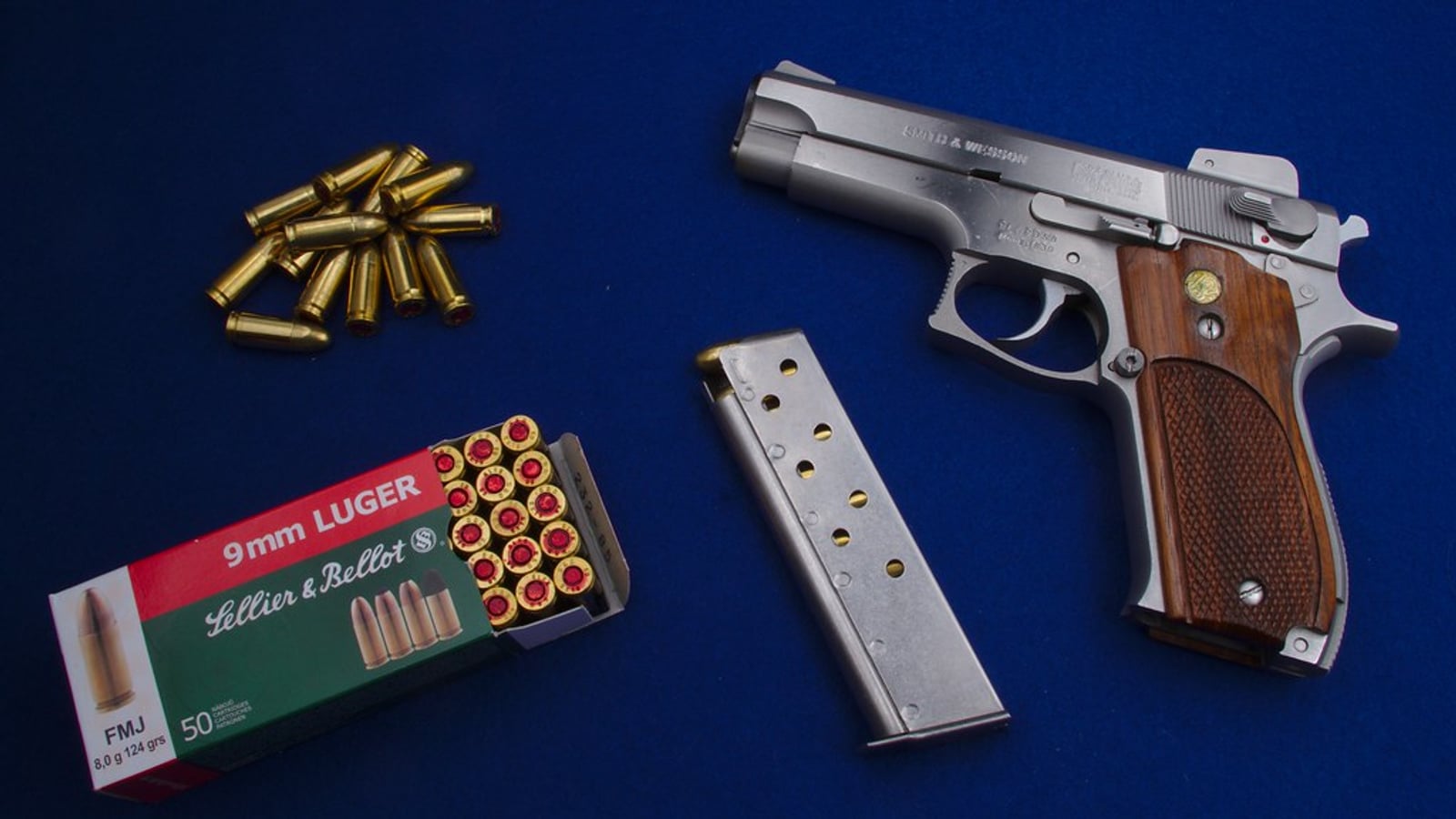
The debate that comes back every time you swap a magazine
As soon as a shooter changes handguns at the club, the question comes back up: 9mm, .40 S&W, or .45 ACP? Everyone has an opinion, often inherited from habit rather than real analysis. This debate still deserves to be taken seriously, because your caliber choice directly shapes your practice.
It touches your budget, ammo availability, recoil in rapid fire, and compatibility with your discipline’s rules. A shooter practicing 25m precision doesn’t face the same constraints as someone doing dynamic shooting on cardboard targets. This article compares the three calibers on concrete criteria, without dogma, to help you choose based on your actual practice rather than a trend.
We’re talking here strictly about civilian sport shooting, at a club or in competition. No tactical or professional dimension comes into play: this is about sport, precision, and the pleasure of shooting.
The regulatory picture: where these calibers stand
Before comparing performance, it helps to set the legal context. Firearms regulations vary widely by country, but semi-automatic pistols chambered in 9mm, .40 S&W, and .45 ACP typically fall under the same licensing category regardless of caliber — usually requiring a permit, a demonstrated need, and active membership in a recognized shooting club with regular, documented practice.
In practical terms, whether you choose 9mm, .40, or .45 ACP, you’ll stay within the same administrative framework for the firearm itself. Ownership is subject to authorization, with paperwork to file with the relevant authority and justified practice at an affiliated club. The chosen caliber changes nothing about this administrative process: it’s the type of firearm (semi-automatic handgun) that determines the category, not the diameter of the projectile.
9mm Parabellum: the unavoidable standard
The 9mm Parabellum (also called 9x19mm) is by far the most common caliber in sport shooting clubs. This popularity isn’t accidental: it’s the most economical caliber to buy, the one you’ll find most easily at every gun shop and on every licensed sales platform.
Its moderate recoil allows fast firing rates with a short sight return, which explains its massive adoption in dynamic shooting (IPSC, USPSA, Steel Challenge). Most divisions in these disciplines are actually designed around this caliber, with power factors calculated to balance 9mm against heavier calibers.
In 25m precision, 9mm sometimes suffers from a reputation as a “less serious” caliber, a perception that rests on no ballistic reality relevant at that distance. A precision pistol chambered in 9mm with quality match ammunition holds up perfectly against a .40 or .45 on a fixed target at 25 meters.
The main practical advantage remains ammo availability and price. Being able to train regularly without going broke on ammunition has a direct impact on progress: a shooter who fires twice as often because their ammo costs less will progress faster than one who limits sessions for budget reasons.
.40 S&W: the compromise that lost ground
The .40 Smith & Wesson was designed as a compromise between 9mm and .45 ACP: more projectile mass than 9mm, less recoil than .45. On paper, the idea is appealing. In practice, in civilian sport shooting, this caliber has steadily lost ground in recent years.
The recoil of the .40 S&W is noticeably sharper than that of the 9mm, with a “snappier” impulse that can fatigue the wrist over a long training session. Many shooters who have tested all three calibers describe this recoil as less pleasant to manage at rapid cadence, especially with standard-weight firearms.
On the availability side, the .40 S&W remains findable but in a more limited selection than 9mm, often with fewer different loads on the shelf at gun shops. The price per round is also higher, which weighs on the ammo budget over the medium term.
In dynamic shooting, the .40 S&W was once favored for its higher power factor at comparable recoil to certain loaded 9mm configurations. But the evolution of the rules and the spread of 9mm ammunition optimized for these disciplines have reduced that advantage. Many practitioners who had invested in this caliber for competition have since switched to 9mm for purely economic reasons.
.45 ACP: the big-bore reference
The .45 ACP (Automatic Colt Pistol) has a long history in civilian sport shooting, particularly through historical disciplines and practices inspired by older firearms. Its heavier, wider projectile produces a different shooting sensation, often described as more “direct” despite a more pronounced recoil.
That recoil is exactly the most debated point. Contrary to popular belief, the .45 ACP isn’t necessarily more unpleasant to shoot than the .40 S&W: its lower muzzle velocity gives a longer, more “rolling” push rather than a sharp jolt. Many experienced shooters find this recoil more predictable to master once they’re used to it, even though it remains more tiring over a long session than 9mm.
The cost per use is the main drawback: .45 ACP ammunition generally costs more per round than 9mm, and the range of loads available from retailers is more limited. For a shooter training intensively, this cost difference adds up quickly over a year of practice.
In 25m precision, the .45 ACP has convinced fans who appreciate the stability of the heavy projectile on a cardboard target. In dynamic shooting, it stays in use but more marginally than 9mm, often among shooters who prioritize the shooting feel over pure cadence optimization.
Recoil comparison: what your wrist will actually feel
Perceived recoil depends on several combined factors: projectile energy, firearm weight, grip geometry, and the shooter’s hold. But with comparable firearms, a clear general ranking emerges between the three calibers.
The 9mm offers the softest and quickest-to-recover recoil, allowing shots to be chained with a short sight return. This is one of the factors explaining why the best times in dynamic shooting are overwhelmingly achieved with this caliber.
The .40 S&W produces a more “jumpy” recoil, perceived by many as the least comfortable of the three over time, with a quick impulse that heavily strains the wrist. The .45 ACP has a broader recoil but is often perceived as softer to absorb, provided the firearm is heavy enough to properly soak up the projectile’s energy.
An experienced club instructor generally recommends testing all three calibers over several sessions before making a decision, rather than relying on generic anecdotes. Recoil perception remains subjective and depends heavily on each shooter’s build and grip technique.
Cost per use: the real impact on your practice
The ammo budget is often the most underestimated factor in choosing a caliber, even though it directly determines how often you can train. A shooter aiming for steady progress needs to train often, and the price per round adds up heavily over a full year.
The 9mm remains the most economical caliber to buy, with a wide range of loads from every licensed retailer, from plinking to match ammunition. This abundance of supply pushes prices down and makes bulk purchases at the club easier.
The .40 S&W sits in an intermediate range, with a higher price per round and a narrower selection. The .45 ACP is generally the most expensive of the three per round, with a more limited range of loads at specialized retailers.
These price gaps vary by period, retailer, and occasional promotions, so it’s better to compare current prices with your gun shop rather than rely on a fixed figure. What stays constant is the relative ranking between the three calibers in terms of cost per use.
Availability: a criterion too often overlooked
Choosing a caliber also means choosing your ability to find ammunition regularly, without depending on a single supply source. The 9mm dominates this criterion by a wide margin: it’s the caliber found in nearly every gun shop and on every licensed online sales platform.
This availability also translates into a wider variety of ammunition suited to each use: economical training rounds, match ammunition for precision, ammunition optimized for dynamic shooting. A shooter using 9mm has plenty of choice to fine-tune their practice.
The .40 S&W and .45 ACP remain available but with a more limited range of loads and sometimes longer lead times depending on the period. A club organizing a competition with multiple disciplines will generally find it easier to source large quantities of 9mm than .45 ACP.
This availability criterion also varies by region and your club’s network: some local gun shops keep different stock depending on their ordering habits. It’s worth checking directly with your regular gun shop before making a final decision based solely on other clubs’ experiences.
25m precision: which caliber for the precision discipline
In 25m precision, the discipline values consistency of grouping and trigger control more than projectile power. All three calibers allow you to reach an excellent level, provided the firearm and ammunition are of quality suited to this practice.
The 9mm is widely used in this discipline, notably because its moderate recoil makes it easier to repeat the shooting motion over long series. Good trigger control matters more than the chosen caliber for achieving tight groups.
The .45 ACP has its fans in precision shooting, with some shooters appreciating the felt stability of the heavy projectile on the cardboard target. This preference stays largely subjective: a regional precision champion may well favor a .45 ACP out of habit and personal comfort, without this reflecting any objective ballistic superiority at this distance.
The .40 S&W is less represented in 25m precision at clubs, likely due to its more limited availability in match ammunition specifically designed for this discipline. This isn’t a technical obstacle, simply a market reality that limits choice.
Dynamic shooting: IPSC, USPSA, Steel Challenge
Dynamic shooting imposes different constraints: high firing rate, quick transitions between multiple cardboard or steel targets, recoil management while moving. Here, the 9mm dominates the practice at clubs and in competition by a wide margin.
Its fast firing rate and short sight return make it the reference caliber for most divisions in these disciplines. The rules actually build in power factors that let 9mm loaded with suitable ammunition stay competitive against heavier calibers.
The .45 ACP keeps a place in certain historical or specific divisions of dynamic shooting, appreciated by shooters who favor the traditional shooting feel. Its broader recoil, however, requires a longer recovery time between shots, which can be a disadvantage in pure cadence.
The .40 S&W had its heyday in dynamic shooting during the years when its power factor offered a clear regulatory advantage. That advantage has largely faded with the evolution of the rules and the optimization of 9mm ammunition, which explains the gradual loss of interest among some competitors in this intermediate caliber.
Metallic silhouettes and other disciplines: which caliber to favor
Metallic silhouette disciplines are shot exclusively at stylized animal silhouettes representing chicken, pig, ram, or turkey, placed at various distances. These targets require solid projectile energy to knock the metal silhouette over on a correctly placed hit.
The .45 ACP has advocates in this discipline for the energy transferred on impact, judged by some to be more effective at knocking over the heaviest silhouettes. The 9mm nonetheless remains widely used too, with ammunition whose energy is sufficient for these same silhouettes provided the discipline’s regulation distances are respected.
The choice mostly depends on the type of silhouette targeted (chicken, pig, ram, or turkey) and the shooting distance set by the event’s rules. An experienced club shooter who practices this discipline regularly will adjust their caliber choice based on the silhouettes they encounter most often in competition.
Magazine capacity and firearm size
The chosen caliber directly influences magazine capacity and the pistol’s overall size, an aspect often overlooked in comparisons that focus solely on recoil or price. A wider projectile takes up more room in the magazine, which mechanically reduces capacity for an equivalent grip size.
A 9mm pistol generally offers the highest magazine capacity in the comparison, a real asset in dynamic shooting where the number of reloads during a stage directly affects final time. Spending less time reloading means gaining precious time on the clock.
The .40 S&W, with an intermediate-sized projectile, reduces this capacity a bit compared to 9mm on the same firearm. The .45 ACP, with the widest diameter of the three, imposes the most marked capacity reduction, or requires a wider grip to keep a sufficient round count.
This size difference also affects handling. A shooter with a rather small hand may have more trouble getting a good wrap of their fingers around a thick grip designed for a high-capacity .45 ACP. Before settling on a choice, it’s worth trying several grip sizes at the club to check what really fits your build, rather than relying solely on the caliber’s specs.
Reloading ammunition: an option worth considering by caliber
Some sport shooters choose to reload their own ammunition, a practice that can noticeably cut the cost per use over the long term, once the initial equipment investment is paid off. This option deserves to be factored into the caliber decision, since it completely changes the budget equation.
The 9mm also remains the simplest caliber to reload for a beginner in this area, with an abundance of published reloading data and wide availability of components (brass, projectiles, suitable powders). This documentary accessibility reduces the risk of errors for someone starting out in this technical practice.
The .45 ACP is also very popular among reloading enthusiasts, partly because its lower muzzle velocity and moderate operating pressure make it a relatively forgiving caliber to work with. Some experienced shooters even consider the .45 ACP a pleasant caliber to reload once the basics are mastered.
The .40 S&W has a different reputation among reloading enthusiasts: its higher operating pressures demand increased rigor in respecting recommended loads. It’s not a caliber to avoid, but it leaves less room for error than 9mm or .45 ACP for someone starting out in reloading.
That said, reloading remains a demanding practice requiring an investment of time, equipment, and rigor, regardless of caliber. A club or experienced shooter can point you toward existing resources and training if this option interests you, rather than diving in alone without guidance.
The caliber’s impact on learning the shooting motion
The choice of caliber has a real influence on how fast you learn the shooting motion, particularly for a beginner who still needs to automate their recoil and trigger management. Recoil that’s too pronounced in the first sessions can install bad reflexes, such as anticipating the shot by tensing the hand before it even breaks.
The 9mm is often recommended to beginners precisely for this reason: its moderate recoil allows focus on the fundamentals (sight alignment, breathing, trigger control) without recoil anxiety getting in the way of learning. A club instructor will very generally start a new shooter on this caliber, whatever caliber they move toward afterward.
The .45 ACP, with its broader recoil, can be harder to tame very early in practice, even though this recoil is often described as “softer” once the technique is acquired. It’s not uncommon for a shooter to start with 9mm then move to .45 ACP after consolidating their fundamentals, rather than the other way around.
The .40 S&W, with its snappier impulse, also demands an already fairly solid technique to be well managed without excessive wrist fatigue. It’s a caliber that suits a shooter who already has several months or years of regular practice behind them.
This progression isn’t mandatory at all: some shooters start directly with their caliber of choice and adapt very well. But for anyone still hesitating, starting with 9mm remains a reasonable pedagogical choice before exploring other options as desired.
Reliability and malfunctions: an often underestimated criterion
Functional reliability depends mostly on the quality of the firearm, its maintenance, and the chosen ammunition, far more than on the caliber itself. But certain mechanical differences between the three calibers deserve to be known before making a choice, since they indirectly influence the malfunction rate during a shooting session.
The 9mm, due to its operating pressure and case geometry, generally works well with the standard recoil springs shipped with most club pistols. Slide cycles are consistent, which limits malfunctions linked to a cycle that’s too soft or too violent, provided the firearm is properly maintained and the chosen ammunition matches the manufacturer’s recommendations.
The .45 ACP, with its lower muzzle velocity and heavier projectile, imposes a different slide cycle. Some older or older-design firearms can be more sensitive to the type of ammunition used, particularly with reloaded ammunition or unusual projectile profiles (truncated cone, for example). A shooter discovering a .45 ACP pistol should verify their firearm’s reliability with several types of ammunition before committing to an important competition with this equipment.
The .40 S&W has a reputation, among some gunsmiths and workshop technicians, of stressing certain wear parts (springs, extractors) more heavily due to its higher operating pressure for a case volume comparable to 9mm. This isn’t a fatality, but it can translate into a slightly higher part-replacement frequency on certain models, a detail worth factoring into the total cost of ownership over several years of practice.
In all cases, the best guarantee of reliability remains rigorous, regular maintenance of the firearm, regardless of the chosen caliber. A poorly cleaned or poorly lubricated pistol jams more often than a clean one, no matter what diameter projectile it fires. The caliber influences the tolerated margin of error, not the need for maintenance itself.
Maintenance and cleaning: constraints that vary by caliber
Cleaning a handgun after a shooting session is an unavoidable step, but its scope varies noticeably depending on the caliber used, which has a direct impact on the time spent on this task after each club outing.
The 9mm, with its moderate operating pressure and the abundance of low-fouling ammunition on the market, generally generates reasonable fouling of the barrel and chamber. A standard cleaning after a session of one to two hundred rounds stays quick with a classic kit (bore brush, cleaning rod, solvent, and suitable oil).
The .45 ACP, due to its lower muzzle velocity, sometimes leaves a slightly more noticeable deposit of unburned powder in certain ammunition configurations, particularly with poorly calibrated home reloads. This isn’t a major problem with quality ammunition from a recognized manufacturer, but shooters who reload their own should pay attention to this detail to avoid excessive fouling of the extraction system.
The .40 S&W, due to its higher pressures, may require particular attention to the chamber and breech face, areas where fouling can be slightly more pronounced with certain ammunition batches. Regular visual inspection of these areas helps anticipate premature wear or the start of a malfunction before it shows up during a session.
Beyond these nuances, the essential thing remains to follow the firearm manufacturer’s recommendations on cleaning frequency and products to use. A club pistol, often shared between several users during loaner sessions, deserves even greater vigilance on this point, since its actual maintenance history isn’t always precisely known by every shooter who borrows it.
Barrel length and firearm weight: a game-changing factor
The perceived recoil and precision obtained with a given caliber depend heavily on barrel length and total firearm weight, a parameter that can shift a caliber preference far more than you’d imagine at first glance. Comparing the three calibers on firearms of different sizes completely distorts the perception you can form.
A compact pistol, designed for discreet carry rather than competition, will absorb the recoil of a .40 S&W or .45 ACP noticeably worse than a longer, heavier competition model. Conversely, a 25m precision pistol with a long barrel and substantial weight can make the recoil of the .45 ACP almost as comfortable as a 9mm fired from a compact firearm. Comparing calibers therefore only makes sense across similar firearm sizes.
The extra weight at the front of the pistol, often brought by a longer barrel or a counterweight under the barrel used in dynamic shooting, absorbs part of the recoil energy before it travels up to the shooter’s wrist. This is one reason why many competition pistols in .45 ACP display a higher weight than their 9mm equivalents: this extra mass partly offsets the caliber’s extra energy.
For a shooter still hesitating between the three calibers, it’s therefore useful to compare firearms of similar design and size rather than judging a caliber from a compact model fired only once at the club. A .45 ACP in a heavy competition pistol can pleasantly surprise a shooter who only knew this caliber through a more punchy compact model.
Try before you buy: the real good method
Beyond theoretical comparisons, the best way to choose a caliber remains to actually shoot it, several times, under conditions representative of your future practice. A sport shooting club generally has a fleet of loaner or rental firearms that lets you test different calibers before any personal investment.
Using these trial sessions to fire several dozen rounds per caliber gives a far more reliable picture than a few isolated shots. The feel of recoil often evolves after the first ten or twenty shots, once the initial apprehension fades and the caliber’s true sensation reveals itself.
It’s also worth asking for feedback from other club members, keeping in mind that each opinion remains personal and tied to the build or experience of the person giving it. An experienced club shooter who has practiced dynamic shooting for a long time won’t necessarily have the same preferences as an occasional 25m precision shooter.
Finally, think about projecting yourself into the medium term rather than just the first impression. The caliber that suits you is the one you’ll be able to shoot often, with pleasure and without excessive budget strain, not necessarily the one that impresses the most during a one-off try.
Reloaded vs new ammunition: another budget angle
Beyond the purchase price per round, the question of ammunition type (new, remanufactured, or reloaded by a third party) deserves to be asked separately for each caliber, since the price gap between these categories varies noticeably from one caliber to another.
For 9mm, the supply of remanufactured or reconditioned ammunition is large, driven by the significant volume of brass collected at clubs and reprocessed by specialized shops. This abundance pushes prices down and lets a dedicated shooter further reduce their annual budget without sacrificing the consistency of their training ammunition, provided they choose a serious supplier recognized by the club.
For .45 ACP, the supply of remanufactured ammunition also exists but to a lesser extent, with a more limited choice of suppliers on the market. Shooters who use this caliber intensively often benefit more from turning to personal reloading rather than commercial remanufacturing, given the less developed supply compared to 9mm.
For .40 S&W, the supply of remanufactured ammunition is the most limited of the three, which restricts cost-reduction options for a shooter who doesn’t reload their own. This relative scarcity further widens the cost-per-use gap already unfavorable to this caliber compared to 9mm.
It’s worth remembering that remanufactured or reconditioned ammunition should come from serious suppliers who respect applicable safety standards and remain compatible with the manufacturer’s recommendations for the firearm used. An affiliated club can point a shooter toward reliable sources rather than dubious offers found at random online.
Compatibility with optics and sighting accessories
The rise of sport shooting with red-dot optics on pistols has changed some club habits in recent years, and the caliber choice has an indirect effect on this practice worth mentioning. A caliber’s recoil influences the speed at which the red dot returns to a stable position in the sight window after each shot.
The 9mm, with its softer recoil, generally allows for a faster recovery of the optical sight point, which partly explains why the vast majority of pistols equipped with an optic in dynamic shooting competition are chambered in this caliber. The shooter loses less time re-finding their red dot between two closely spaced shots.
The .45 ACP, with its broader recoil, requires a slightly longer visual recovery time with an optic, which can show up in high-cadence drills. This in no way prevents quality practice with this caliber and an optic, but it’s a parameter worth knowing before investing in this type of equipment for this particular caliber.
Mounting an optic also slightly changes the firearm’s balance and weight, which can in turn influence recoil perception depending on the chosen caliber. A .45 ACP pistol equipped with an optic and a suitable counterweight can thus become more pleasant to shoot than a standard model without accessories, which ties back to the point already made about the importance of total firearm weight in caliber comparisons.
Recommendation by shooter profile
For a beginner discovering sport shooting who wants to train often without going broke, 9mm remains the most sensible choice. Its moderate cost per use and wide availability allow for regular practice, an essential condition for progressing quickly in the first years.
For a dynamic shooting practitioner aiming at competition, 9mm also stands out as the reference caliber, carried by its firing rate and the wealth of ammunition optimized for this practice. It’s the choice consistent with the overwhelming majority of the competition field.
For a 25m precision shooter who’s primarily looking for grouping consistency, the caliber choice matters less than the quality of the firearm and ammunition. 9mm remains a relevant, economical choice, while .45 ACP will suit those who appreciate its particular shooting feel and have the budget to train enough despite the higher cost.
For a fan of historical disciplines or metallic silhouettes, .45 ACP keeps all its appeal, particularly for the energy transferred onto the heaviest silhouettes. The .40 S&W, finally, remains a relevant choice especially if you already own a firearm in this caliber: there’s no urgency to switch if the practice suits you, but it no longer really has a decisive advantage when buying a new firearm today.
FAQ
Q: Is the .40 S&W a caliber to avoid for a first purchase? A: It’s not a bad caliber, but it offers fewer concrete advantages today compared to 9mm in terms of cost and availability. For a first purchase with no existing firearm in this caliber, 9mm generally remains more practical day-to-day.
Q: Is the recoil of the .45 ACP really an issue in competition? A: It’s broader than that of 9mm but often described as more “rolling” and predictable once you get used to it. It depends a lot on the weight of the firearm and the shooter’s grip technique.
Q: Can you use the same pistol for 25m precision and dynamic shooting? A: It depends on the model and each discipline’s rules, which sometimes impose specific constraints on weight or sighting devices. Check with your club to find out which categories are allowed in each event.
Q: Does the chosen caliber change the firearm’s administrative category? A: No, nearly all semi-automatic pistols in 9mm, .40 S&W, and .45 ACP fall under the same licensing framework. It’s the type of firearm that determines the category, not the caliber.
Q: Do you need to switch calibers to progress faster? A: Rarely. Consistency of training and mastery of trigger control matter far more than the caliber used. It’s better to train often with an economical caliber than rarely with a more prestigious one.
Q: Where can you check current ammunition prices and availability? A: Prices and stock vary by period and retailer, so it’s best to check directly with your regular gun shop or licensed sales platforms. Clubs also sometimes organize bulk purchases that can affect the final price.