
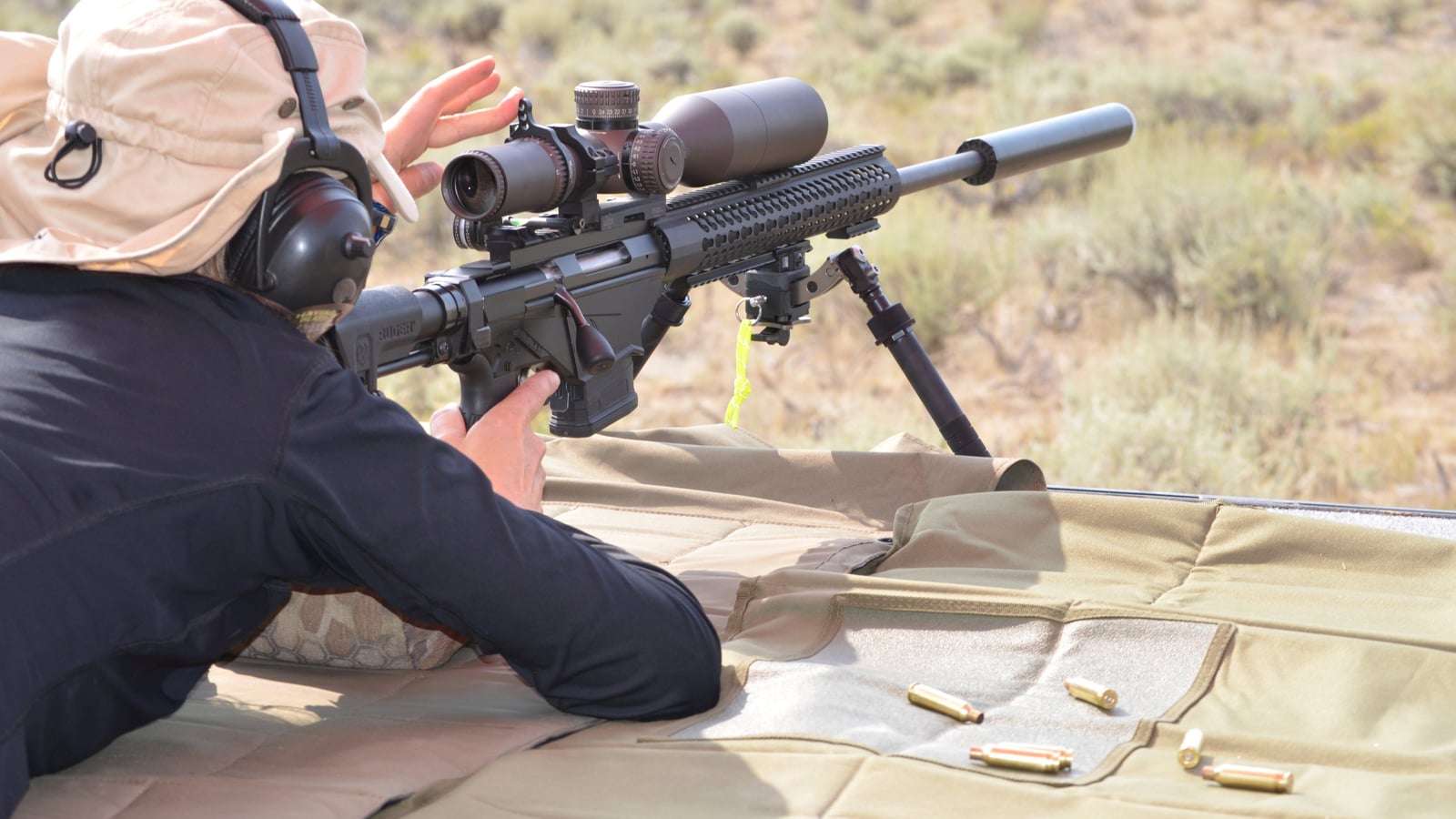
An Olympic discipline almost nobody practices in France
300-metre rifle shooting is one of the oldest disciplines in sport shooting, present at the Olympics since the origins of the modern Games. And yet, ask ten random club shooters if they’ve ever tried it: the answer will almost always be no.
The paradox has a simple explanation. 300m rifle demands infrastructure that very few clubs can offer: a clear firing line over three hundred metres, free of obstacles, with no risk to neighbouring areas, and a backstop sized accordingly. In dense urban or suburban areas, that kind of land simply doesn’t exist.
The result is a discipline that mostly survives in a handful of historic strongholds: a few regional ranges inherited from old infrastructure, rural clubs with enough land, or facilities shared with other uses (old fairground shooting galleries, military terrain converted to civilian shooting). The scarcity isn’t a choice shooters made — it’s a geographic constraint.
This article covers what really sets 300m apart from the more common 50m: the ballistics change in nature, wind reading becomes a discipline of its own, the gear gets specialised, and the scarcity of ranges forces a different way of organising your practice. The goal is to give a realistic picture of this discipline to anyone who’s heard of it but never had access to it, or who’s considering giving it a try if the opportunity comes up.
One clarification up front: rifles used at 300m usually fall under category C (declaration) for classic manual-repeat actions, or category B (prefectural authorization) for certain semi-automatic models or particular loading systems. The exact classification always depends on the specific model of the firearm, never solely on the shooting distance targeted: always check with your gunsmith or federation before any purchase.
This paradox between Olympic pedigree and practical obscurity isn’t unique to France. In several neighbouring countries, the discipline also stays concentrated on a limited number of sites, for the same reasons of land footprint. What sets the French situation apart is mostly the density of the urban fabric, which leaves little room for the vast, open terrain this practice requires.
There’s still a loyal core of practitioners who keep the discipline alive with an almost militant passion. They’re often shooters who came from other precision disciplines (50m, air rifle) who discovered 300m through a training course, a regional competition, or word of mouth from a neighbouring club — and who never looked back once the technical demands hooked them.
This obscurity also has a positive flip side: the clubs and time slots that still exist cultivate a different, tighter-knit atmosphere, where mutual support between shooters matters more than pure competition. The small number of shooters involved favours a direct, often oral transmission of know-how between long-time regulars and newcomers curious about this distance.
What actually changes between 50m and 300m
On a 50m firing line, most of the work is about holding position and repeating the same movement consistently. The bullet flies in an almost straight line, wind has a measurable but rarely dramatic effect, and a good standard rifle is enough to stay competitive.
At 300 metres, everything changes. The bullet’s time of flight multiplies, giving gravity, wind, and even the Earth’s rotation on extreme distances, time to act on the trajectory. It’s practically a different sport in terms of technical demands, even though the basic movement (prone, kneeling, standing positions) stays the same.
Bullet drop becomes a central parameter. Over 300 metres, a bullet that seemed to fly “straight” at 50m will have dropped several tens of centimetres, sometimes more than a metre depending on caliber and load. The shooter has to correct their aim accordingly, either through graduated elevation adjustment on the optic or front sight, or through a calculated hold-over above the aim point.
Group dispersion also increases mechanically with distance, even at equal shooting quality. A tenth-of-a-degree inaccuracy in the barrel’s departure angle produces a negligible deviation at 50m, but a much more visible one at 300m. That means consistency flaws (ammunition, cheek weld, breathing) that went unnoticed at short range become decisive scoring factors.
Finally, the time between the shot leaving the barrel and impact leaves a window where atmospheric conditions can change. A gust of wind picking up between two shots, a shift in light that changes how the front sight is perceived: these matter far more at 300m than at 50m, where the shot is nearly instantaneous from the shooter’s point of view.
Even the pace of a session changes in nature. At 50m, a shooter can fire off a complete string in a few minutes, with quick visual feedback on each impact. At 300m, every shot comes with time spent observing through the spotting scope, reading conditions, sometimes adjusting settings before the next shot: a full session structurally takes more time for a much smaller volume of ammunition fired.
Even the very idea of a “good group” changes scale. A group of a few centimetres at 50m, considered excellent, would correspond to a much wider angular spread once translated to 300 metres. Shooters used to both distances learn to think in angles rather than raw dimensions on the target, which takes a non-trivial mental adjustment when switching from one discipline to the other.
Feedback itself differs too: at 50m, the target often stays visible to the naked eye or through a low-magnification scope set up on the firing line. At 300m, without a dedicated spotting scope and a suitable impact-tracking system, the shooter can stay uncertain about their result for several shots, which deeply changes how you manage a string and adjust technique in real time.
300-metre ballistics: what you really need to understand
A bullet’s trajectory is never a straight line: it’s a parabola that starts dropping the moment it leaves the barrel, under the effect of gravity. Over 50 metres, that drop stays small enough to be compensated by a basic setting without constantly thinking about it. Over 300 metres, it becomes an active calculation every session.
The bullet’s initial velocity (measured in metres per second) directly determines how long it stays airborne, and therefore how long gravity has to act. A faster bullet drops less over a given distance, which explains why certain calibers are preferred at 300m for their relatively flat trajectory.
The bullet’s ballistic coefficient plays an equally important role: it measures the projectile’s ability to hold its velocity against air resistance. A long, tapered, well-shaped bullet loses less velocity in flight than a shorter, rounder one, even at the same initial velocity. Over 300 metres, this cumulative effect noticeably shifts the point of impact.
Air density itself varies with temperature, altitude, and humidity, and affects the resistance the bullet encounters. The same elevation setting won’t produce exactly the same impact on a scorching hot day versus a cold, dense-air day. Experienced 300m shooters adjust their aim point according to these conditions, even though the effect stays more subtle than wind’s.
You also have to account for spin drift, caused by the bullet’s own rotation (the gyroscopic effect imparted by the barrel’s rifling). This drift, often negligible at 50m, becomes measurable at 300m and pushes the bullet slightly to one side depending on the barrel’s twist direction. A regular shooter at this distance learns their rifle’s specific drift and compensates for it in their setup rather than correcting shot by shot.
The barrel’s twist rate (the distance needed for one full rotation) has to match the weight and length of the bullet used to achieve proper gyroscopic stabilization. A bullet too heavy for too slow a twist rate stays unstable in flight, with dispersion that worsens sharply as distance increases. It’s a parameter 300m shooters systematically check before choosing a load, whereas it often stays secondary at 50m.
The firing line’s elevation relative to the target introduces an extra variable rarely encountered at short range: a shot slightly downhill or uphill changes gravity’s actual effect on the trajectory, to a degree that becomes noticeable at 300 metres while it would be insignificant at 50. 300m ranges built on even a slight slope therefore require a setting adjustment specific to each firing point.
Finally, the ammunition’s manufacturing quality matters more at this distance. A tiny variation in bullet weight or powder charge from one cartridge to the next, invisible in its effect at 50m, translates into a velocity difference that amplifies proportionally with flight time. It’s one of the reasons top-level 300m shooters sort and weigh their ammunition with a care that few 50m shooters consider necessary.
Reading the wind: the skill that makes all the difference
If you had to sum up in one sentence what separates a 50m shooter from a seasoned 300m shooter, it would be wind reading. At short range, crosswind pushes the bullet only a limited amount. At 300 metres, the same wind, applied over a much longer flight time, can shift impact by several tens of centimetres.
Wind is almost never uniform across the bullet’s entire path. It can blow one direction near the firing line and another near the target, with different intensities midway. A 300m shooter has to learn to observe several cues at once: the optical mirage above heated ground, the movement of flags or pennants set up along the range, the swaying of surrounding vegetation.
A common method is to mentally break the bullet’s path into several segments and estimate a weighted average wind, giving more weight to the wind encountered near the departure point (where the bullet is still fast and where the cumulative effect takes longer to show). This weighting isn’t intuitive and is mostly learned through repeated practice on the same type of terrain.
Mirage, that visual shimmer of hot air rising from the ground, is a valuable but tricky indicator to read. Its direction and apparent speed give an indirect indication of wind, provided you know how to observe it with a dedicated spotting scope, set to a suitable magnification and pointed slightly above the ground between shooter and target.
Many clubs that practice 300m organize sessions in pairs, where an experienced spotter reads conditions and calls out adjustments while the shooter focuses on their execution. This team-based setup, almost absent from classic solo 50m shooting, is one of the discipline’s strong cultural traits.
You also have to accept a share of irreducible uncertainty. Even a seasoned club shooter never reads the wind with perfect accuracy: the skill lies in reducing error, not eliminating it. That margin of uncertainty is what makes the discipline demanding and explains why 300m scores vary more from one session to the next than at 50m.
Some shooters use artificial markers in addition to flags, like light ribbons fixed at regular intervals along the firing line, to visualize wind direction and intensity at different distances rather than a single point. This kind of instrumentation stays optional but considerably helps build a finer mental picture of the actual wind the bullet encounters over its whole path.
The vertical component of wind, often neglected in favour of crosswind alone, also deserves attention on hilly terrain or terrain surrounded by relief that creates local updrafts or downdrafts. These vertical air movements can slightly alter the shot’s effective range, a phenomenon only very experienced shooters learn to perceive after many sessions on the same terrain.
A common exercise in clubs that coach this discipline is to have the same shooter fire with a wind call the spotter deliberately gets wrong, to teach them to trust their own reading rather than an unverified outside call. This teaching exercise illustrates well that wind reading ultimately remains an individual skill that can never be fully delegated.
Gear specific to 300 metres
Choosing a rifle for 300m differs from choosing one for 50m on several structural points. The barrel is generally longer, letting the powder burn more completely and accelerate the bullet to a higher initial velocity, reducing flight time and therefore sensitivity to wind and drop accordingly.
The weight of the rifle counts differently too. A heavier rifle dampens recoil better and stabilizes the aim more over the course of a prone string, which becomes valuable when every hold error translates into an impact error amplified by distance. Many rifles dedicated to 300m are noticeably heavier than their 50m equivalents.
A stock adjustable in length, cheek height, and sometimes cant takes on greater importance. At 300 metres, the prone position has to be held rigorously identical shot after shot for elevation settings to stay valid: the slightest change in eye position relative to the sight line shifts the perceived point of impact.
On the optics side, scopes used at 300m generally offer higher magnification than at 50m, with precise turrets adjustable in clicks, often expressed in milliradians or minutes of angle. These adjustments let you compensate for bullet drop in a repeatable way, pre-calibrated based on ballistic tables established for each caliber and load.
The bipod or the shooting bag (bean bag) remains the preferred support in the prone position, with a clear preference for very stable rests, minimally sensitive to micro-movements, since any residual barrel vibration at the shot amplifies over 300 metres. Some shooters add a rear support bag under the stock to further refine vertical stability.
Finally, a separate spotting scope, mounted on its own tripod distinct from the rifle, is almost indispensable for tracking impact on the target and reading wind conditions continuously — equipment rarely needed at 50m, where the naked eye or the rifle scope is usually enough to spot the point of impact.
The barrel itself often benefits from a heavier profile (thicker along its full length) at 300m, which reduces progressive heating over the course of a string and limits the thermal distortion that can slightly deflect subsequent shots in the same sequence. This profile choice costs in overall weight, which explains why 300m rifles are rarely designed to be carried on foot over long distances.
The muzzle brake, a device fitted to the end of the barrel to redirect part of the firing gases, is found more frequently on rifles dedicated to 300m than on those used at 50m. Its role is to reduce perceived recoil and muzzle rise, which makes it easier to track the shot visually and reacquire the sight picture between shots in the same string.
The carrying case and the optic’s protective gear also gain importance, since trips to the rare 300m ranges often mean longer travel and sometimes repeated handling of the equipment between vehicle and firing line. A scope knocked out of zero by a transport impact instantly ruins all the calibration work done in previous sessions.
Typical calibers used at 300 metres
Caliber choice at 300m follows a different logic than at 50m, where almost any reasonable caliber works. Here, ballistic coefficient and resistance to wind become decisive, which naturally points towards heavier, better-shaped bullets.
Calibers like the .308 Winchester remain a solid reference at 300m thanks to their balance of availability, reasonable cost, and proven ballistic behaviour at this distance. Its bullet, heavier than that of a light caliber, holds its velocity better and resists crosswind better.
Other, more specialized calibers, developed specifically for long-range precision, offer an even better ballistic coefficient at the price of more limited availability and a higher cost per round. These choices mostly make sense for a shooter who practices the discipline regularly, not for a one-off try.
Conversely, light and fast calibers, very popular in dynamic shooting or at the 50m beginner level for their low recoil and reduced cost, quickly show their limits at 300m: their bullet loses velocity faster against air resistance, which accentuates drop and wind sensitivity beyond a certain distance.
Reloading ammunition, a practice already widespread among precision shooters, becomes almost unavoidable in competitive 300m shooting. Precisely adjusting powder weight, bullet type, and seating depth achieves a ballistic consistency that store-bought ammunition — good for general use — doesn’t always deliver at the level this distance demands. This practice, however, requires rigorous learning and serious guidance, and shouldn’t be improvised without proper training.
Whatever caliber is chosen, the consistency of a given load (same powder lot, same primer type, same bullet) matters more than raw power. A seasoned club shooter will almost always prefer a modest but perfectly reproducible load over a faster one that varies irregularly from one cartridge to the next.
Cost per round becomes a concrete budget factor for anyone who practices 300m regularly. The ammunition best suited to this distance, often heavier and better shaped, is structurally more expensive than generic light-caliber ammunition used for beginners or dynamic shooting. This cost, accumulated over a competition season, weighs on caliber choice as much as pure ballistic performance.
Availability in stores also varies noticeably from one caliber to another. Some very common calibers are easy to find at most gunsmiths, while others, more specialized for long-range precision, sometimes require ordering ahead or sourcing through more specialized channels. This practical availability criterion often matters as much as pure performance in the final choice of a shooter starting out in the discipline.
The choice of bullet type (polymer tip, boat-tail, or other precision-specific profiles) also influences the ballistic coefficient independently of the caliber chosen. Two rounds of the same caliber but with different bullet profiles can show noticeably different behaviour in wind at 300 metres, which explains why experienced shooters in this discipline care as much about bullet type as about caliber itself.
Why 300m ranges are so rare in France
The scarcity of 300m firing lines in France comes down first to a simple physical constraint: you need land clear over three hundred metres, with a sufficient lateral safety zone and a backstop sized to stop projectiles with high residual energy. This kind of land is rarely available near populated areas.
Historically, some of the existing 300m ranges in France date back to a time when civilian sport shooting had access to more extensive land, often in rural areas or on the edge of municipal properties. Many of these grounds have since been reduced, repurposed, or closed as urbanization has eaten into available space.
Managing noise and perimeter security for a 300-metre distance also imposes regulatory constraints and development costs that few clubs can shoulder alone. A suitable safety berm, signage, and access control over such a large area represent an investment only a handful of well-funded clubs or regional structures can carry.
This scarcity translates concretely into a very geographically concentrated practice: a few reference clubs host most of an entire region’s 300m shooters, and many practitioners have to travel a significant distance to reach a firing line suited to their discipline. The proximity logic that applies to 50m or 25m simply doesn’t apply here.
Some clubs partly work around the constraint by organizing occasional slots or courses on facilities shared with other federations or other land uses (long-range archery, clay pigeon shooting on part of the grounds). This kind of sharing, however, remains the exception rather than the rule.
For a shooter discovering an interest in 300m, the first step is almost always to check directly with their regional league or federation to identify the facilities available within reasonable reach, rather than assuming a typical local club offers this distance.
Local environmental constraints also weigh on maintaining these facilities over time. The noise generated by more powerful ammunition than what’s used at 50m or 25m can lead to complaints from residents, an issue less present for short-range disciplines often housed in enclosed or soundproofed structures.
Some projects to develop or renovate existing 300m ranges also run into the difficulty of funding regular upkeep of the backstop and safety zone over such a great length. Unlike a 50m firing line that’s often covered and protected from the weather, a 300m range stays largely exposed, which accelerates infrastructure wear and requires recurring maintenance work.
Regional initiatives do exist, driven by certain leagues, to map and support the rare remaining 300m facilities, aware that losing even a single range can deprive an entire region of access to the discipline. Getting in touch with your league also lets you learn about these preservation efforts and, sometimes, support them as a practitioner.
Organizing yourself to practice 300m despite the scarcity of ranges
Faced with this scarcity, shooters who actually practice 300m develop organizational habits different from classic weekly club shooting. A 300m session is often prepared in advance, grouped over a full day, and sometimes shared among several people to make the trip worthwhile.
Many clubs with a 300m firing line organize dedicated time slots, less frequent than simple open access, with prior booking or registration. This setup lets them manage a flow of shooters on a facility that demands more safety oversight and supervision than a short-range firing line.
Carpooling and sharing spotting gear (scopes, tripods, wind flags) are common among regular practitioners of this discipline, precisely because the full equipment set represents an investment few individual shooters can justify alone for occasional practice.
Some shooters also organize their progression by alternating rare, travel-intensive 300m sessions with more frequent training at 50m or dry-fire practice at home, working on position and breath control — skills transferable between both distances even though the ballistic settings differ.
The competition side follows the same logic of scarcity: official 300m matches often bring together shooters from several departments, making them rarer events on the calendar but also more convivial, with a different atmosphere than the more frequent, more local 50m or 25m competitions.
Budget planning for a 300m season also differs markedly from a weekly 50m practice. Between travel costs, more expensive ammunition, and entry fees for the rare available competitions, a regular shooter in this discipline has to plan an annual budget distributed differently, with fewer outings but a higher cost per outing.
Some shooters choose to build their holidays or weekends around a trip to a region with a well-known 300m range, turning the constraint of scarcity into an opportunity for broader regional discovery. This approach, closer to sport tourism than classic club practice, is unique to this discipline precisely because of the geographic spread of available facilities.
Building a small, stable group of training partners who share the same trips and the same interest in the discipline greatly eases this organization over time. Many 300m shooters interviewed about their practice mention this core group of travel companions as a factor as important as the gear itself in their ability to progress despite the scarcity of shooting opportunities.
Shooting positions and their increased demands at 300m
The three classic rifle shooting positions (prone, kneeling, standing) also exist at 300m, but their technical demands scale up with distance. The prone position, the most stable, remains the most practiced in long-range competition, precisely because it minimizes the micro-movements that amplify so much over this range.
Breathing takes on added importance: the moment of release has to coincide with a natural pause in the breathing cycle, to keep chest movement from disturbing the sight line at the critical moment. This breathing discipline, already taught from the beginning, becomes a direct scoring factor at 300m.
Trigger release has to remain absolutely consistent, with no jerk and no anticipation of recoil. An error of a few millimetres in finger movement on the trigger, negligible at 50m, translates into a far more visible impact deviation at 300 metres. It’s one of the points experienced instructors stress most heavily with shooters discovering the discipline.
Follow-through (staying in position and holding the sight picture for a moment after the shot) helps confirm nothing moved at the moment of release and gives useful clues about any hold flaws. This habit, useful at any distance, becomes almost a mandatory reflex at 300m, where every flaw costs the score dearly.
The standing position, far more unstable by nature, is much less practiced in classic competitive 300m shooting, except in certain specific events that require it. The difficulty of stabilizing aim at this distance without support makes this position demanding enough to be reserved for shooters already very experienced in the more stable positions.
The kneeling position, intermediate in stability between prone and standing, finds little place in common 300m practice, being used more at 50m or in mixed disciplines that require cycling through all three postures. Over such a demanding distance, the stability gap between prone and kneeling translates into a score gap significant enough that most 300m competitions favour the prone position almost exclusively.
Precise body alignment relative to the firing axis deserves particular attention specific to this distance: a body angle poorly aligned with the sight line creates residual muscle tension that gradually releases over the course of a string and imperceptibly shifts the point of impact from one shot to the next. Experienced 300m shooters spend a disproportionate amount of time, compared to 50m, fine-tuning this body alignment even before starting to fire.
Managing muscle fatigue over a long session is also an important practical difference. Holding a rigorously identical prone position for several tens of minutes — the time of a complete string with observation pauses between each shot — engages muscle groups differently than a faster sequence at 50m, and requires physical preparation sometimes neglected by beginners in the discipline.
Progression and learning: how to approach this discipline
For a shooter coming from 50m who wants to discover 300m, the transition doesn’t happen overnight. The best approach is to ask an experienced instructor at a club with the right facility, rather than attempting self-training in such a technical discipline.
The first session mainly serves to understand the scale of the adjustments: how many clicks of elevation correspond to which distance, how to read the first wind cues, how to adjust position to hold a stable shot over a full string. These basic reference points take time to internalize and don’t substitute for direct experience on the range.
Many clubs that offer this discipline organize supervised discovery days, where suitable gear (rifle, optics, rests) is loaned or shared, letting you test the discipline before investing in personal, dedicated equipment. It’s a recommended step before any purchase, given how much 300m gear differs from general-purpose 50m gear.
Keeping a precise shooting log takes on particular importance at 300m: noting observed wind conditions, elevation settings used, caliber and load lets you gradually build reliable personal reference points instead of starting from zero every session. This tracking discipline is arguably even more useful here than at 50m, where fewer variables are in play.
A seasoned club shooter who practices 300m regularly often stresses one point: progression is slower than at 50m, precisely because shooting opportunities are rarer. You have to accept this different pace and not compare your 300m progression curve to what you’d experience in a more accessible discipline.
Dry-fire practice (without ammunition, to work purely on position and release) takes on particular value between 300m sessions spaced several weeks apart. This practice helps maintain the muscle memory of position and trigger control without depending on rare access to a suitable firing line, even though it never replaces the real experience of reading wind in the field.
Reviewing sessions after the fact, comparing shooting log notes against results, helps distinguish real progress from variation due to the day’s conditions. A shooter starting out in the discipline sometimes tends to over-interpret a single good or bad session, whereas the true measure of progress at 300m shows up over several sessions spread over time, given the intrinsic variability of outdoor conditions.
Taking part, even occasionally, in local or regional competitions in the discipline also helps speed up learning through direct comparison with other practitioners and by observing their setup and wind-reading methods. This collective dimension of learning partly makes up for the scarcity of individual shooting opportunities.
Safety and regulations specific to long range
Safety on a 300m firing line imposes stricter constraints than a short-range line, if only because of the extent of the area to secure and the residual energy of projectiles at this distance. Scrupulous compliance with club and range officer instructions is even more essential here than elsewhere.
Communication between shooters and range staff takes a more formalized shape on these facilities: clear signals for start and end of firing, systematic verification that the area is clear before each string, strict management of movement into the target zone for posting and checking targets. These protocols, present at any distance, are applied with heightened rigor at 300m.
The classification of the firearms used always follows the same national regulatory framework: category A banned for civilians, category B subject to prefectural authorization, category C subject to declaration, category D freely sold or simply registered. No special classification applies to the mere fact of shooting at 300 metres: it’s the model of the firearm, not the practice distance, that determines its category.
Transporting and storing equipment follows the same general rules as for any sport shooting firearm, with the usual precautions for unloaded, secured transport. The practice distance changes nothing about these basic obligations, which remain identically valid from 25m to 300m.
Timelines and procedures for category B authorizations vary by prefecture and individual case: stay general on this point and check directly with your federation or your prefecture rather than relying on a typical timeline, which can differ noticeably from one case to another.
Supervision by a qualified range officer, specifically trained in managing a long-range firing line, remains a basic requirement at this type of facility. The number of shooters allowed on the line at once is often more limited than at 50m, precisely to allow closer individual supervision given the energy involved.
Managing the target zone deserves a special mention: checking and posting targets 300 metres from the firing line requires a strict safety procedure, with a full ceasefire and clear confirmation before any movement into that zone. This procedure, heavier than at 50m where the target often stays close and continuously visible, strongly shapes the pace of a competition or training session.
Hearing and eye protection remains, of course, an equal obligation at any shooting distance, but some 300m shooters add enhanced hearing protection given the generally higher power of the ammunition used at this distance compared to 50m practice with lighter calibers.
The mental game specific to long range
The mental dimension of 300m differs from 50m through the duration of uncertainty between releasing the shot and reading the impact. This delay, much longer than at short range, leaves time for doubt to creep in before you even know whether the wind call was right.
This prolonged uncertainty calls for a different form of accepting a one-off miss. A shooter who misses an impact despite a careful wind read has to learn to distinguish a judgment error from simply uncontrollable variability in conditions, without tensing up or over-correcting on the next shot.
Patience between strings also takes on particular weight: unlike 50m, where the sequence can be relatively fast, 300m often imposes pauses to observe targets, adjust settings, and wait for a lull or stabilization in wind conditions before resuming. Knowing how to manage this waiting without losing concentration is a skill in its own right.
An experienced club instructor often sums it up to her students like this: at 300m, consistency of movement has to become total muscle memory, to free up all conscious attention for reading outside conditions, the only real lever for progress left once basic technique is acquired.
Managing frustration in the face of a disappointing result also calls for a different relationship with failure. Given how rare sessions are, a shooter having a bad day at 300m can’t always “get their revenge” the following week the way they could with 50m shooting accessible every weekend. This wait between two chances to correct the shot demands an extra form of perspective and patience specific to the discipline.
Confidence in your own gear also plays an important psychological role. A shooter who has personally zeroed their rifle, tested their load, and validated their elevation tables in previous sessions approaches every new outing with a calm that unfamiliar equipment can’t provide. This technical confidence, built slowly given how rare shooting opportunities are, ends up becoming a mental asset in its own right in this discipline.
Finally, many regular 300m practitioners describe a relationship with time different from what’s experienced in faster disciplines like dynamic shooting. The slowness imposed by distance, observation, and waiting for the right conditions become, with experience, an appreciated part of the practice rather than an imposed constraint — which partly explains the loyalty of shooters who commit long-term to this discipline despite its rare accessibility.
FAQ
Q: Can you practice 300m rifle without owning your own firearm? A: It depends entirely on the club and its available facilities: some offer loaned or shared equipment for discovery days in this discipline. Check directly with the club that has the right firing line before assuming an availability that varies a lot from one facility to another.
Q: Is 300m harder than 50m for a complete beginner? A: Technically, position and trigger release stay the same fundamentals as at 50m, but wind reading and managing bullet drop add an extra layer of demand. Most clubs recommend a solid foundation at 50m before moving towards 300m.
Q: Why don’t some light calibers suit 300m well? A: Their lighter bullet loses velocity faster against air resistance, which accentuates drop and crosswind sensitivity over such a long distance. Calibers with heavier, better-shaped bullets hold their trajectory better at 300 metres.
Q: Do you have to reload your own ammunition to practice 300m seriously? A: No, it’s not mandatory, but many regular shooters in the discipline take it up to gain ballistic consistency. It’s a practice that requires rigorous training and should never be improvised without proper guidance.
Q: How do you find a 300m range near you in France? A: The best approach is to contact your regional league or federation directly, since they know the facilities available in their area. As these ranges are rare, you often have to accept a longer trip than for classic 50m practice.
Q: Is spotting gear (scope, tripod) really essential at 300m? A: In practice, yes: precisely tracking impact on the target and reading wind conditions continuously becomes very difficult without a dedicated spotting scope mounted on a stable support. It’s one of the gear items that most clearly sets 300m apart from 50m.