
What is the 25m Standard Pistol
The 25m Standard Pistol is an Olympic sport shooting event, fired with a .22 Long Rifle pistol at a target 25 meters away. It combines two demands that normally oppose each other: the pure accuracy of a slow shot, and the stress management of a fast timed shot. This mix is exactly what makes it a benchmark for judging a shooter’s real level, far more so than a simple grouping exercise.
Unlike 50m Precision, which only asks for calm and time, Standard forces you to produce the same quality of aim in 150 seconds, then in 20 seconds, then in 10 seconds. A shooter who improves in this discipline almost automatically improves in every other pistol event, because they’ve been forced to work on execution speed without sacrificing the quality of the motion.
It’s a historic Olympic event, present on the international program for decades, and one of the pivotal disciplines on the national federation calendar for shooters aiming at regional or national competition. It also serves as a training base for shooters coming from other pistol disciplines, because it condenses most of the fundamental skills into a single event: stable grip, mechanical sighting, breath management, and above all, time management.
What makes Standard particularly formative is that it leaves no room for approximation over the course of a full match. A great precision series never fully makes up for two botched fast series, and vice versa. The shooter has to stay solid across the whole format, which makes it an excellent indicator of consistency — far more revealing than an isolated score at a single distance or speed.
The format of the four series
The event runs in four series of 6 shots each, fired at different speeds and in a fixed order that never changes:
- Series 1 — Precision (150 seconds for 6 shots): the time is generous, the goal is the pure bullseye. This is the series where the average score should be highest.
- Series 2 — Medium speed (20 seconds for 6 shots): the time tightens considerably. You have to chain raising the arm, aiming, and firing at a sustained pace.
- Series 3 — Rapid fire (10 seconds for 6 shots): the constraint becomes severe. Each shot has barely more than a second and a half on average once you factor in the initial raise.
- Series 4 — Repeat rapid fire (10 seconds for 6 shots): identical to series 3, to confirm the previous result wasn’t a fluke.
The final score adds up the four series over a total of 24 shots, each shot worth up to 10 points. The theoretical maximum score is therefore 240 points, a ceiling only very high-level shooters approach in competition.
This sequence of four series isn’t arbitrary: it follows a precise pedagogical logic. The long series serves as a reference — it shows the shooter’s raw accuracy level, with no time constraint. The following series, by progressively tightening the clock, measure the ability to maintain that reference accuracy under growing pressure. That’s why Standard is often described as a “diagnostic” event: it tells you exactly where a shooter’s weakness lies, between pure technique and time management.
One point deserves clarifying about the practical flow: between each series, a pause is scheduled to allow for the target change, checking the magazine and, often, a brief moment of mental recovery. This downtime also counts in the overall management of the match — many beginners handle each series well in isolation but lose their focus during the pauses, arriving at the next series less present than they think.
The target and its scoring scale
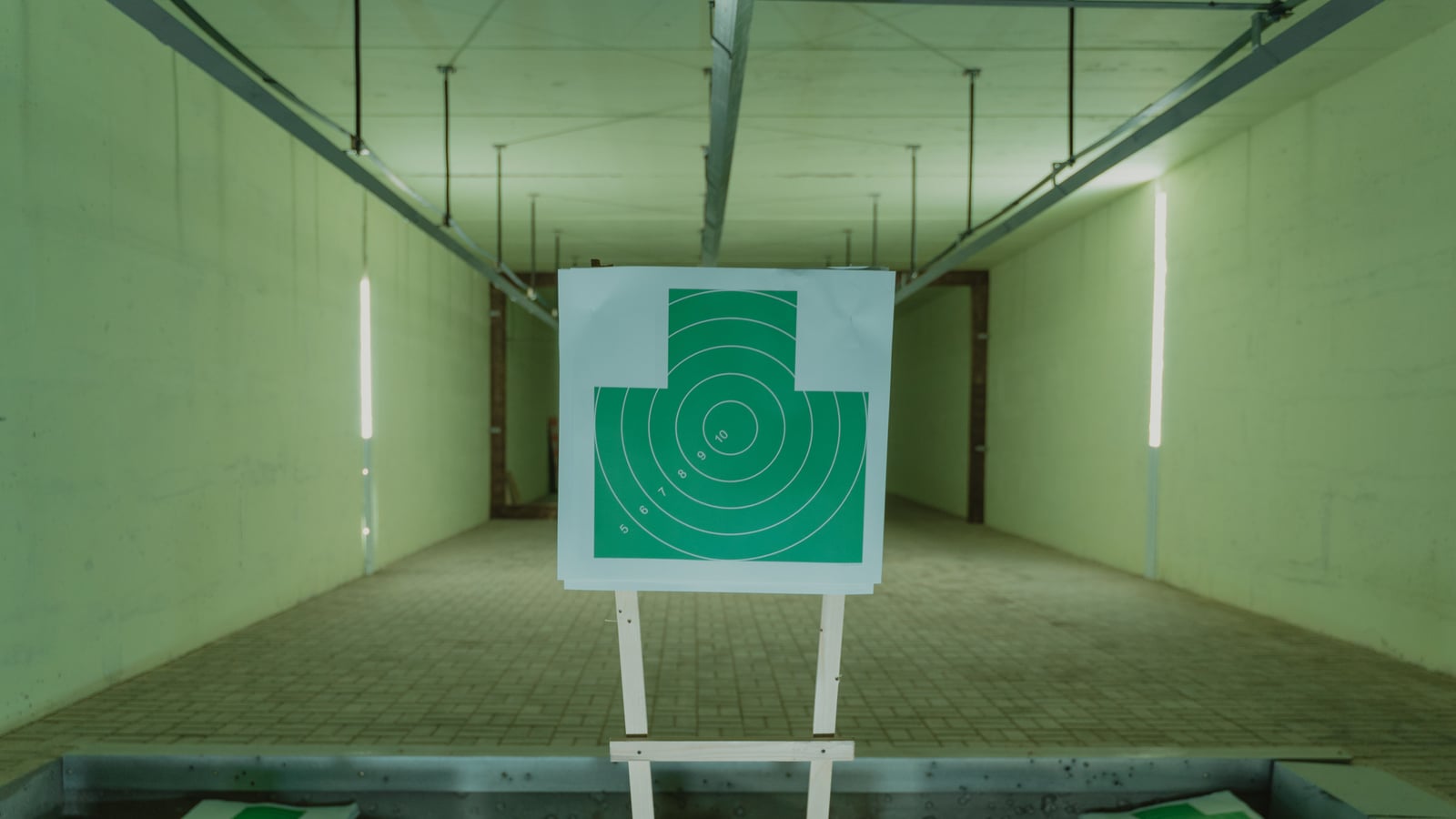
The Standard 25m target is a circular black target, with a system of numbered concentric zones from 1 to 10, the 10 being at the center. The bullseye zone (the famous “10”) is tight, which is why the smallest deviation in a rapid series translates immediately into lost points.
For the precision series, you can aim directly at the visual center of the black zone. For the timed series, most experienced shooters adopt a slightly more instinctive aim, where the eye validates the black zone as a whole rather than seeking a perfect alignment before each shot — the time constraint simply doesn’t leave room for a meticulous aim repeated six times in a row.
Scoring is done either by eye on a paper target with a gauge, or electronically at ranges equipped with sensor targets, increasingly common in clubs at regional competitions. The gauge is used in particular to settle borderline cases, when a hit touches the dividing line between two zones: in that case, the higher value is systematically retained, provided the hit genuinely touches the line.
On electronic targets, measurement precision is markedly higher than the naked eye, which sometimes changes how a shooter perceives their own level: some generous scores obtained on paper with a lenient human judgment become more modest once measured electronically to a tenth of a point. It’s not a matter of cheating, simply of measurement resolution — and it’s a good reason to get used early to electronically-equipped ranges if you’re aiming for national competition, where this kind of setup is the norm.
Authorized equipment
The pistol used is a .22 Long Rifle caliber pistol, of the “sport pistol” or “match pistol” type. The models most commonly seen in this event: Walther GSP, Pardini SP, Hämmerli X-esse, or entry-level models like the Ruger Mark IV for beginners who haven’t yet invested in a dedicated match gun.
The rules impose precise constraints: maximum weight of the weapon, capped barrel length, trigger adjustable within a weight range defined by the national/ISSF rules, adjustable grip but without an arm rest or external stabilization device. No compensator, no optics — mechanical sights only (front sight and rear sight adjustable for windage and elevation).
On the side of additional equipment:
- Hearing protection (plugs or earmuffs) and shooting glasses are mandatory.
- An approved carrying case for moving the unloaded weapon between the trunk and the firing line.
- A shooting glove is tolerated for the weak hand or the gripping hand depending on habits, without excess that would artificially stabilize the wrist.
- Match-quality .22 LR ammunition (Eley, Lapua, SK): in this event, ammunition consistency counts almost as much as consistency of motion, because the smallest variation in muzzle velocity shows up in the rapid series.
The adjustable grip deserves particular attention because it’s often the most underestimated lever for progress among beginner shooters. A poorly adjusted grip forces the wrist to constantly compensate to bring the gun back into the natural axis of the arm, which needlessly fatigues the grip over the course of a 24-shot match spread across four series. A properly done adjustment, done calmly, ideally with the help of a coach, often changes more than a change of ammunition.
On the choice of the weapon itself, there’s no universal rule: a match pistol costs noticeably more than an entry-level weapon, but the performance gap it provides remains marginal as long as the shooter hasn’t already exploited the limits of their current equipment. An experienced club coach can generally tell whether the ceiling a shooter is hitting comes from technique or equipment — and in the vast majority of cases early in practice, it’s technique that’s the limiting factor, not the weapon.
Difference with the Grand Combiné
The pistol Grand Combiné actually groups two distinct events fired on the same competition day: a pure precision event (often close to the 50m format or a dedicated precision event) and a speed event. Standard, on the other hand, is a standalone event that already contains its own speed progression within a single format.
The important nuance: the Grand Combiné tests your ability to switch between two different disciplines in the same outing, sometimes with two weapons or two different settings. Standard tests your ability to stay consistent while the only variable that changes is the time given for each series. It’s a tighter discipline, often recommended as an entry point before tackling the Grand Combiné, because it teaches you clock management without multiplying the parameters to manage at the same time.
Many clubs offer Standard as a regular season event, while the Grand Combiné remains reserved for more structured competitions, often at the county or regional level.
Another practical gap concerns competition logistics. The Grand Combiné, by adding two distinct events, often demands a full day and two different mental preparation phases, which weighs more heavily on a shooter’s concentration endurance. The more compact Standard is generally fired in one continuous session of a few dozen minutes outside of administrative waiting time, which makes it easier to fit into a busy club calendar, and easier to repeat several times over a single season to track a real progress curve.
Finally, on the equipment side, the Grand Combiné sometimes requires adapting two different settings on the same weapon or changing weapons between the two parts, depending on the shooter’s habits. Standard eliminates this variable: the pistol, the trigger, and the sights stay identical from start to finish of the competition, which isolates even better the variable actually being tested — time management.
The concrete flow of a competition
A Standard competition session always follows the same administrative mechanics, which is useful to know before your first participation:
- Roll call and equipment check: the referee checks that the pistol complies with the rules (weight, dimensions, trigger).
- Sighting shots: a few untimed or timed shots on a sighting target, to set the point of aim and check that nothing has shifted since training.
- Series 1 (precision): on the referee’s command, the target presents itself (rotating mechanism or audio signal depending on the setup), you have 150 seconds for the 6 shots.
- Series 2, 3, and 4: the target presents itself for the allotted time then turns away or switches off, whether or not you’ve finished firing your 6 shots.
- Scoring: scores are recorded series by series, then added up for the final total.
The pace is set by the referee, with standardized commands (“Attention”, “Fire”, “Cease fire”). It’s forbidden to keep shooting after the end signal, even if you haven’t finished your series — a shot fired outside the time limit is generally counted as a miss or penalized according to the rules in force.
At ranges equipped with retractable targets, the mechanics slightly change the shooting experience: the target physically rotates toward the shooter at the start signal and turns away at the end signal, which creates a visual constraint on top of the time constraint — you have to find your alignment the moment the target appears, with no buffer time. At installations with a light or sound signal without physical rotation, the target stays facing you permanently and only the signal indicates the start and end of the allotted time, which slightly changes timing management for some shooters used to one system or the other.
The referee’s role isn’t limited to giving commands: they also monitor safety throughout the event, notably the direction of the muzzle during non-firing phases and strict compliance with safety zones between firing points. Any safety anomaly immediately takes priority over the sporting proceedings of the event, no matter what point of the current series it occurs at.
Why this discipline builds a complete shooter
Standard forces work that many shooters naturally avoid: accepting the imperfection of the fast motion without panicking. In pure precision, you can wait until “everything is perfect” before firing the shot. In a 10-second series, that option no longer exists — you have to trigger the shot on a “good enough” sight picture, not a perfect one.
This skill transfers directly to other timed sport shooting situations, including dynamic disciplines where stress and clock management weigh as much as raw accuracy. A shooter who has mastered Standard’s 10-second series has already done most of the mental work required by any timed event.
The other, less visible benefit: Standard immediately reveals grip flaws. An unstable hold or a wrist that breaks on recoil is barely visible in slow fire, but becomes glaring in a fast series where the weapon has to return naturally to its axis between two shots.
There’s also a benefit for breathing management that deserves detail. In classic precision shooting, the shooter has the time needed to settle their breathing before each shot, seeking the natural plateau of calm between two breathing cycles. In Standard’s rapid series, this luxury disappears almost entirely: the shooter has to learn to fire a correct shot even while actively breathing, or to synchronize accelerated breathing with a sequence of closely spaced shots. It’s a skill rarely trained elsewhere, and it largely explains why some shooters who are very solid in pure precision initially struggle with this event.
Typical progression of a shooter in this discipline
A shooter discovering Standard generally follows a fairly recognizable curve, useful to know so as not to get discouraged too quickly:
- First months: the precision series (150 seconds) comes out fine, but the 10-second series collapse. That’s normal — the brain simply hasn’t yet automated the “raise, aim, press” sequence in such a short time.
- After a few months of regular practice: the gap between the precision series and the rapid series starts to narrow. The shooter manages to maintain a decent score even under time pressure.
- Confirmed level: the four series become homogeneous, with a minimal gap between the slow series and the rapid series. This is the sign that the motion has become automatic enough to withstand the pressure of the clock.
- Regional/national competition level: the shooter now works on fine details — the exact timing of breathing between two shots in a rapid series, recovering the sight picture after recoil, the consistency of grip rhythm across the 6 shots of a series.
This progression isn’t linear and varies enormously from one shooter to another depending on training volume, but it almost always follows this four-stage sequence. An experienced club coach can generally identify which stage a shooter is at just by looking at the spread between their series.
An interesting phenomenon often appears at the transition between the second and third stage: some shooters go through a phase where their precision score stagnates, or even slips back very slightly, while their rapid series progress strongly. This isn’t a sign of general regression, but rather a sign that the brain is reallocating its attention resources toward time management, temporarily at the expense of the usual perfectionism of the slow series. This phase resolves itself after a few more sessions, once the two skills coexist without cannibalizing each other.
Another useful marker for gauging your own progress: consistency from one session to the next often matters more than the raw score on a given day. A shooter who gets a decent score very irregularly from one session to the next still has work to do on consistency of motion, even if their best performance is already solid. Conversely, a shooter with a more modest but very stable score from session to session generally has a sounder technical base, on which it’s easier to progress afterward.
How to structure your training
To progress in this discipline without exhausting yourself needlessly, a few principles come up repeatedly among experienced club shooters:
- Work the precision series first in a session, while concentration is still fresh — it’s the one that gives the measure of your form for the day.
- Isolate the rapid series in dedicated blocks, without chaining them indefinitely: grip fatigue quickly degrades the quality of the motion after about ten repetitions.
- Systematically time your series in training, even alone at the range, to accustom the body to the real constraint rather than an approximate “by feel” version.
- Log every session in a shooting logbook to visualize the gap between your series over the months — it’s often the only way to see objectively whether the gap between precision and speed is really narrowing, or whether it’s just an impression.
A complementary principle, often neglected by shooters starting out in competition: deliberately vary the training order from one session to the next. If you always work the rapid series at the end of a session when fatigue has already set in, you build a biased habit that won’t necessarily show up on competition day, where the order is fixed and you’ll arrive fresh at those same series. Alternating the order in training — sometimes starting with the rapid series, sometimes finishing with them — gives a more honest picture of your real level, independent of accumulated fatigue.
Recovery between sessions matters too. Standard intensely stresses the grip over a short time, with spikes in muscular tension at the moment the shot fires in a rapid series. Stringing together several close sessions without enough rest tends to degrade the quality of the motion rather than improve it, particularly for beginners whose grip musculature isn’t yet hardened to this kind of repeated effort.
Common mistakes at this level
A few traps come up regularly among shooters discovering Standard:
- Wanting to aim as finely in the rapid series as in the slow series: this is the number one cause of failure in the 10-second series. The brain seeks a perfect sight picture that doesn’t have time to arrive, and the shot goes off in a rush in the final seconds.
- Rushing the precision series in anticipation of the coming stress: some shooters, already thinking about the rapid series, botch their 150-second series even though it’s supposed to be the most comfortable.
- Neglecting dry-fire training: repeating the sequence of raising the weapon and firing without ammunition, stopwatch in hand, remains one of the most effective ways to automate the motion before doing it under real conditions.
- Switching ammunition right before a competition: a different box can slightly change the point of impact or the feel of recoil, which mostly disrupts the rapid series where there’s no room to adapt mid-series.
Another classic mistake concerns handling the last shot of each rapid series. Many shooters, feeling time slipping away, specifically rush the sixth and final shot for fear of not having time to fire it within the allotted time. This rushing reflex at the end of the series often costs more points than a slightly late but controlled shot — it’s better to train to know your own rhythm precisely, so you know, without consciously thinking about it, that there’s always enough time left for the last shot if the previous five were fired at a steady tempo.
One last, more subtle mistake affects mental management between series. A shooter who dwells on a botched series during the pause arrives at the next series still mentally burdened by the previous failure, which degrades their performance in a cascade. Experienced shooters almost all develop a small mental reset ritual between series — slow breathing, a gesture of putting equipment away, a short inner phrase — to start each series on a neutral basis, regardless of the result of the previous one.
The role of the mental game in performance
Standard is often described by club coaches as a discipline “that’s played as much in the head as in the hand.” This phrase isn’t just a figure of speech: the time constraint activates a performance stress that the shooter doesn’t encounter in free precision shooting, where they can simply wait for their thoughts to calm before firing.
In the rapid series, this luxury of waiting no longer exists, which forces the shooter to learn to shoot correctly even with an underlying tension. It’s a skill that’s trained like any other, through repetition and progressive exposure, rather than an innate quality some have and others don’t. An experienced club shooter who long struggled with the rapid series often tells the same story: accepting that the stress won’t fully disappear, and learning to shoot correctly despite it rather than waiting for it to evaporate.
A simple exercise, used by many coaches, consists of having a rapid series fired right after a brief physical effort (a few core-bracing repetitions or a fast walk), to artificially reproduce the cardiac acceleration of competition stress during training. This method accustoms the body to aiming correctly even when the pulse isn’t at rest, a situation much closer to the reality of a match day than the usual training under calm conditions.
Shooter categories and rankings
Like most national federation disciplines, the 25m Standard Pistol is structured into age categories and sometimes level categories, allowing a beginner to place themselves without being immediately compared to a long-time confirmed shooter. The most common categories distinguish juniors, seniors, and veterans, sometimes with an additional distinction between first category and following categories according to the national ranking.
The ranking itself builds up over time: results obtained in sanctioned competition accumulate over the seasons, and a regular shooter sees their ranking evolve progressively rather than based on a single exceptional performance or a single bad day. This ranking logic rewards consistency more than an isolated flash of brilliance, which fits well with the very nature of Standard: an event that, by design, severely punishes inconsistency between the four series.
For a shooter starting out in competition, it’s common to first take part in club-internal meets or county-level competitions before considering the regional level. This gradual progression allows getting used to the pressure of competition — the presence of a referee, an external stopwatch, the gaze of other shooters — before facing a more demanding context where these stress factors pile up alongside a higher level of competition.
Equipment maintenance and reliability in competition
A .22 LR pistol used in Standard receives particular wear: series of 6 shots fired at a sometimes very sustained pace, week after week, with ammunition that leaves powder and lead residue in the mechanism. Regular maintenance isn’t a cosmetic detail — it’s a direct condition for reliability in an event where a jam in the middle of a 10-second series can ruin an entire score.
A few principles come up among experienced club shooters on this topic:
- Clean the barrel and the breech after every fairly demanding session, not just at the end of the season.
- Regularly check the trigger’s function, especially if it’s finely adjusted — a setting that’s too light can drift with use and cause unwanted discharges.
- Check the condition of the magazine, often the most fragile part of a .22 LR pistol and the leading cause of jams when worn or with a fatigued spring.
- Systematically keep a backup box of ammunition of a different brand in case of unusual misfires with the box of the day, so as not to lose an entire competition over an isolated ammunition problem.
Mechanical reliability counts double in this discipline precisely because the clock doesn’t stop in the event of an incident. A jam on the first shot of a 10-second series can potentially leave you without the six shots to fire in the allotted time, with no way to catch up — the rules govern these situations strictly, and it’s better to prevent them through serious maintenance than to count on the referee’s leniency on the day.
What this discipline teaches you beyond competition
Even for a shooter who isn’t specifically aiming at regional or national competition, training regularly in the Standard format brings benefits that go beyond the score achieved on any given day. The discipline demands a rigor of practice — strict respect for the stopwatch, clean chaining of motions, stress management — that proves useful in any sport shooting context, including pure recreational shooting with no ranking ambitions.
Many club shooters who mainly practice other disciplines periodically come back to Standard as a general maintenance exercise, a bit like an athlete who keeps a cross-cutting base practice even while specializing elsewhere. The rigor of the format — 24 shots, four different time constraints, a score that doesn’t forgive approximation — makes it an excellent general fitness test, capable of quickly revealing whether fundamentals have deteriorated since the last serious session.
Standard’s short, well-framed format also makes it easy to fit into a classic training session, without needing any special organization beyond a stopwatch and a suitable set of targets. That’s one of the reasons this event is still so widely offered in clubs: it’s both demanding in substance and simple to organize in form, which isn’t the case for every discipline on the federal calendar.
Adapting the discipline to your goal
Not all shooters practicing Standard have the same goal, and the way of approaching training can vary slightly depending on what you’re looking for. A recreational shooter, who practices for technical enjoyment without ranking ambitions, can afford to work the series in whatever order they prefer, focusing on the ones they find most enjoyable to improve.
A shooter aiming for regular competition has an interest in scrupulously respecting the official order and constraints as early as training, so that match day is just a repetition of already-known conditions rather than a discovery. It’s a subtle but real difference: training “for the pleasure of precision” and training “to reproduce a competition context” don’t call on exactly the same kind of attention, even though the basic technical motion remains identical.
In both cases, the discipline stays accessible and progressive: it doesn’t require any particular starting level to begin drawing benefits from it, and its structure of four speed tiers lets everyone work precisely on the missing link, without needing to rethink their whole training with every new constraint.
There’s also no shame in stepping back in your practice. A shooter who feels their rapid series deteriorating after an extended break has every interest in resuming a few sessions focused solely on the precision series before tackling the full format again, rather than inflicting a disappointing score across all four series at once. The discipline rebuilds itself in the same order it was built the first time — from long time toward short time.
FAQ
Q: Do you need a specific pistol to start Standard? A: No, a standard .22 LR pistol like a Ruger Mark IV or Buckmark is enough to start and progress through the first seasons. A dedicated match pistol becomes relevant once you’re aiming for regular competition and start feeling the limits of the trigger or balance of your entry-level weapon.
Q: How long does it take to stabilize a decent score on the rapid series? A: This varies enormously depending on training volume and prior shooting experience, so it’s hard to give a universal timeframe. Regular practice and specific dry-fire work on the raising sequence clearly speed up progress.
Q: Is Standard accessible to a complete beginner? A: Yes, but it’s recommended to first master the basics of safety, grip, and slow precision shooting before tackling the timed series, so as not to pick up bad habits of rushing.
Q: What’s the best way to track your progress in this discipline? A: Logging the detail of all four series at every session, not just the total score, lets you see precisely which series is improving and which is stagnating. A digital shooting logbook is particularly well suited to this series-by-series tracking over time.
Q: Can you shoot Standard with a weapon fitted with a red dot? A: No, the rules of the Olympic and national federation event require strictly mechanical sights, with no optical device or red dot, unlike some more permissive dynamic disciplines regarding equipment.
Q: Does Standard count toward progression to category B? A: Yes, a 25m Standard Pistol session stamped in your shooting logbook counts like any other pistol session for calculating the three required seasons, provided it’s supervised and validated by the club.
Going further
- Digital shooting logbook: the app for every sport shooter
- The perfect grip according to the discipline
- IPSC vs Precision: two philosophies of sport shooting