
A discipline that forgives nothing
25m rapid fire pistol, also called Olympic rapid fire, is probably the most nerve-wracking event in the entire Olympic shooting program. You don’t shoot at your own pace: you shoot within a time window fixed in advance, one that shrinks series after series until it’s almost instantaneous.
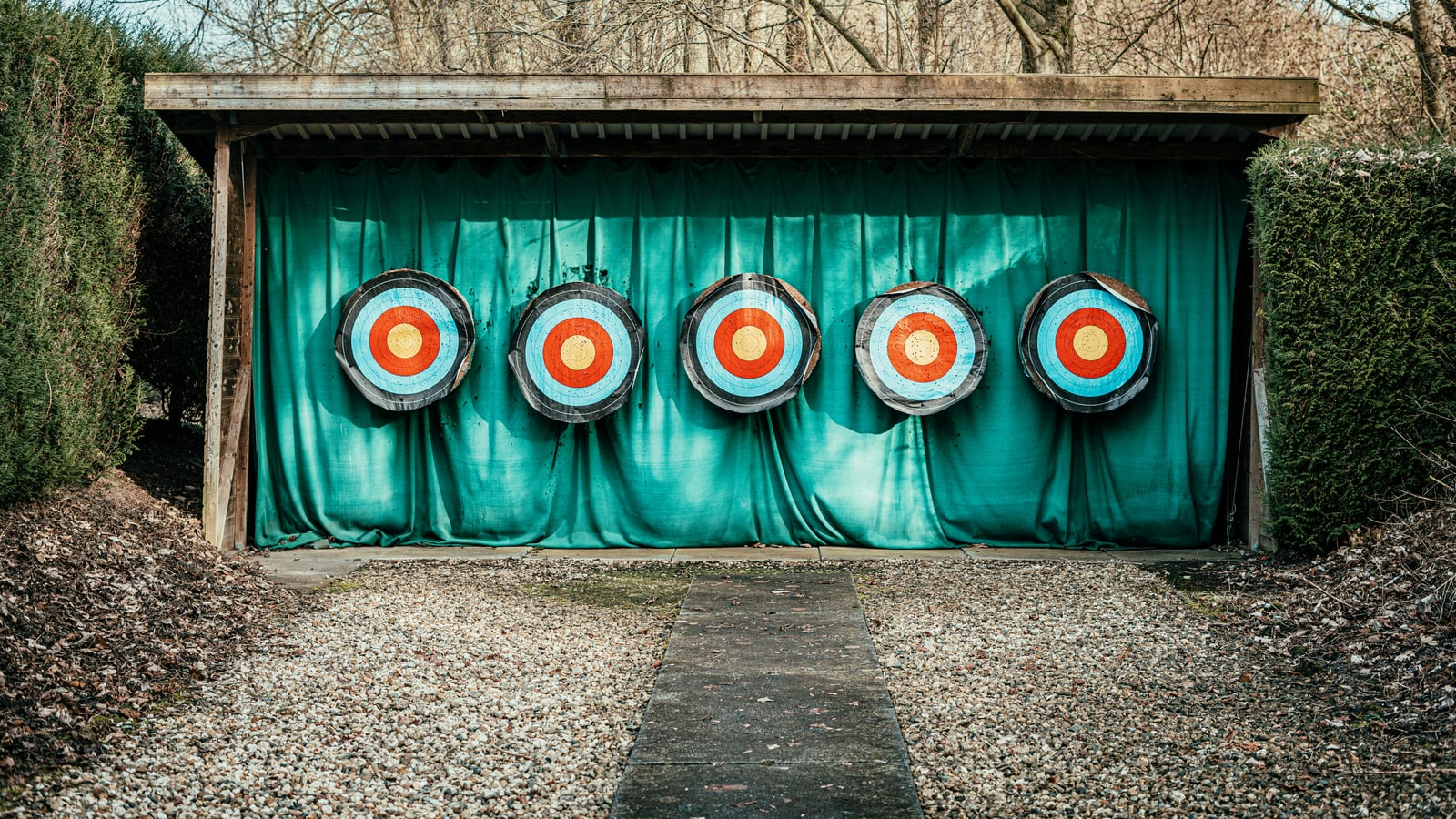
In practice, the event unfolds on five targets lined up side by side, with series where you get 8 seconds, then 6 seconds, then 4 seconds to raise your gun, aim, and fire one shot at each target. Four seconds for five shots on five different targets leaves less than a second per shot once you factor in the transitions between targets.
This constraint completely changes the nature of the movement. In 10m air rifle or 10m precision pistol, you have time to build your sight picture, breathe, wait for the right moment. Here, that time barely exists anymore: everything has to be automated beforehand, through training repetitions, so the body executes without the brain needing to think mid-series.
It’s also a discipline that exposes your flaws immediately. A precision shooter can sometimes mask a slight instability by taking more time. In rapid fire, time isn’t negotiable: either your movement is reliable, or it isn’t, and the target that day will tell you bluntly.
Many shooters discover this discipline after several years of precision shooting, thinking they can transpose their skills directly. Reality is more nuanced: some fundamentals transfer well, like the rigor of your grip, but most of the work specific to rapid fire has to be rebuilt almost from scratch, with an automation logic that has few equivalents elsewhere in sport shooting.
The format of the event, target by target
The official event is shot at 25 meters on five cardboard targets set up side by side, each with a classic concentric scoring zone. The shooter starts with the gun lowered or pointed at the ground depending on the protocol in force, then raises it and fires on the signal.
The standard format includes two precision series, often described separately, followed by the actual rapid fire series: eight series of five shots, split into groups at 8, 6, and 4 seconds. Each series, one shot per target, in order, without going back.
The difficulty doesn’t come only from the clock. You also have to manage the eye and body transition from one target to the next: your gaze, your torso, your arms need to pivot smoothly and repeatably, without any jerkiness, so you don’t lose a precious tenth of a second on each target change.
Final scoring is done across all impacts, target by target, using a zone-based scoring system. A single stray shot landing in a low zone on one of the five targets can cost you a podium spot, which demands extreme consistency across the whole series, not just on your best shots.
This format comes with particularly strict rules on respecting the allotted time, with electronic timing systems connected directly to the targets or to sound and visual detection devices. A shot fired after the time window closes is generally penalized, regardless of its quality on the target. This rigor changes how you approach each series: a shooter has to learn to accept sacrificing a marginal shot rather than risking a late shot that would hurt the overall score even more.
Officials who run rapid fire competitions are specifically trained to read timing devices and apply the rules consistently across all shooters in a given series. A shooter starting out in competition in this discipline should get familiar with these officiating rules well before their first official event, by watching local competitions or talking with experienced club shooters already used to the format.
Drawing the gun up and the starting position
The protocol requires a starting position with the arm bent down or the gun pointed downward, depending on the rules applied by your federation. From this neutral position, the shooter must raise the gun, align the sights, and fire within the allotted time, which is fundamentally different from a shot where the gun is already in a high, stabilized position.
This raising motion has to be trained as a technical movement in its own right, just like releasing the trigger. Raising too fast and abruptly throws the grip off balance and costs you precision from the very first shot of the series. Raising too slowly eats into the time available to aim properly.
The goal for a seasoned club shooter is to find a consistent raising tempo, repeated thousands of times in training, that brings the gun exactly onto the axis of the first target without any further correction. It’s this tempo that then allows the other four targets to be strung together smoothly.
Many experienced coaches insist that this initial movement conditions the whole series: if the first alignment is off, the shooter spends the rest of the series trying to catch up on aim instead of simply executing their usual sequence.
Some clubs recommend breaking the raise into two distinct phases during the first weeks of learning: first, a phase of pure arm elevation with no attempt at aiming, then a phase of final lock-in of the alignment. This breakdown, artificial at first, makes it possible to pinpoint exactly where the fault lies when a series fails, before naturally recombining the two phases into one smooth movement.
The transition between targets: the real technical challenge
What truly sets rapid fire apart from other disciplines is managing the transition between the five targets. Your gaze has to anticipate the next target before the previous shot has even gone off, which requires a fine decoupling between visual attention and the ongoing shooting motion.
Rotating the torso, not just the arms, is generally favored by high-level club shooters, since it limits asymmetric tension in the shoulders and allows a smoother pivot from one target to the next. A pivot using the arms alone often creates a lateral drift in the point of impact on the targets at the end of the line.
Breathing also has to be adapted. There’s no question of holding your breath for four complex seconds of movement: many experienced shooters learn to synchronize a short, controlled exhale with each shot, rather than seeking the full breath-hold used in slow precision shooting.
Finally, managing where your eyes focus between the sights and the next target is the subject of specific work: some shooters prefer to keep the front sight sharp and let the target stay slightly blurred until the last instant, others reverse that priority depending on their visual makeup and experience.
Pivot speed isn’t uniform across the five targets either. Moving from the center target to the outer targets requires a wider rotation, which forces you to slightly adjust the tempo as the series goes on rather than aiming for a strictly constant speed. Many shooters underestimate this asymmetry and calibrate their sequence only on the center targets, only to discover that the ends of the line concentrate most of their errors.
The trigger: the movement that makes or breaks the series
In a discipline where every tenth of a second counts, the trigger becomes the most critical element of the whole technical movement. A poorly controlled press, even a minor one, immediately shows up as a visible deviation on the target, with no way to correct it mid-series.
Unlike slow precision shooting, where you can hold off the press until you get perfect alignment, in rapid fire you have to apply firm, steady pressure as soon as the alignment enters the useful zone. This requires specific work with the first joint of the finger on the trigger, isolated from the rest of the hand, which has to stay stable.
Many beginners in this discipline make the same mistake: they anticipate the shot breaking by clenching the whole hand as they press the trigger, which systematically pulls the point of impact down or to the side. An experienced coach generally spots this flaw by watching the groupings on a fixed target, even before bringing out the stopwatch.
Dry firing, without ammunition, remains the reference tool for isolating this trigger motion from the rest of the grip. Many clubs recommend regular dry-fire sessions focused specifically on the trigger, outside any time constraint, before reintroducing the clock.
The trigger’s break point also deserves particular attention in this discipline. A trigger with a crisp, predictable break lets the shooter precisely anticipate the moment the shot goes off, while a trigger with a mushy or inconsistent break from one example to another introduces an uncertainty incompatible with the repeatability sought in rapid fire. That’s one reason fine trigger tuning takes up an important place in the equipment preparation for this discipline.
Mental and physiological preparation: managing the pressure of the clock
Rapid fire tests the nervous system in a completely different way than slow disciplines do. The simple fact of hearing the start signal triggers a stress response in many shooters that, if not managed, translates into general tension harmful to precision.
One of the most useful mental exercises is to separate the perception of time passing from the execution of the movement. A seasoned club shooter often describes this as a subjective slowing down of time once the series is sufficiently automated: the clock still exists, but it no longer interferes with the attention paid to the movement.
Mental visualization, practiced away from the firing line, also helps prepare the nervous system for the full sequence: starting position, raise, first alignment, then the sequence of the four remaining targets. Mentally repeating this sequence, target by target, reinforces the automatism without even handling the gun.
Managing an isolated failure is also part of the mental work specific to this discipline. One bad series out of eight has to remain an isolated data point, not an event that contaminates concentration on the following series. The shooters who progress fastest in this event are often those who are best at resetting their focus between two series.
Performance in rapid fire also depends on factors that seem far removed from the firing line but directly influence the stability of the nervous system. Chronic lack of sleep degrades the fine motor control needed for a clean trigger press and a smooth pivot between targets. Caffeine or other stimulants consumed before a session also deserve particular attention, since an overly excited nervous system can amplify the micro-tremors that go unnoticed in slow precision shooting but that, in rapid fire, immediately translate into a worse grouping.
Hydration and regular eating before long sessions also help maintain consistent physiological stability. This obviously varies from shooter to shooter, but most experienced coaches recommend observing these factors over several sessions before drawing firm conclusions: an isolated off day rarely comes from a single cause, but rather from a combination of small cumulative factors, including fatigue that builds up between several blocks of timed series without enough rest.
Some shooters find it useful to keep a small journal of their state before each rapid fire session, noting their sleep level, their general stress level, and how they feel physically. Over several months, this kind of tracking makes it possible to spot personal correlations between overall condition and quality of movement — correlations that vary enormously from one shooter to another and therefore can’t be generalized from generic advice.
Equipment suited to rapid fire
The pistol used in rapid fire is generally a .22 Long Rifle sport pistol, often with a trigger set lighter and shorter than on a slow precision gun, to allow a faster shot break without sacrificing grip stability.
The weight and balance of the gun play an important role in how fast the pivot between targets can be executed. A gun too muzzle-heavy slows down the transition from one target to the next, while a gun that’s too light can make holding the alignment harder during the split second of the shot.
Under French regulations, this type of .22 caliber sport pistol generally falls under Category B, subject to prefectural authorization, like the vast majority of handguns used in sport shooting. This authorization is obtained through your federation license and regular practice at a club, with the exact procedure varying by prefecture.
The grip, often adjustable, needs to be carefully set so the hand finds exactly the same reference point every time the gun is raised. An unstable grip setting forces the shooter to readjust their hold every series, which is incompatible with the consistency required in rapid fire.
Regular maintenance of the gun also takes on particular importance in this discipline. A dirty or poorly lubricated trigger mechanism can introduce variation in travel and break point from one session to the next, which directly disrupts the automatism built in training. Regular, methodical cleaning is an integral part of preparation, on par with physical and mental training.
The sights also deserve a systematic check before every session. A front or rear sight that has shifted slightly since the last outing, even almost imperceptibly, is enough to shift the point of impact across all the targets in a series. Many experienced shooters start their session with a few check shots on a single target before moving on to the timed series, purely to confirm that the sight settings haven’t moved since last use.
Building a training routine specific to rapid fire
Rapid fire training can’t be limited to stringing together timed series on target. It has to combine several distinct blocks of work: dry-fire work on the raising motion, isolated work on the trigger, and finally the complete timed series to validate everything together.
A training scheme often recommended by experienced coaches is to regularly return to longer times, like 8 seconds, even once the shooter already handles the 4-second series, in order to re-anchor the quality of the movement without the maximum pressure of the clock. This deliberate step back in time is used to correct faults that creep in under pressure.
The number of repetitions matters more than the intensity of a single session. Steady progress in this discipline generally comes from training volume spread over several months, with short but frequent sessions, rather than long occasional sessions that tire the nervous system without any real technical gain.
Using a personal stopwatch or a tracking app makes it possible to objectively measure progress series after series, rather than relying on a subjective impression of success. Many shooters underestimate the real variability in their reaction times and sequences until they measure them precisely.
Alternating blocks of work within the same session also avoids fatigue and the risk of overworking the same movement. A commonly recommended structure is to start with a block of dry-fire work, follow with a block of long series, then finish with a small number of series at competition speed, always keeping this last block short to preserve execution quality rather than trying to pile up repetitions at maximum demand.
A rigorously kept training log also makes it possible to spot, session after session, the days when accumulated fatigue reduces the quality of the movement despite the will to perform well. Recognizing these signals and adjusting the session’s load accordingly avoids ingraining technical faults born of fatigue rather than a genuine lack of mastery.
Rapid fire lends itself particularly well to tracking progress numerically, since every series produces both a precision score and whether or not the time limit was respected. Logging these two pieces of data separately, series after series, makes it possible to identify whether the points to work on concern precision, speed, or both. A digital shooting log lets you keep a complete history of these series, along with details of the equipment used, the trigger setting, and the conditions of the session, which becomes especially useful for understanding why one training period produced faster progress than another.
Comparing your series over several months, rather than session by session, gives a more accurate picture of your real progress in such a demanding discipline. Occasional swings in form are normal and shouldn’t be over-interpreted at the scale of a single training session. This methodical approach to tracking mirrors the very logic of the discipline: rapid fire doesn’t reward isolated lucky shots or improvisation, but the patient construction of a reliable movement, repeated and measured over time until it becomes second nature.
Common mistakes and how to fix them
Premature clenching of the hand at the moment the shot breaks remains the most common mistake among shooters starting out in this discipline. It’s easy to spot by watching the groupings on a fixed target: a systematic shift downward or to the side almost always signals this problem.
The second classic mistake concerns pivot speed between targets. Some shooters pivot too fast at the expense of precision, while others pivot too slowly and end up behind the clock as early as the third target. The right balance is only refined through timed repetition and series-by-series analysis.
Another common difficulty comes from poorly managed breathing during the series. Completely holding your breath through four seconds of intense movement creates parasitic tension in the shoulders and neck, which directly affects the stability of the shooting arm.
Finally, many shooters neglect the specific work on the starting position and the raise of the gun, focusing only on the shot itself. Yet it’s precisely this initial movement, often the least trained, that determines the quality of the whole series that follows.
One last, more subtle mistake concerns eye focus at the end of the series. On the fifth and final target, some shooters unconsciously let their concentration slip a split second before the shot, convinced that the bulk of the series is already decided. This premature letting go often results in the worst impact of the entire series, even though the technical difficulty is no greater than on the four previous targets. Treating every target with exactly the same rigor, including the last one, is one of the reflexes that separates a consistent shooter from one who plateaus.
Identifying which of these mistakes dominates for a given shooter usually requires an outside eye. An experienced coach watching several consecutive series often spots a recurring pattern invisible to the shooter themselves, simply because the shooter is focused on execution rather than on the overall observation of their own movement.
Why this discipline is considered a technical summit
Olympic rapid fire combines, in a single event, demands that elsewhere are handled separately: high-level shooting precision, execution speed, managing pressure from the clock, and the fine coordination of a multi-target sequence. Few other sport shooting disciplines stack up this many simultaneous constraints.
This accumulation of constraints explains why very few shooters reach a level of excellence in this specific event, even among competitors already solid in other pistol disciplines. The discipline demands a particular technical and mental profile, different from that of a slow precision specialist.
Sport shooting has been present at the Olympic Games since 1896, and pistol rapid fire has been part of it since the modern origins of the Olympic discipline, which speaks to its historical recognition as the reference event in rapid shooting.
It’s also a discipline that particularly rewards long-term consistency. Unlike some events where a one-off peak in form can be enough to get a good result, rapid fire severely punishes the smallest technical inconsistency, which makes it an excellent indicator of a shooter’s real level.
Olympic rapid fire isn’t, incidentally, the only discipline that requires managing several targets in a limited time, but it remains one of the most codified formats. Other dynamic sport shooting formats, on cardboard targets or steel plates, exist with different time and sequencing constraints. What sets Olympic rapid fire apart from these dynamic formats is the complete fixity of the setup: five targets always at the same distance, always in the same alignment, with an identical starting protocol on every series. This standardization allows for a much more advanced automation of the movement than on courses that change with every configuration.
Dynamic disciplines, by contrast, demand more adaptability and real-time reading of the terrain, whereas Olympic rapid fire mostly rewards the perfect repeatability of an identical movement, series after series. A shooter already practicing a dynamic discipline can find in Olympic rapid fire an excellent complement for working specifically on trigger finesse and managing ultra-short time frames, two transferable skills rarely trained elsewhere with the same rigor.
Body position and grounding
Even before talking about raising the gun or the trigger, everything rests on a stable connection to the ground. In rapid fire, the body goes through a succession of micro-rotations in a very short time, and an unstable base amplifies every flaw instead of absorbing it.
The feet are generally positioned slightly more open than in a classic slow precision stance, to make it easier to pivot the torso toward the outer targets without having to shift your footing during the series. A shooter who has to move their feet during a 4-second series loses time they can’t make up.
The center of gravity has to stay stable throughout the series, including during the initial raise. Many beginners tend to lean slightly forward as they raise the gun, which shifts the center of gravity and makes stabilizing the arm for the first shot harder.
Postural work specific to rapid fire is often done alongside pure technical work: strengthening the core stabilizer muscles, balance work, and repeating the starting position until it becomes completely natural. An experienced coach can quickly spot a postural imbalance that would limit progress in this discipline.
This stable body base is also what ultimately allows the upper body to be decoupled from the lower body: the torso pivots, the arms follow, but the legs and pelvis remain a motionless foundation that doesn’t move from one series to the next.
Weight distribution between the two legs also deserves particular attention. Leaning too much on one leg creates a slight instability that shows up mostly toward the end of the series, once muscle fatigue starts to set in after several consecutive blocks of timed series. Balanced weight-bearing, regularly checked and corrected by an experienced coach, prevents this progressive drift over the course of a full session.
The arm holding the gun also works very differently in rapid fire compared to slow precision shooting. In precision shooting, the arm seeks near-total stillness over several seconds. In rapid fire, it instead has to produce a fast, controlled movement, then briefly freeze at the exact moment the shot breaks, before moving on to the next target. This alternation calls on different muscle groups than static shooting, with shoulder stabilizer muscles that have to both allow the range of the pivot and guarantee enough rigidity at the precise moment of the shot.
The elbow plays an important hinge role in the smoothness of the pivot: an overly straightened arm can transmit parasitic vibrations, while an overly bent arm lacks rigidity at the moment of the shot. Most experienced shooters look for a slightly bent elbow angle, kept constant series after series. The wrist, finally, has to stay locked throughout the pivot and shot phase: a wrist that moves, even slightly, introduces variability that directly translates into greater dispersion on the target.
The role of protective gear and comfort
Rapid fire demands repeated, intense effort over short time spans, which makes equipment comfort particularly important over the course of a full training session. Well-fitted hearing protection, comfortable over several hours, avoids the micro-tensions that could interfere with concentration.
Eye protection, for its part, has to offer a wide enough field of view so it doesn’t hinder the gaze transition from one target to the next. Glasses that are too wraparound or poorly fitted can create visual distortion at the edges of the field of view, which specifically bothers you on the targets at the ends of the line.
Clothing, often overlooked in general advice, also plays a role: sleeves that snag, a poorly positioned belt, or overly loose clothing can slightly disrupt the raising motion and introduce unwanted variability from one series to the next.
Some experienced shooters recommend always training in exactly the same outfit and equipment used in competition, to eliminate any parasitic variable on the day performance actually counts. This search for consistency applies to all the equipment, not just the gun itself.
The gear bag and the way equipment is organized also deserve thoughtful planning. Having to search for a pair of glasses or a magazine in the middle of a timed session breaks concentration and introduces needless stress. Preparing your gear in a fixed order, always the same before each session, is one of those small habits that free up attention for what really matters: the technical movement itself.
Getting started with rapid fire at a club
If you already shoot pistol at a club and want to try this discipline, the first step is generally to talk to an experienced coach at your club, who can assess whether your safety and handling fundamentals are solid enough before introducing the constraint of the clock.
The classic progression starts with series at a long time, often well beyond the regulation 8 seconds, to get familiar with the sequence of the five targets without the pressure of a tight clock. Only once this pattern is stable are the times gradually reduced toward competition values.
The equipment doesn’t need to be specialized from the start: a standard sport pistol, already used for other precision disciplines, lets you discover the basics of rapid fire before investing, if needed, in a trigger setting or a grip more specifically adapted.
Support from an experienced coach remains particularly valuable in this discipline, since technical faults like clenching, a poorly controlled pivot, or held breath are often invisible to the shooter themselves and get corrected much faster with a qualified outside eye.
Once short-time series are mastered consistently at the club, the next step is often to take part in a first regional competition. This transition changes things: the firing line is different, the targets may look slightly different visually from the ones used in everyday training, and the social pressure of being watched changes the shooter’s mental state. The best preparation for this transition remains multiplying situations close to competition, even at the club: inviting other shooters to watch a series, training at unusual times, or simply saying your expected score out loud before shooting.
An experienced regional champion in this discipline often describes the same observation: the first competition mainly serves to measure the gap between club performance and performance under real pressure, more than to aim for a specific result. Once identified, that gap becomes the basis for mental work over the following months. Equipment used in competition has to be rigorously identical to that used in training: same gun, same trigger setting, same ammunition if possible.
After this first experience, most shooters find that their usual club reference points, like ambient noise, the layout of the facilities, or the rhythm between series, had become unconscious supports. Finding them again progressively in competition, session after session, is part of the normal path toward stable performance regardless of context.
The coach’s role, incidentally, doesn’t stop after the first competition. Many shooters keep seeking regular outside feedback, even after several seasons of practice, simply because certain faults quietly resurface when training load increases or routine sets in. This medium-term follow-up, less visible than the first months of learning, often proves decisive for continuing to progress beyond an initial technical plateau.
Over the long run, it’s often the most methodical shooters in their practice who progress most consistently in this discipline, more so than those who bet on occasional, very intense sessions with no real continuity between them. Rapid fire rewards consistency of work at least as much as natural talent, which makes it accessible to any club shooter willing to commit over time rather than chase an immediate result. That’s also, in the end, what makes it a discipline as formative as it is feared: it leaves no room for sloppiness, but it faithfully rewards every hour of serious work invested at the firing line, session after session, season after season.
FAQ
Q: Is 25m rapid fire pistol accessible to beginners? A: Yes, provided you already have solid pistol shooting fundamentals and the approval of an experienced coach. Progression always starts from long times before gradually reducing them toward competition times.
Q: What type of pistol is used for this discipline? A: Generally a .22 Long Rifle sport pistol, with a trigger set shorter and lighter than on a slow precision gun. In France, this type of gun usually falls under Category B, subject to prefectural authorization.
Q: Why is the trigger so critical in this discipline? A: Because the time available leaves no room for correction mid-movement. A poorly controlled press on the trigger immediately shows up as a visible deviation, with no way to salvage the shot before the end of the series.
Q: How long does it take to progress in rapid fire? A: This varies enormously depending on the shooter, training frequency, and starting level. Progress is generally more linked to the consistency of sessions spread over several months than to the intensity of a single session.
Q: Does rapid fire require specific mental preparation? A: Yes, managing the stress linked to the clock is an integral component of this discipline. Visualization work and separating the perception of time from the execution of the movement help many shooters progress.
Q: Can you train for rapid fire without ammunition? A: Dry firing, without ammunition, is widely recommended for isolating the raising motion and the pressure on the trigger, before reintroducing the constraint of the clock with real ammunition at a club.