
Why 10m pistol is the classic entry point
If you’re starting out in precision sport shooting, there’s a good chance your club will point you toward 10m air pistol before anything else. That’s not a scheduling coincidence or a matter of range availability: this discipline packs everything that makes Olympic precision shooting special into an accessible format.
The short distance, the reduced caliber, and the relatively affordable equipment make it a discipline any beginner can practice from their very first license. No need for a 25 or 50 meter range, no need for a traditional firearm with everything that implies in terms of category and paperwork.
It’s also the discipline that teaches you the fundamentals you’ll reuse everywhere else: gripping the gun, breath control, releasing the trigger, managing your mind against a target that doesn’t move but still seems to dance in front of your eyes. An experienced club shooter will often tell you that 10m is the discipline that “forgives nothing,” because every technical flaw shows up immediately on the target.
Finally, it’s a full-fledged Olympic discipline, present at the Games since sport shooting was included. This status gives it legitimacy and a very codified competition structure, from club level to international level, which makes it particularly easy to grasp for a new license holder who wants to understand what they’re getting into.
This discipline also has the advantage of being practicable year-round, independent of weather or season. A 10m range is an indoor, climate-stable space, unlike an outdoor 300m rifle line or a trap shooting field. For a beginner who wants to train regularly without external constraints, that’s a concrete logistical advantage.
The short format of each session also fits a busy schedule. A 10m pistol session easily fits into a weeknight evening, including travel, setup, and putting the equipment away. This scheduling flexibility partly explains why so many clubs make it their welcome discipline for new license holders, regardless of age or work schedule.
The individual dimension of the discipline is also worth highlighting: each shooter is alone facing their target, solely responsible for their result. Unlike team sports, there’s no one else to blame and no one else who can compensate for a bad day. This direct confrontation with oneself is often cited by practitioners as the most formative aspect, well beyond pure technique.
The ISSF and national federation regulatory framework
10m air pistol is governed by the rules of the ISSF (International Shooting Sport Federation), the international body that oversees Olympic sport shooting. National federations pick up and adapt these rules for national, regional, and local competitions.
In practical terms, this means the rules you’ll learn at a regional competition are, aside from a few organizational details, the same ones applied at an international final. That’s rare enough in amateur sport to be worth pointing out: you literally train to Olympic standards from your very first local match.
The ISSF rulebook specifies everything: shooting distance, target size and shape, time allowed per series, number of shots, permitted attire, right down to how results are validated and contested. National federations publish their own technical and safety regulations that supplement this base, notably regarding range organization and shooting safety.
For a beginner, the key thing to remember is that this framework isn’t arbitrary. Every rule has a reason tied to sporting fairness or safety, and your club or coach will explain them to you as you progress. It’s better to understand the why than to blindly memorize a list of constraints.
The rules also distinguish categories of shooters: men, women, juniors, according to the breakdowns set by the ISSF and adopted by national federations. These categories sometimes determine slight variations in match format or qualification minimums for higher-level competitions, without ever changing the technical nature of the discipline itself.
Another point new license holders often discover with surprise is the role of referees and technical officials. They aren’t simple observers: they’re trained to validate scores, settle measurement disputes on electronic or paper targets, and make sure every competitor strictly follows the same framework. This referee rigor is what gives the final ranking its full credibility.
It’s also useful to know that these regulations evolve, generally slowly, over the course of Olympic cycles. Federations sometimes adjust the number of shots, the duration of matches, or the final format to make the discipline more readable for the public or fairer between competitors. Your club remains the best source to find out the current version of the rules once you start competing.
The distance, the target, and the match format
The name of the discipline already says the essential thing: 10 meters. That’s the distance separating the firing line from the target, precisely measured by certified installations. At this distance, the tolerated margin of error on the target is minimal, which explains the technical difficulty despite the apparently short distance.
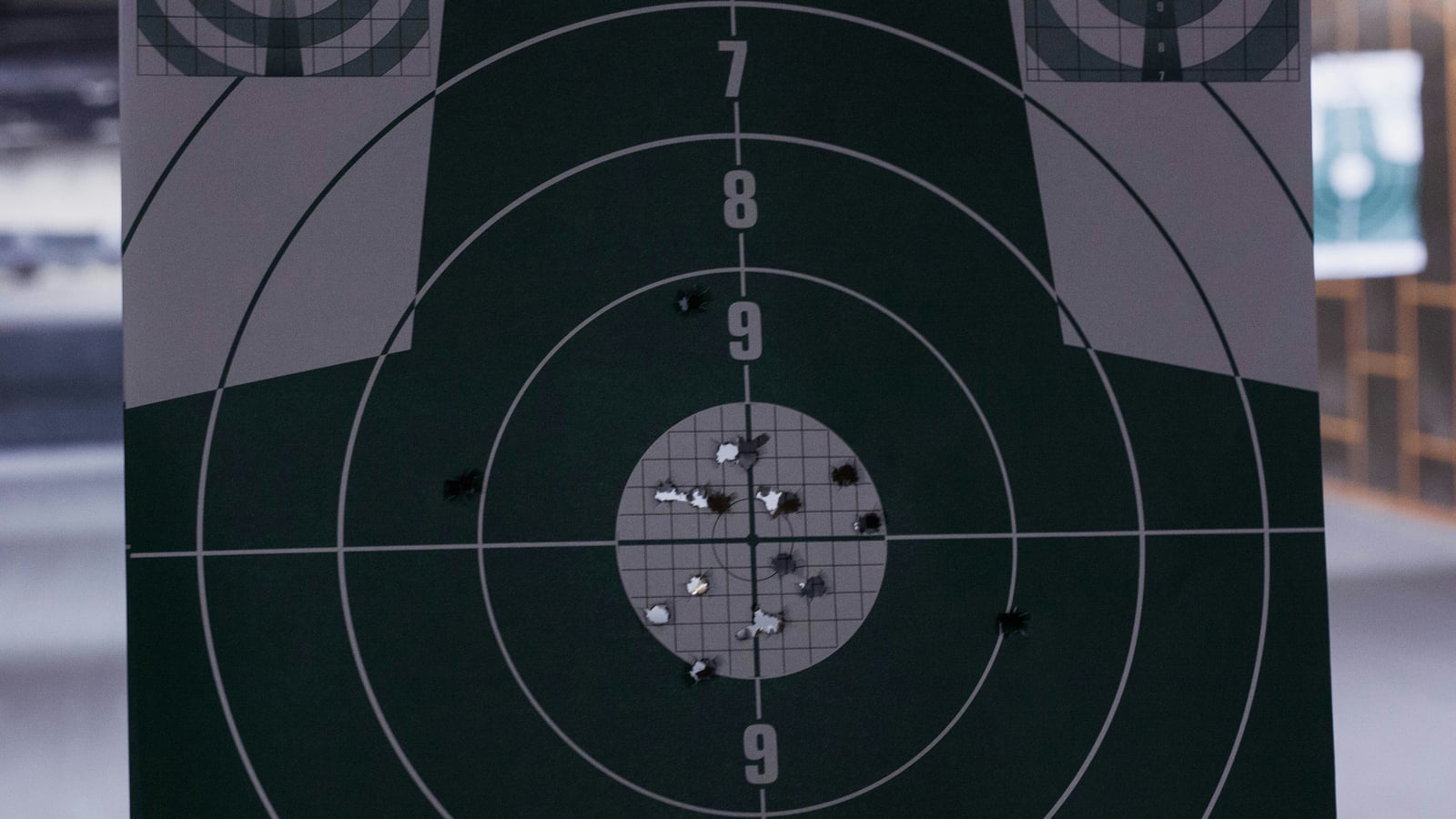
The standard ISSF target for 10m pistol features a central black aiming mark with numbered concentric zones, the 10 being at the center and representing a very small circle. The bullseye (the highest-value zone) is tiny to the naked eye from the firing line, which requires extremely rigorous sight alignment.
A classic 10m air pistol match runs over a number of shots set by the rules, generally preceded by a series of untimed sighting shots that let the shooter adjust their position and check their equipment. The overall time allotted for the match is also regulated, which introduces pace management on top of pure precision.
Major competitions often add a final phase for the top qualifiers, with a progressive shot-by-shot elimination format. This highly spectacular final phase is generally shot in front of an audience with real-time electronic score display, which adds a completely different dimension of stress management compared to qualification.
Electronic targets, increasingly common in modern ranges, measure the pellet’s impact to a tenth of a point thanks to acoustic or optical sensors built into the target structure. This system removes the human debate over reading an impact close to a dividing line between two zones, a topic that could once lead to disputes with traditional paper targets.
In ranges that still use paper targets, scoring is done using a calibrated gauge that the referee applies to each disputed impact. This method remains perfectly valid and continues to be used in many clubs, particularly for daily training where investing in an electronic system isn’t always justified.
The match format can also vary slightly depending on the competition level: an internal club competition will often be shorter than a regional qualifying event, itself shorter than a national-level event. This gradation lets the duration and demands of the match be adapted to the intended audience, while preserving the same scoring logic and the same technical fundamentals.
Approved equipment: the gun
The pistol used in 10m air pistol runs on compressed air or CO2, with a 4.5mm (pellet) caliber. This type of weapon falls under a lightly regulated category in most jurisdictions — often free sale or simple registration depending on the model — which considerably simplifies access to the discipline for a beginner compared to a traditional handgun.
The ISSF rules strictly govern the characteristics of these pistols: maximum weight, dimensions, permitted trigger type, absence of optical or electronic sighting devices (only open mechanical sights are allowed). The goal is to ensure the competition remains a test of the shooter’s skill rather than an equipment arms race.
Many clubs have 10m pistols available for loan or rental for beginners, letting you discover the discipline before investing in personal equipment. That’s a good practice to favor: choosing a 10m pistol is personal and depends on your hand’s shape, so it’s worth trying several models before buying.
As for price, it varies enormously depending on the model, brand, and condition (new or used). Ask directly at your club or with gunsmiths specialized in sport shooting rather than relying on a generic figure, since ranges change regularly.
Technically, these pistols mainly come in two power configurations: pre-charged pneumatic (PCP), which uses a rechargeable compressed air cylinder offering great pressure consistency shot after shot, and the CO2 cartridge system, simpler but sometimes more sensitive to ambient temperature variations. PCP largely dominates high-level competition for its consistency.
The trigger itself deserves particular attention when choosing or adjusting your equipment. Most modern 10m pistols offer fine adjustment of travel, break point, and trigger weight, within the limits allowed by ISSF rules. A serious club will help you adjust these parameters gradually, never seeking an extreme setting before you’ve acquired a stable technique.
Maintaining the pistol, while simpler than a traditional firearm, remains important: regular checking of the air circuit’s seal, cleaning the barrel, and checking the mechanical sights. A poorly maintained pistol loses shot consistency, which can throw off your technical diagnosis by making you wrongly think the problem lies in your position or aim.
Approved equipment: accessories and attire
Beyond the pistol itself, the rules also govern accessories. 4.5mm pellets must meet quality standards to guarantee a consistent trajectory, which has a direct impact on shooting precision in a discipline where every tenth of a point counts.
Shooting attire is also regulated in official competition: certain rigid or reinforced clothing used in other shooting disciplines (notably rifle) is limited or banned in pistol, because the discipline favors neutral attire that doesn’t provide the shooter with artificial support. Classic, comfortable, non-form-fitting pants and a top are generally enough to get started.
Shooting glasses, whether corrective or specific with an integrated sighting system, are allowed and even recommended. Given the precision required to make out the bullseye at 10 meters, good vision correction genuinely changes things for many shooters.
Finally, hearing protection is strongly advised even though the air pistol is noticeably quieter than a traditional firearm. Getting into the habit of systematically protecting your hearing, whatever the discipline, is a safety reflex to lock in from the very start of your practice.
The carrying bag or case is also part of the basic equipment, both to protect the pistol and to comply with safe transport rules between your home and the club. Most federations and internal club rules require that the weapon be transported disassembled or secured in a closed case, out of direct sight and unloaded.
A shooting glove or wrist support band is sometimes used by certain shooters to slightly stabilize the joint without falling into the rigid devices banned by the rules. The line between tolerated accessory and prohibited equipment can be subtle, so if in doubt before a competition, ask a referee or your coach for confirmation rather than improvising.
The logbook or tracking app used during the session rounds out this set of accessories. Many shooters record their trigger settings, their feelings, and the session conditions right after shooting, while the information is still fresh, which greatly facilitates analysis work with the coach afterward.
How a typical training session unfolds
A club training session almost always starts with a dry-fire warm-up phase, meaning without ammunition, to recover a feel for position and aim. This step, often neglected by beginners eager to start shooting at targets, is nonetheless the one that builds technical consistency over the long term.
Then comes setup: checking the pistol, controlled loading, positioning facing the target at 10 meters. The coach or the club’s rules strictly govern the firing and safing phases between each series, with voice commands or precise signals to synchronize all the shooters present on the line.
The session itself alternates series of shots, generally followed by a pause to check and mark impacts on the target or check the electronic readout if the range is equipped with one. This is a key moment for analysis: understanding why a grouping shifts allows you to correct position or grip before the next series.
A beginner shooter will spend several sessions, even several months, simply stabilizing their grouping before trying to center it on the bullseye. This is a normal and unavoidable progression: precision comes after consistency, never the other way around.
The end of the session is just as important a moment as the shooting itself. Methodically putting equipment away, checking that the gun is empty and secured, and a brief cleanup of the firing point are all integral parts of the collective discipline expected in a serious club. These habits, repeated session after session, become reflexes that strengthen the shooter’s safety culture over the long term.
Some clubs also organize supervised small-group sessions, where several beginners train at the same time under the supervision of a single coach. This format lets you observe others’ mistakes, which often speeds up understanding of your own technique, in addition to creating a collective momentum that’s beneficial for long-term motivation.
Finally, many shooters keep a detailed session logbook, noting the weather if the range isn’t climate-controlled, their physical and mental state, and their feelings on each series. This longitudinal tracking makes it possible to spot trends invisible at the scale of a single session, like a systematic drop in consistency toward the end of training linked to arm muscle fatigue.
How a competition unfolds
In official competition, the day starts with equipment inspection: officials check that each shooter’s pistol, ammunition, and equipment comply with the ISSF or national rules applicable to the event. This check is systematic and non-negotiable, whatever your level.
Once assigned to your firing point, you get preparation time and sighting shots before the official timing starts. This time is used to adjust your position, check your sights, and get into the right mental state, because once the match has started, the pace is entirely governed by the regulated time.
Shooting then takes place in series, under the supervision of a referee or range officer who gives the start and stop commands. Collective discipline is strict: no one handles their weapon before the signal, and everyone secures it at the end of each series following the same procedure.
At the end of the match, the targets are analyzed (electronically in modern ranges, manually otherwise) and scores are validated then displayed. The top qualifiers sometimes advance to a final with a different format, tighter and more intense, which decides the medals at major competitions.
Managing downtime between competitors is an aspect often underestimated by beginners experiencing their first competition. Waiting your turn, managing the wait between firing point rotations, or waiting while a technical issue is resolved at a neighboring station is all part of the competition experience. An experienced club shooter learns to fill that time without losing focus, for example by mentally visualizing their shooting routine.
Shooting incidents, though rare, are also governed by the rules: a misfire, a mechanical problem with the gun, or accidentally dropped equipment must be reported immediately to the referee rather than handled alone by the shooter. The exact procedure varies depending on the nature of the incident, but the principle always stays the same: secure first, then report, never try to fix a weapon issue without supervision in the middle of a competition.
The social side of competition is also worth mentioning: matches are often an opportunity to meet shooters from other clubs, exchange thoughts on equipment and technique, and build a community beyond sporting performance alone. Many license holders keep competing over the long term as much for this social aspect as for the competition itself.
The basic technique: position
The position in 10m pistol is shot standing, one arm fully extended, with no support whatsoever. This constraint, which seems simple, is actually the source of most of a beginner’s technical difficulties: holding an arm extended and still for several seconds requires specific muscular work that few people have developed beforehand.
Foot placement, body weight distribution, torso angle relative to the target: all of this makes up what’s called the natural shooting position. The goal is to find a body-arm-gun-target alignment that requires the minimum amount of corrective muscular effort, so that the body’s natural tremor stays as low as possible.
An experienced coach will spend a lot of time, especially in the early sessions, adjusting your position rather than talking to you about aim or trigger. That’s a justified pedagogical choice: a bad position makes everything else pointless, while a good position forgives quite a few small aiming errors.
Breathing is an integral part of this positional technique. Most shooters learn to fire during a natural respiratory pause, neither in forced breath-holding nor mid-inhale, to limit torso oscillations at the moment of release.
Grip on the stock is another pillar of position. A 10m pistol’s grip is often molded or adjustable to fit the exact shape of the shooter’s hand, which explains why so many competitors have their grip custom-made or adjusted once they progress beyond beginner level. A poorly fitted grip forces you to permanently compensate with muscles that should stay passive.
Wrist stability completes this technical chain. Unlike other shooting disciplines, the wrist in 10m pistol must stay locked, with no play, to faithfully transmit the arm’s alignment through to the gun. A wrist that breaks slightly at the moment of firing introduces a deviation that’s hard to correct through aim alone, hence the importance of specific wrist and forearm stabilization exercises that many clubs offer.
Gaze and visual fixation also play a role in the overall stability of the position. Fixing on a neutral point before raising the gun, then raising the arm to the sight line without hunting for the target with your eyes, is a routine many coaches teach to limit stray head and neck movements during the approach to the shot.
The basic technique: aiming and trigger management
Aiming in 10m pistol relies on aligning the mechanical sights: the front sight (at the front) must be perfectly centered and level within the rear notch (at the back), with equal light gaps on each side. This eye-front sight-rear sight triad must stay stable while the gaze focuses on the front sight, with the target deliberately staying blurry in the background.
Managing the trigger is unquestionably the most decisive element of precision. Pressure must be progressive, straight, without jerking, up to the shot breaking, which should almost surprise the shooter themselves. A sudden or anticipated movement on the trigger breaks the sight alignment in the last fraction of a second, which explains most off-target impacts despite an initially correct aim.
Many beginners make the mistake of trying to “catch” the perfect moment when everything is aligned in order to press the trigger sharply. That’s precisely the opposite of good technique: pressure must be continuous and independent of the gun’s natural micro-oscillations, accepting that the pistol will never be completely still.
Dry-fire practice, without ammunition, is the number one tool for improving on these two points. It lets you repeat the aiming and trigger motion hundreds of times without the cost of ammunition or the noise of the shot breaking, which can slightly disturb a beginner’s perception of the motion.
Managing the “hold,” meaning the length of time the shooter maintains their aim before the shot breaks, is a constant subject of work at every level. Too long a hold tires the arm and increases oscillations, while too short a hold doesn’t leave enough time to confirm a correct alignment. Finding your own tempo, neither rushed nor excessively prolonged, is part of the individual work each shooter refines with experience.
The notion of “follow-through” after the shot breaks is also worth mentioning: keeping the aim stable a fraction of a second after the shot, without immediately releasing the position, lets you check that the trigger motion didn’t disturb the final alignment. This follow-through discipline is often what distinguishes an intermediate shooter from an experienced one, far more than raw equipment quality.
Finally, mental management between two shots in the same series is a consistency factor too often neglected by beginners. Repeating an identical routine before every shot — breathing, aiming, progressive pressure — prevents fatigue or a small frustration after a mediocre shot from contaminating the next one. This is a skill built up through the number of series shot, far more than through theory alone.
Progression and levels of practice
Progression in 10m pistol generally follows a marked path within federation-affiliated clubs: discovery, an internal club badge or technical level, then participation in the first local competitions. Each stage validates a base of skills before moving to the next, which prevents skipping over safety and technique steps.
Competitions then run from local level to regional then national level, with score or ranking minimums to reach in order to access higher tiers. This pyramid structure lets a recreational practitioner stay at their comfort level while offering a clear path for those who want to aim for serious competition.
Individual rankings, recalculated as competition results come in, make it possible to track your own progress over time and objectively compare yourself with other shooters of similar level. This is a valuable motivational tool, provided you don’t turn it into a source of excessive pressure, especially early in your practice.
A regional club champion will often tell you that the best progress comes from consistency in training rather than occasional intense sessions. Two short, focused sessions a week will produce more progress than one long, tiring session on the weekend.
General physical preparation, even modest, usefully accompanies technical progression. Core work for the back and shoulders, along with light forearm strengthening, helps hold the position longer without unwanted compensation. Many good-level shooters incorporate a few simple exercises into their weekly routine, without this requiring a complex or specialized fitness program.
Mental preparation also takes on a growing place as competition level increases. Visualization techniques, controlled breathing before the event, or competition stress management are offered by some clubs or by specialists in sports mental preparation. This aspect, long underestimated in precision shooting, is now recognized as a performance factor in its own right, on par with physical technique.
The coach’s role also evolves with the shooter’s level: very directive at the start to correct fundamentals, they gradually become a companion who helps the experienced shooter refine very fine details of their own technique, often invisible to a beginner’s eye. This years-long progression relationship is one of the reasons why many shooters stay loyal to the same club and the same coaching for a long time.
Common beginner mistakes
The first classic mistake is trying to “force” precision by clenching the hand on the grip. Too tight a grip transmits muscular tension that directly affects the gun’s stability and the arm’s tremor. The grip must be firm but relaxed, a balance that’s built up over time.
The second common mistake concerns anticipating recoil, even if minimal on an air-powered gun. Some beginners develop a “flinch” reflex, an anticipated movement at the moment the shot breaks that makes the gun deviate before the pellet even leaves the barrel. This reflex is corrected mainly through dry-fire practice and specific exercises with your coach.
Third classic pitfall: neglecting muscular warm-up before the session. Holding an extended, stable arm demands real muscular engagement, and a cold arm shakes more and tires faster. A few minutes of stretching and shoulder mobilization before picking up the gun noticeably changes shooting quality, especially toward the end of the session.
Finally, many beginners change settings or equipment too often, looking for a technical solution to a problem that’s actually a fundamentals problem. It’s better to stabilize your position and trigger management before trying to optimize your equipment, because a perfectly tuned pistol never compensates for shaky technique.
Another classic mistake is neglecting preparation before each shot, shooting mechanically series after series without an identifiable mental routine. This rushing, often linked to wanting to “finish” the session, progressively degrades grouping quality over the course of the shots, which is easily spotted by comparing the first and last impacts of a series on the target.
Some beginners also tend to over-interpret each isolated impact, changing their technique after a single off-target shot rather than waiting for a confirmed trend across several series. Sport shooting involves a share of natural variance, even for an experienced shooter, and correcting technique based on too small a sample can introduce new flaws instead of fixing a real one.
Finally, underestimating the importance of sleep and hydration before a session or competition is a common mistake among beginners who think only physical technique matters. A tired or dehydrated body shakes more and recovers less well between series, which directly affects shooting consistency, regardless of the quality of technique learned at the club.
10m pistol as a springboard to other disciplines
Once the fundamentals of 10m are acquired, many shooters expand their practice to other precision disciplines: 25m pistol rapid fire or precision, 10m rifle, or other more specific federation disciplines using different calibers and target formats.
Transferable skills are numerous: trigger management, building a stable position, mastering breathing and competition mindset show up in virtually all civilian sport shooting disciplines, whether static precision or more dynamic disciplines.
Some shooters, on the other hand, choose to stay exclusively on 10m air pistol for years, even their entire sporting career, given how much room for technical progress the discipline offers. Reaching a score close to the theoretical maximum requires such fine mastery that it can occupy an entire lifetime for a dedicated practitioner.
In any case, 10m remains the reference for assessing your basic technique. Many coaches recommend regularly returning to train on 10m pistol even when mainly practicing other disciplines, because it’s the most demanding format for detecting and correcting a fundamentals flaw.
Some shooters also move toward more dynamic disciplines like IPSC or Steel Challenge once fundamentals are acquired in 10m, training on cardboard targets or generic metal plates and on movement sequences rather than a single static shot. The transition requires real technical adaptation, but the basic mastery of trigger and alignment acquired in 10m remains a valuable foundation, even in a timed, moving-shooting context.
Others turn to historical or specific federation disciplines, using old firearms or different target formats, notably animal silhouettes used in certain precision events at variable distance. Here too, the rigor of position and breath control learned in 10m carries over, applied to a different equipment context.
The choice to stick with a single discipline or diversify your practice mainly depends on the shooter’s personal goals: pursuing maximum performance in a single format, or enjoying versatility and discovery. Neither choice is objectively better than the other, and many clubs actually encourage their members to try several disciplines before specializing.
Choosing the right club and starting off calmly
To get started in 10m pistol, the mandatory starting point is a federation-affiliated club with a range certified for this discipline. Most clubs offer discovery sessions or an initial introductory course with equipment loan, letting you test it out without investment before committing to an annual license.
Check that the club has coaches specifically qualified in pistol, since the teaching approach for this discipline is fairly specific compared to rifle or dynamic disciplines. Good coaching from the very first sessions will keep you from picking up bad technical habits, which are often longer to correct than to learn properly from the start.
Administrative steps (medical certificate, license paperwork) vary depending on the club and regional federation, so ask directly at the organization you’re targeting rather than relying on generic information found online.
Keeping a shooting logbook, digital or on paper, from your very first sessions is a habit that pays off in the long run. Noting your scores, shooting conditions, and feelings lets you objectify your progress and identify faster the areas to work on with your coach.
Don’t hesitate to attend a competition as a spectator before signing up for your first event either. Watching how it unfolds, the atmosphere, and time management on site will let you approach your own first competition with much less apprehension, already knowing what to expect in terms of organization and the day’s pace.
Integration into club life goes well beyond the shooting sessions alone. Taking part in collective moments, chatting with shooters of all levels, and gradually getting involved in the club’s community life, if you feel like it, considerably enriches the experience and makes it easier to access valuable informal advice, often as useful as formal coaching.
Finally, keep in mind that progression in sport shooting is never perfectly linear. Plateaus followed by sudden progress are normal and are part of the journey for every practitioner, beginner and experienced alike. Patience and consistency remain the two qualities that, over time, matter above everything else in this demanding but deeply rewarding discipline.
FAQ
Q: Do you need a license or special authorization to shoot 10m air pistol? A: 10m air pistol generally falls under a lightly regulated category, freely sold or subject to simple registration depending on the model and local laws. To practice at a club, a federation license and a medical certificate are generally enough, without administrative procedures comparable to those for firearm categories requiring a permit.
Q: How long does it take to progress in 10m pistol? A: This varies enormously depending on training frequency and individual aptitude, so it’s hard to give a precise timeframe. Most shooters notice a clear stabilization of their grouping after several months of regular practice with serious coaching.
Q: Is 10m pistol very loud or does it have a lot of recoil? A: No, that’s actually one of this discipline’s strengths for beginners: recoil is minimal and noise noticeably lower than a traditional firearm. Hearing protection remains recommended as good practice, even though the acoustic comfort is a real plus for learning.
Q: Can you train with a 10m pistol at home? A: Dry-fire practice, without ammunition, is possible and even recommended for working on position and trigger control. Shooting with ammunition, on the other hand, must take place at a certified range that complies with safety rules; this varies depending on local regulations and available facilities.
Q: What’s the difference between 10m pistol and 25m pistol? A: 10m is shot with air power at a fixed target with a single match format, while 25m groups several disciplines (rapid fire, precision) with different time constraints and a different caliber. 10m generally remains the technical entry point before moving on to 25m.
Q: Is there a youth or beginner category in 10m pistol competition? A: Yes, national federations organize categories by age and level that let young shooters and beginners compete in a suitable framework. Check with your club to find out which categories are available for your profile, as the exact terms can vary from one regional league to another.