Why distance is the beginner’s first real decision
Before you even think about the caliber or brand of your gun, there’s a more structural question: at what distance are you going to shoot. Civilian sport shooting in France is largely organized around three reference distances — 10m, 25m and 50m — each with its own disciplines, its typical gear, and its own range atmosphere.
This choice isn’t cosmetic. It determines your entry budget, the type of gun you’ll use, the pace of progress you can realistically hope for, and even the profile of the other shooters you’ll meet at the club. A beginner who picks a distance at random, or simply because a friend practices it, often starts out with a handicap they don’t even suspect.
Many clubs offer all three distances under one roof, which is a real advantage: you can try before you commit. But not every club has all three infrastructures, so the distance available near you can also guide your decision in a very pragmatic way.
This article compares the three distances on the criteria that actually matter for a beginner: practical accessibility, real cost, required gear, and fit with different profiles and goals. The point isn’t to crown one distance as “best” in absolute terms, but to help you find the one that matches your situation.
Also keep in mind that this initial choice shapes your relationship with the discipline for the months that follow, without locking you in for good. A beginner who’s well informed about the real differences between these three distances saves precious time, avoids disappointments caused by mis-calibrated expectations, and starts their sport shooting practice on solid ground rather than on superficial impressions picked up here and there — often from forums or social media that don’t really reflect what happens on the ground.
10m: the most accessible entry point
10m is shot indoors, with air-powered guns, rifle or pistol depending on the discipline chosen. It’s historically the most widely used distance for introducing beginners in clubs and shooting schools, largely because it requires almost no heavy infrastructure.
A 10m range can fit into a fairly modest room, which is why so many clubs, even in dense urban areas, offer this distance. No outdoor land and no deep building needed: that’s a major factor of geographic accessibility for a beginner who doesn’t necessarily have a large club nearby.
Legally, guns used at 10m fall under Category D, freely sold or subject to simple registration, which considerably simplifies the administrative process compared with other distances. No prefectural authorization to obtain, no processing delay to plan for: you can start training as soon as your club membership is confirmed.
The cost of air ammunition is much lower than that of centerfire ammunition used at 25m or 50m. That means you can multiply sessions and repetitions without your budget exploding, which is valuable when you’re discovering a discipline and need volume to progress.
The near-absent recoil of air guns also lets you focus entirely on basic technique: stance, breathing, trigger control. Instructors often cite this as a major teaching advantage for first sessions, before introducing stronger sensations at other distances.
25m: the balance between technique and real sensations
25m is most often practiced with a pistol, in disciplines like standard 25m pistol or the combined event, which blend precision with time management. It’s a natural transition distance for a shooter who already has some basics and wants to get closer to the feel of a classic centerfire gun.
Unlike 10m, 25m generally involves Category B firearms, which require prefectural authorization. That means extra paperwork and a waiting period before you can acquire your own gun, although training at the club with loaned equipment remains possible in the meantime.
The cost of centerfire ammunition is significantly higher than air ammunition, and it varies by caliber, brand and current availability. It’s a budget item to factor in from the start, keeping in mind that ammo prices can shift depending on supply-chain pressure.
In exchange, 25m offers a shooting experience closer to what many beginners imagine when they picture sport shooting: real recoil, a real bang, and pacing between strings that demands more mental control. It’s a distance that often appeals to those who’ve already done their basic training at 10m and want to move up a level.
25m is also the distance for many introductory dynamic disciplines, where managing time between shots becomes a scoring factor in its own right, on top of pure accuracy. That calls for a somewhat more sustained commitment to regular training in order to progress steadily.
50m: the distance of demanding precision
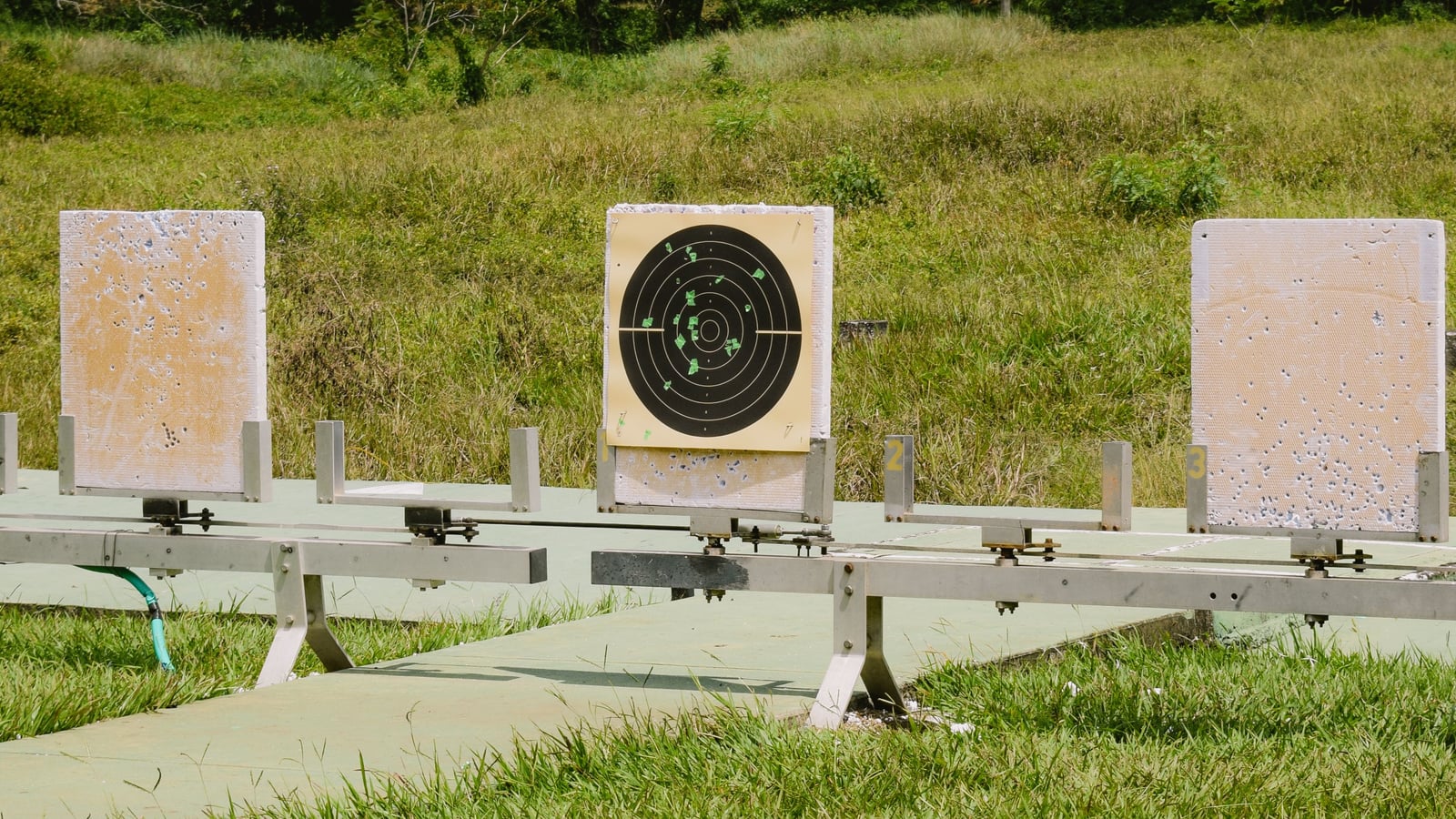
50m is shot with a rifle, most often prone for beginners, with programs that can extend across the three regulation positions for more experienced shooters. It’s a distance that requires outdoor infrastructure or a long covered range, which mechanically reduces the number of clubs able to offer it.
Rifles used at 50m most often fall under Category C, subject to declaration — an intermediate regime between the simplicity of 10m and the administrative complexity of 25m’s Category B. That’s a point worth checking precisely with your club, since it varies depending on the exact gun model used.
The cost of 50m ammunition generally sits in a moderate range compared with other centerfire calibers, which still allows for a decent training volume without an outsized budget. It remains, however, higher than the cost of 10m air ammunition.
50m is often seen as the distance that rewards patience and mental consistency over time the most. Competition programs stretch over long periods, with a large number of shots to be fired with rigorous consistency, which makes it a discipline particularly suited to methodical profiles who enjoy sustained, in-depth work.
It’s also a distance where age is less of a barrier to performance than in other, more physically demanding formats, especially in the prone position, which places less strain on overall body balance. Many veteran shooters keep performing at 50m long after cutting back on other, more physically demanding disciplines.
Direct comparison: accessibility, logistics and indoor/outdoor
If you live in an urban or suburban area, 10m will almost always be the easiest distance to find near you, simply because the infrastructure it requires is light. 25m needs a somewhat longer range but remains common in many multi-discipline clubs.
50m is the most demanding distance in terms of infrastructure, which is why some clubs, especially in dense areas, don’t offer it at all, or only at an outdoor site outside the city. If you’re specifically targeting 50m, check beforehand that your club actually has this facility before signing up based on geographic proximity alone.
Another logistical factor to consider is transporting your gear: a 50m rifle with its associated equipment often takes up more storage and transport space than a 10m or 25m handgun. If you don’t have a vehicle or have limited storage space at home, that can weigh in the balance.
Finally, think about available time slots. An indoor 10m range can often run continuously all day, whereas an outdoor 50m firing line depends more on weather and light, which can reduce available training slots depending on the season.
10m is practiced almost exclusively indoors, which means stable conditions year-round: no wind, no light variation, controlled temperature. For a beginner, that stability is a real teaching advantage, since it removes an entire variable from the equation and lets you focus solely on your own technique.
25m is practiced both indoors and outdoors depending on the club and discipline, which introduces extra variability for shooters who alternate between the two setups. A shooter used to an indoor range can notice a non-trivial difference in feel the first time they shoot outdoors, even at the same nominal distance.
50m is more often practiced outdoors or in a long covered range exposed to the elements at its ends, which introduces wind management as an additional technical variable. That complicates the initial learning curve, but it also becomes a real training ground for shooters who want to move toward long-range disciplines later on.
This weather and light dimension isn’t just a matter of comfort: it directly influences the consistency of your groupings, and therefore your perception of your own progress. A beginner who starts outdoors needs to factor in this extra variable when evaluating their own results, without getting discouraged if their scores vary more from session to session than a friend who trains indoors.
Direct comparison: starting budget and recurring cost
The lightest starting budget is clearly on the 10m side: freely sold Category D gear, inexpensive air ammunition, and often a fleet of club rifles or pistols available on loan for the first sessions. It’s the most suitable distance if you want to test sport shooting without committing to a significant budget.
25m involves a noticeably higher recurring cost in centerfire ammunition, plus a heavier administrative and financial investment if you’re aiming to acquire your own Category B firearm. The timeline and costs tied to the prefectural authorization also need to be factored into your schedule, since these vary by prefecture and by case.
50m sits in an intermediate position in terms of ammunition cost, but the investment in optics and specific accessories, like a bipod or a suitable sighting system, can represent a significant budget once you progress beyond basic club gear.
In every case, the real budget depends heavily on the club, the region and the gun model chosen: be cautious with precise figures found online, and check directly with your club about locally applied rates.
Direct comparison: learning curve and technical demands
10m is often recommended first because the absence of noticeable recoil lets you focus on pure fundamentals: stable stance, controlled breathing, gradual release of the trigger. It’s an excellent training ground before adding the variables of recoil and noise.
25m adds an extra dimension of stress and pace management, particularly in disciplines that impose a limited time per string. The transition from 10m to 25m generally goes smoothly for a shooter who has already consolidated the basics, but it can be unsettling if approached too early.
50m demands a different kind of mental endurance: the programs are long, and repeating the same identical motion over a large number of shots becomes the main challenge, more so than the occasional stress management of a timed string. It’s a discipline that rewards patience over the course of an entire session, or even an entire season.
None of these three distances is inherently “easier” or “harder” than the others: they call on different qualities. A shooter who excels at 50m thanks to their patience may feel unsettled by the pace of 25m, and conversely a shooter comfortable with time management may find 50m monotonous at first.
Which distance for which beginner profile
If your main goal is to discover sport shooting at low cost, without heavy administrative commitment, and to progress on pure technical fundamentals, 10m is the most logical starting point. It’s also the best choice if you want to introduce a child or teenager to the discipline through a shooting school.
If you’re drawn to the sensations of a handgun closer to the classic image of sport shooting, and you’re ready to invest in the administrative steps tied to Category B, 25m better matches your goal. It’s also a good option if you’re eventually considering dynamic disciplines, for which 25m often serves as the technical foundation.
If you have a methodical temperament, enjoy repeated in-depth work over time, and have access to a club offering outdoor infrastructure or a long range, 50m can be your best choice from the start, without necessarily going through 10m first.
For many beginners, the best strategy remains to start with 10m regardless of the distance ultimately targeted, simply because it’s the cheapest and least committal way to confirm your taste for the discipline before investing more time and money elsewhere.
Combining distances: an often underrated option
Nothing forces you to commit to a single distance for good. Many clubs offer access to all three distances, and many experienced shooters practice several disciplines in parallel depending on the season or their mood at the time.
Practicing 10m alongside 25m or 50m has a concrete advantage: it’s an excellent, low-cost way to maintain basic technique between two more expensive sessions at another distance. An experienced instructor often recommends this approach to their most motivated students.
Combining distances, however, requires more available time and a larger budget, so it’s not necessarily the right plan for a very first-time beginner who’s mainly looking to confirm their interest in sport shooting. It’s an option worth considering once the basics are set on a first distance.
Finally, some competitive shooters deliberately choose to specialize in a single distance to maximize their progress, especially when aiming for regional or national qualifications in a specific discipline. Specialization and versatility are both valid strategies, depending on your personal goals.
To help you decide between these strategies, your club and your instructor remain the best source of information for refining this choice, because they know the gear actually available, the time slots per distance, and the profile of the club’s other members. A generic comparison, however thorough, doesn’t replace advice tailored to your local situation.
Don’t hesitate to explicitly ask to try the different distances offered by your club before making your decision. Most clubs are happy to accommodate this kind of trial, especially for a new member who’s still finding their way.
An experienced instructor can also guide you based on constraints you might not have anticipated yourself: a physical discomfort that makes one position less comfortable than another, a natural preference for rifle over pistol, or simply a particular chemistry with the atmosphere of a given range.
Finally, keep in mind that your initial choice is never set in stone. Many experienced shooters have changed their main distance along the way, sometimes several times, as their goals and personal situation evolved.
An experienced instructor often sees the same pattern among new members: those who choose their distance purely out of enthusiasm for a specific gun, without regard for budget or available infrastructure, tend to drop out more often within the first few months. The rational choice, based on real accessibility, produces better results over time.
An experienced club shooter will often tell you they started with whatever distance was most available near them, without much initial enthusiasm, before discovering a real passion for the discipline once the basics were in place. It illustrates well that attachment to a distance is often built afterward, through practice, more than it pre-exists the initial choice.
Conversely, some beginners who head straight for the distance they dream about most, despite limited budget or availability, end up running out of steam because they can’t train often enough. Consistency of sessions matters more for progress than the perceived prestige of a particular distance.
The advice most commonly heard at clubs is therefore to favor, at first, the distance that’s simplest to practice regularly, and to diversify later once the fundamentals are in place and your taste for the discipline is confirmed.
Protective gear: a factor often overlooked in the comparison
Whatever distance you choose, hearing and eye protection is non-negotiable, though the intensity of the need varies noticeably. At 10m with air guns, noise levels are much lower than with a centerfire gun, which makes the choice of hearing protection less critical, without making it optional.
At 25m and 50m, the report of a centerfire gun requires serious hearing protection from the very first session, or you risk cumulative hearing damage that sometimes only shows up years later. Basic earmuffs are enough to start, but many regular shooters later invest in electronic protection that lets them hear instructions while filtering out the report.
Shooting glasses are recommended across all three distances, mainly to protect against particles and possible debris, but their necessity is perceived as more obvious at centerfire distances. Some clubs even make them mandatory by internal rule, regardless of the distance practiced.
The protective gear budget stays broadly comparable across the three distances if you choose entry-level equipment, but it can diverge sharply if you upgrade to electronic protection or custom earplugs, more often considered by regular 25m and 50m shooters because of the higher noise levels.
Beyond protection, the profile of shooters you’ll meet also differs noticeably by distance. 10m attracts a very broad crowd, from children in shooting schools to veteran shooters and beginners of every age, which often makes it the most family-friendly and socially accessible atmosphere for a new member.
25m brings together a crowd that includes both motivated beginners and competitors already invested in dynamic or precision pistol disciplines. The atmosphere can be a bit more performance-oriented there, especially in clubs with teams competing at regional or national level.
50m, because of its endurance and patience dimension, often attracts a somewhat calmer crowd, with a notable share of shooters who’ve been practicing for many years. It’s not an absolute rule, but it’s a trend reported by many clubs that offer all three distances under the same roof.
These differences in atmosphere shouldn’t be an exclusive selection criterion, but they’re worth taking into account if you’re looking for a training environment that fits your own temperament. A shy beginner might feel more at ease in the generally relaxed atmosphere of 10m, while a competitive profile might prefer the stronger sense of drive found at 25m.
Common mistakes to avoid in this choice
The first classic mistake is choosing a distance based solely on gear seen online or in the media, without checking its actual availability at an accessible club. This often leads to quick disappointment if the nearest club doesn’t offer that distance or only has very limited slots.
The second common mistake is underestimating the recurring cost of centerfire ammunition by focusing solely on the purchase price of starting gear. A poorly anticipated budget can slow down the regularity of sessions, which directly hurts progress, whatever distance you’ve chosen.
The third mistake is rushing into a technical distance like 25m or 50m without having consolidated basic fundamentals, thinking it will save time. In practice, this can actually slow progress, because bad habits picked up without enough supervision are harder to correct later on.
Finally, a subtler mistake is switching distances too often within the first few months, out of impatience or comparison with other beginners. Technical progress requires a certain continuity; it’s better to give a distance a few months of real practice before judging whether it truly suits you.
On the question of gear, across all three distances, most clubs offer loaner equipment for the first sessions, letting you test the discipline before investing in your own gun. This loan period is valuable: it saves you from buying equipment poorly suited to your build or preferences before you even know whether you actually enjoy the distance.
At 10m, the club’s equipment pool is generally large and well maintained, since it’s the most widely used distance for group introduction. You can often stay there for several months, even more than a season, without feeling any urgent need to acquire your own gear.
At 25m, the question of personal acquisition comes up faster for shooters who want to make serious progress, notably because how a pistol fits your hand is a highly personal factor that directly affects accuracy. A club can loan basic equipment, but a motivated shooter will fairly quickly look for a gun that fits their hand exactly.
At 50m, club equipment generally covers a beginner’s needs well, but shooters aiming for competition often invest in additional gear, an adjusted stock or a more capable sighting system, once the basics are in place and their commitment to the discipline is confirmed.
The time you can devote to training each week also influences this choice, even though this factor is rarely highlighted in typical comparisons. 10m, with its low cost per session and indoor availability, lends itself well to short, frequent slots — for example, one hour two or three times a week.
25m generally calls for somewhat longer sessions to offset setup and preparation time, and ammunition cost often pushes you to group training into less frequent but denser slots — for example, one two-hour session per week rather than several short ones.
50m, especially with competition programs stretching over an hour or more, requires a fairly generous time slot to be practiced under good conditions. This can be less compatible with a very fragmented schedule than 10m, which more easily accommodates short sessions.
Think honestly about your actual schedule, not the one you’d like to have. A distance that requires long, infrequent slots can be hard to fit in if your daily life is already busy, whereas a distance compatible with short, repeated sessions fits more easily into a tight schedule.
Competition goals: which distance opens which doors
If your medium-term goal is to compete in official competitions, all three distances lead to distinctly different pathways within the federation. 10m opens access to air precision disciplines, heavily present from youth categories onward and widely represented in regional qualifications.
25m is the gateway to several pistol disciplines recognized at national level, as well as to certain introductory dynamic disciplines that use this distance as a technical base before moving on to more complex formats.
50m leads to rifle precision disciplines across the three regulation positions, a path that can lead all the way to national qualifications for the most dedicated shooters. It’s also a distance present in certain historical and reenactment shooting disciplines, for those drawn to these particular practices.
If you already have a fairly clear idea of the competition discipline that appeals to you long term, it can be wise to work back to the corresponding distance from the start, rather than changing course repeatedly. But if you’re starting out without a specific competition goal, this criterion shouldn’t weigh more heavily than real accessibility and real budget.
Faced with these three options, the most reliable method is to honestly answer four simple questions before deciding. First, which distances are actually available and well equipped at clubs accessible from where you live, without excessive compromise on commute or schedule.
Second, what monthly budget can you realistically devote to ammunition and equipment upkeep over time, keeping in mind that this budget needs to stay sustainable enough to allow regular practice, the number one condition for progress.
Third, how much weekly training time actually fits your schedule, and which distance best accommodates that format, between short and frequent sessions or longer and more spaced-out ones.
Finally, if you already have an idea of a competition discipline that appeals to you long term, check which distance it naturally points you toward, without sacrificing the three previous criteria for that reason alone. Cross-referencing these four answers usually reveals, on its own, the distance best suited to your profile — far more reliably than relying on an aesthetic preference for a particular type of gun.
One last point worth keeping in mind once your choice is made: analyzing your groupings doesn’t have quite the same meaning depending on the distance practiced. At 10m, the short distance and absence of recoil mean that grouping spread reveals almost exclusively pure technique errors, making it an excellent learning tool for a beginner who wants to understand precisely what to correct.
At 25m, reading groupings becomes a bit more complex, since the recoil and the execution speed demanded in certain disciplines introduce additional variables. The same grip flaw can show up differently depending on whether you’re shooting in relaxed precision or in a timed string.
At 50m, distance itself amplifies every small inaccuracy proportionally, meaning a beginner can feel unsettled by wider groupings than at 10m, even though their basic technique is actually quite sound. You need to learn to put the scale of results into perspective depending on the distance, rather than directly comparing groupings obtained at different distances.
This difference in how results should be read is one more reason to clearly understand, from the start, which distance you’re mainly training at, so you don’t get needlessly discouraged comparing your progress to a friend who practices a different distance with benchmarks that simply don’t transfer.
Ultimately, remember above all that none of these choices is irreversible, and that no distance permanently closes the door on the other two. 10m, 25m and 50m are three different ways of approaching the same underlying discipline, and most shooters who stay committed to sport shooting over the long run end up touching several of them, driven as much by curiosity as by the desire to keep progressing year after year.
FAQ
Q: Can you start directly with 25m or 50m without going through 10m first? A: Yes, nothing requires it technically or legally. But many instructors recommend going through 10m first, since it’s the cheapest way to lay the groundwork before investing in a distance that’s more demanding in budget and paperwork.
Q: Which distance is the cheapest to start with? A: 10m, thanks to freely sold Category D guns and inexpensive air ammunition. The 25m and 50m distances involve more expensive centerfire ammunition and, for 25m, a prefectural authorization to obtain.
Q: Is 50m reserved for experienced shooters? A: No, but access mainly depends on whether your club has a suitable range. A motivated beginner can absolutely start directly at 50m if their club offers this infrastructure and appropriate coaching.
Q: Do you have to choose between rifle and pistol depending on the distance? A: Not strictly, but in practice 10m and 50m are mostly practiced with rifles for beginners, while 25m is very largely dominated by pistol. Your club may still offer variants depending on its infrastructure.
Q: Can you change your main distance after getting started? A: Yes, it’s very common. Many shooters move from one distance to another as their skills progress, as their competition goals evolve, or simply as their interests shift, without this being an issue for their club.
Q: Does ammunition cost vary a lot depending on distance? A: Yes, 10m air ammunition remains significantly cheaper than the centerfire ammunition used at 25m or 50m. The exact amount varies by caliber, brand and availability period, so check with your club for up-to-date figures.