
Why this matters
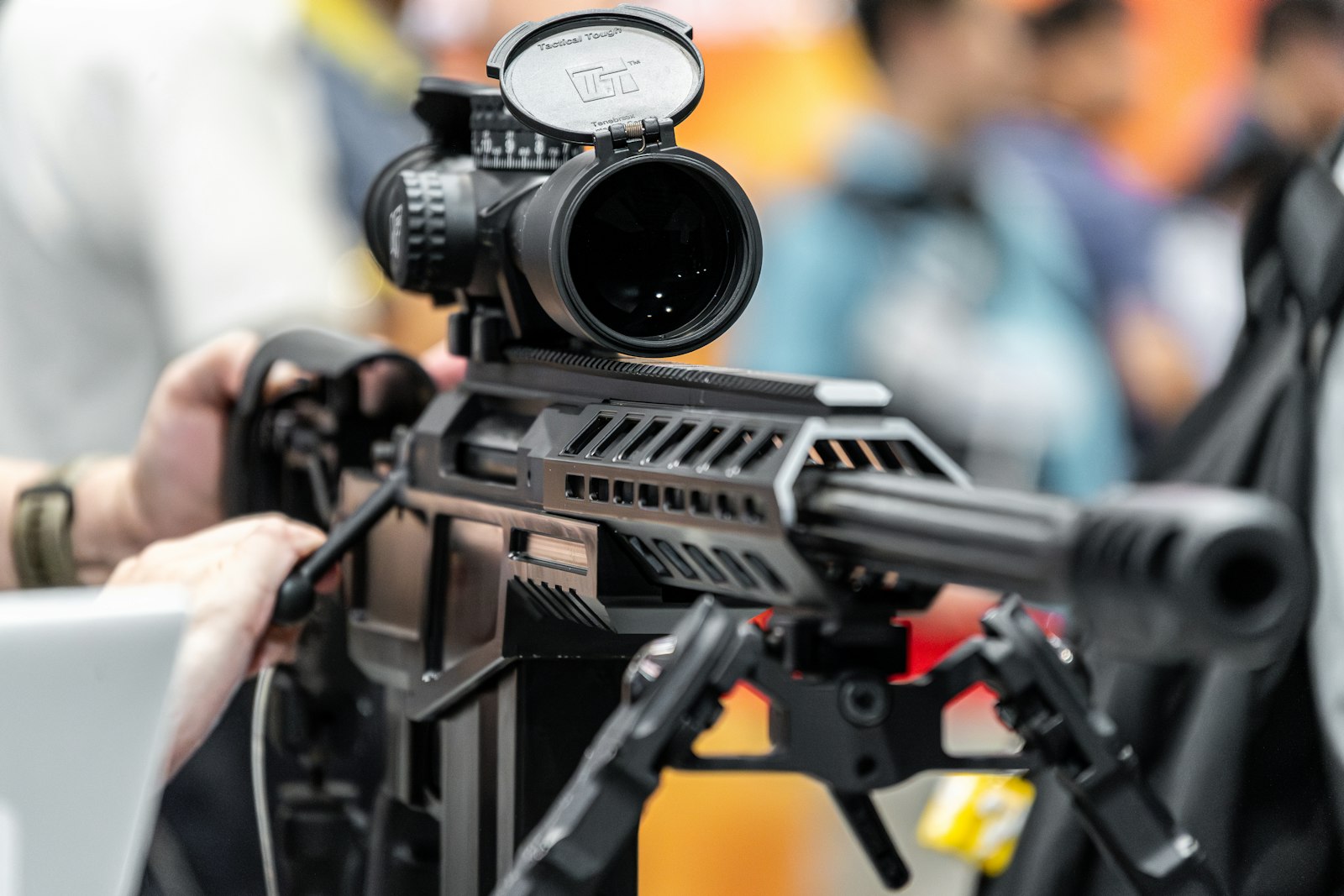
A scope isn’t an accessory — it’s a measurement instrument. If you can’t read your reticle, you’ll try shooting 300m by aiming “a bit higher”, and you’ll miss for five years. Ballistics is applied geometry. One hour to understand, a lifetime to apply.
MOA or Mil — that’s your system
Every scope uses one of two angular units:
- MOA (Minute of Angle): 1 MOA ≈ 2.9 cm at 100m, 5.8 cm at 200m, 8.7 cm at 300m. Linear math.
- Mil (Milliradian): 1 Mil = 10 cm at 100m, 20 cm at 200m, 30 cm at 300m. Even simpler mental math.
Pick one. NEVER mix. Golden rule: reticle and turrets in the same unit. MOA scope with MOA turrets, or Mil/Mil. A Mil reticle with MOA turrets (yes, it exists on older gear) means every correction is wrong.
In Europe, Mil dominates PRS and tactical. MOA stays common in hunting and US competition. France: Mil/Mil, no hesitation.
The reticle
Three main families:
- Plain crosshair: short-range hunting, nearly useless for sport.
- Mil-dot or TMR: dots or hashes 1 Mil apart. You can range, measure drop, hold over.
- Christmas-tree (Vortex EBR-7C, Athlon APRS): dense lower section for long-range drop, branches for windage. Modern PRS standard.
Reticle plane: front (FFP) or rear (SFP). FFP: graduations stay accurate at every zoom. SFP: graduations only true at one zoom (often max). For precision sport: FFP, no question.
BC: why your bullet doesn’t fly straight
A projectile leaving at 850 m/s drops 30 cm at 300m from gravity — physics, no escape. What changes per bullet is its drag profile: the ballistic coefficient (BC).
- BC 0.200: classic hunting bullet, sheds speed fast. Useless past 800m.
- BC 0.500-0.600: Match bullet, Berger or Hornady ELD-X. Holds trajectory to 1,000m reasonably.
- BC 0.700+: very heavy .338 or .50 projectiles, 1,500m+.
Higher BC = retain more energy and stability far out. For standard PRS, target 0.500 minimum.
Dial or holdover?
Two ways to correct elevation:
- Dial: turn your elevation turret to put the reticle center on target. Precise, slow, perfect for static targets.
- Holdover: use the lower reticle graduations to aim without touching the turret. Fast, demands a readable reticle, perfect for engaging multiple distances quickly.
In PRS, you do both depending on the stage. Club 100-300m: dialing is enough.
Reading a drop chart
A drop chart tells you how much to correct per distance. Simplified for .308 168 grain:
- 100m: 0
- 200m: 1.1 Mil
- 300m: 2.7 Mil
- 400m: 4.8 Mil
- 500m: 7.3 Mil
- 600m: 10.2 Mil
Generate it with an app (Strelok Pro, Hornady 4DOF, Applied Ballistics). Enter cartridge, temperature, altitude, baro. Print, tape it to your stock.
Wind, the real challenge
Drop is predictable. Wind isn’t. At 600m, a 5 km/h crosswind drifts a .308 about 30 cm. Double the wind, double the drift. Linear in this range. But wind changes every 50m on the ground.
Learn the indicators: grass, mirage, flags. Shoot in different winds before claiming you “get” wind. Wind reading is probably the skill that separates good from excellent PRS shooters.
Three classic traps
- Mixing units. A 1/4 MOA click isn’t 0.1 Mil. Off by 3, missing by 30 cm at 300m.
- Trusting your app blindly without verifying. The DOPE (Data On Previous Engagement) you log at the range beats any calculator. Shoot, log, calibrate.
- Buying a powerful scope without understanding it. A poorly-zeroed 5-25×56 is an expensive 1×1.
FAQ
Q: Variable or fixed magnification? R: Variable 4-16× or 5-25× for 90% of sport. Fixed high mag (10×, 16×) for pure benchrest where the gear doesn’t move.
Q: How much for a first precision scope? R: €600-900 minimum for reliable turrets, coherent reticle, decent glass. Below that you’ll see zero drift and early dusk.
Q: Need a laser rangefinder? R: Yes, soon as you shoot past 200m on unknown distances. €200-500 for a Vortex Ranger or Leica Rangemaster.
Read more
- How to pick your first rifle
- Long-range precision (PRS): gear and basics
- Breathing and trigger control